
FREE WHITE PAPER
Artificial intelligence has rapidly become part of everyday work. Employees experiment with AI tools, generate content, and explore new ways to be more productive.
Organizations rely on intranet platforms to centralize company knowledge, share internal communications, and give employees access to essential resources.
However, as the modern workplace has become more digital and information-driven, many traditional intranets struggle to keep up with the growing volume of data, tools, and collaboration platforms used by employees every day.
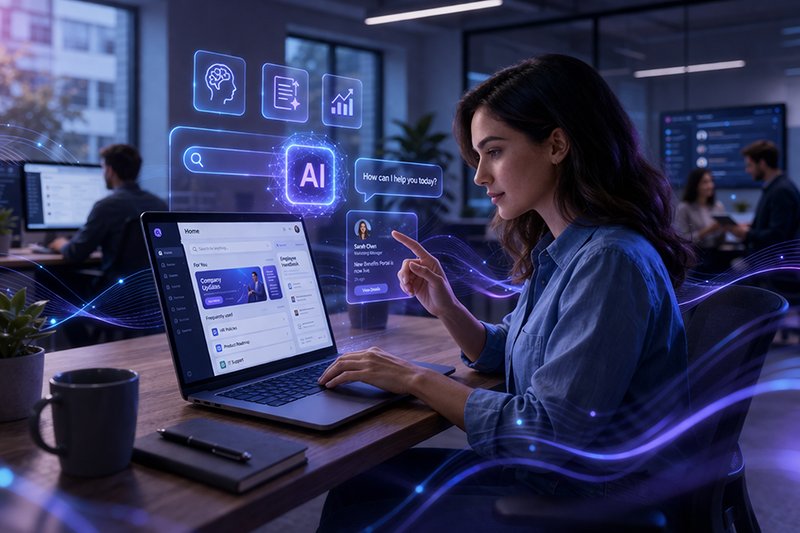
In many organizations, information is scattered across emails, shared drives, messaging tools, and internal applications. As a result, employees often spend valuable time searching for documents, policies, or answers to routine questions.
Research highlighted by Atlassian, which indicates that knowledge workers lose approximately 2.4 billion hours annually to search and context-switching, suggests that inefficient knowledge management and fragmented tools can significantly impact employee productivity, as teams frequently struggle to locate the right information when they need it.
To address these challenges, companies are increasingly adopting AI-powered intranets, modern digital workplace platforms enhanced with artificial intelligence technologies such as machine learning, natural language processing (NLP), and intelligent data analytics.
Unlike traditional intranet portals that function primarily as static repositories, AI-powered intranets actively assist employees in their daily work. These platforms can understand user intent, analyze employee behavior, and automatically deliver relevant information. Instead of navigating complex folder structures, employees can ask questions in natural language and receive contextual answers instantly.
This shift reflects a broader transformation in enterprise technology. Major technology providers such as Microsoft and IBM are integrating AI into workplace tools to help organizations automate routine tasks, improve knowledge discovery, and enhance collaboration. According to research from Gartner, which predicts that 70% of enterprise applications will use AI-integrated features to assist in employee experience by 2026, AI-driven workplace technologies are becoming essential components of digital transformation strategies as companies seek to improve productivity and employee experience.
By turning static information hubs into intelligent digital workplaces, AI-powered intranets help organizations reduce information overload, improve collaboration, and ensure employees can access the right knowledge at the right time.
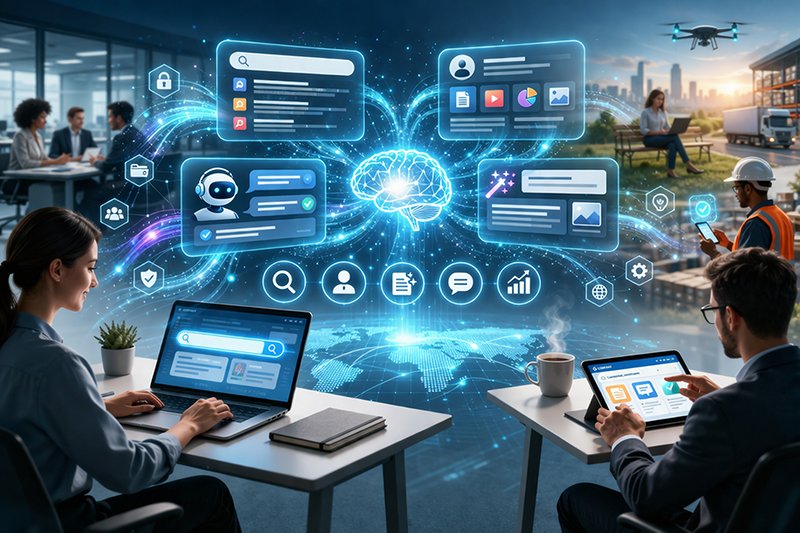
Several core technologies power modern AI intranet platforms:
Because of these capabilities, an AI-powered intranet can perform tasks that traditional intranet systems cannot. For example, it can recommend relevant documents based on an employee’s role, suggest colleagues with specific expertise, automate responses to frequently asked HR questions, and personalize internal dashboards with the most relevant updates and resources.
These capabilities are becoming increasingly important as organizations generate large volumes of digital content and rely more heavily on distributed teams. Studies referenced by McKinsey & Company indicate that employees spend nearly 20% of their workweek, roughly 1.8 hours per day, searching for information or recreating knowledge that already exists within the organization.
By using AI to organize and deliver knowledge more effectively, AI-powered intranets transform the traditional company portal into a smart digital workplace platform that improves collaboration, accelerates decision-making, and helps employees focus on higher-value work.
Traditional intranets were originally designed as centralized repositories where employees could access company documents, policies, and internal announcements. While this model worked when organizations generated relatively small amounts of digital information, modern workplaces now operate in a far more complex environment.
Employees rely on dozens of tools, communication platforms, document storage systems, project management applications, and HR software. Information is often scattered across platforms such as Microsoft Teams, Slack, and Google Drive, making it increasingly difficult to locate the right knowledge at the right time.
One of the most significant problems is what many organizations call the “search tax.” Studies cited by IDC indicate that knowledge workers can spend up to 2.5 hours each day searching for internal information. Similarly, research from Gartner suggests that organizations implementing AI-enhanced workplace tools can significantly reduce this friction, as 47% of digital workers currently struggle to find the data needed to do their jobs.
Traditional intranets also struggle with several long-standing issues:
As a result, many employees bypass the intranet entirely, turning instead to messaging platforms or colleagues to find information.
AI-powered intranets are designed to solve these challenges. Instead of functioning as passive portals, they act as intelligent digital workspaces that connect data, tools, and employees in a unified platform. Modern solutions such as Workvivo and Simpplr demonstrate how AI-driven intranet systems can deliver personalized content, automate tasks, and provide conversational access to organizational knowledge.
This shift represents a major evolution: the intranet is no longer just a place employees visit occasionally, it becomes a central operating system for the digital workplace.
AI-Augmented Digital Workplace
Artificial intelligence has rapidly become part of everyday work. Employees experiment with AI tools, generate content, and explore new ways to be more productive.
Artificial intelligence has rapidly become part of everyday work. Employees experiment with AI tools, generate content, and explore new ways to be more productive.
Traditional intranet search relied heavily on keyword matching, meaning employees needed to know exactly which terms or document titles to search for. This often resulted in long lists of irrelevant results.
AI-powered intranets use semantic search and natural language processing (NLP) to understand user intent rather than simply matching keywords. An employee searching for “remote work policy” might receive a summarized answer, relevant policy documents, HR forms, and related resources in a single response.
This contextual understanding dramatically improves knowledge discovery. According to research referenced by intranet platforms like Staffbase, intelligent search significantly reduces the time employees spend locating internal information by providing “Google-like” accuracy for internal data.
In practical terms, this means employees can ask questions such as:
The AI system interprets the intent behind these queries and delivers accurate, relevant answers.
Another major transformation is hyper-personalization. Traditional intranet homepages display the same information to every employee regardless of their role, department, or location.
AI-powered intranets analyze user behavior, job roles, and interaction history to tailor the experience for each individual. For example:
Platforms like eXo Platform emphasize that personalized intranet experiences significantly improve engagement because employees immediately see content that is relevant to their work.
By delivering targeted information automatically, AI-powered intranets help employees stay informed without needing to manually search or filter through irrelevant content.
AI also introduces conversational interfaces that transform the intranet into a question-answering system.
Through chatbots or virtual assistants, employees can interact with the intranet in the same way they might interact with a messaging platform. Instead of navigating multiple pages to submit a request or locate a document, employees can simply ask the system for help.
For example, an employee might type:
The AI assistant retrieves the information or completes the task automatically. According to insights from workplace platforms like Reworked, conversational interfaces significantly reduce friction in everyday workflows.
This conversational interaction model makes the intranet feel less like a static website and more like a digital workplace assistant.
Another area where AI-powered intranets deliver significant value is workflow automation.
Many routine workplace processes, such as onboarding new employees, submitting expense reports, requesting IT support, or accessing HR forms, traditionally involve multiple steps and manual approvals.
AI-driven intranet systems streamline these processes by integrating with enterprise tools such as HR platforms and CRM systems. This reduces administrative workload, addressing the McKinsey finding that workers spend nearly 20% of their workweek just searching for and gathering information.
For example, AI agents embedded in the intranet can:
This automation reduces administrative workload and allows employees to complete tasks faster without switching between multiple systems.
Maintaining intranet content is often a major challenge for organizations. Over time, documents become outdated, links break, and knowledge becomes difficult to manage.
AI-powered intranets address this issue through automated knowledge management.
Artificial intelligence can:
By automating these processes, AI helps organizations maintain a more accurate and reliable knowledge base. Employees can trust that the information they find through the intranet is relevant and up to date.
Finally, AI-powered intranets can analyze organizational data to generate predictive insights that help leaders make better decisions.
By analyzing patterns in communication, collaboration, and content usage, AI can identify trends such as:
These insights enable companies to improve internal processes and optimize knowledge management strategies.
Employees spend up to 20% of their workweek searching for documents, policies, or colleagues to answer questions. AI-powered intranets solve this problem through:
👉 Example: A manager needing the latest expense policy can ask the AI chatbot and get the correct document immediately, instead of navigating multiple folders or emailing HR.
Traditional intranets are often “one-size-fits-all,” showing irrelevant content to different teams. AI personalization delivers:
Personalized experiences improve adoption, reduce information overload, and make employees more productive.
Organizational knowledge is often lost when employees leave. AI-powered intranets preserve and codify this information:
👉 Example: A researcher can quickly locate a prior internal study using semantic search, a task that previously required weeks of internal networking.
AI-powered intranets also act as digital workplace assistants, connecting employees to the right knowledge and automating internal workflows:
Platforms like eXo Platform integrate AI seamlessly across documents, communication, and workflow tools, turning intranets into hubs for productivity.
AI relies on accurate, well-structured data. Outdated or inconsistent content leads to unreliable answers. Organizations should:
Without strong content governance, AI recommendations may mislead employees rather than assist them.
AI intranets access employee and organizational data, which requires careful handling of sensitive information. Key considerations include:
Balancing AI personalization with privacy is critical for legal compliance and employee trust.
For guidance on governance frameworks, data-sharing agreements, and AI risk mitigation, organizations can browse AI law professionals specializing in emerging regulations for enterprise AI deployments.
AI-generated responses can occasionally produce hallucinations, plausible-sounding but incorrect information. Mitigation strategies include:
Even with automation, some workflows still require human validation.
The initial AI integration is only part of the investment. Effective intranet AI requires:
Strategic planning ensures sustained productivity gains and prevents adoption bottlenecks.
📋AI-powered intranets transform static portals into dynamic, intelligent digital workplaces. They save time, personalize employee experiences, retain institutional knowledge, and automate workflows. At the same time, organizations must plan for data quality, privacy, accuracy, and maintenance to realize these benefits fully. With thoughtful implementation, platforms like eXo Platform can become central hubs for productivity, engagement, and knowledge sharing.
Together, these capabilities transform the intranet from a simple document repository into a central hub for productivity, communication, and knowledge sharing.
Instead of acting as a passive portal where employees search for information, the AI-powered intranet actively supports employees throughout their workday. It connects enterprise systems, organizes organizational knowledge, and delivers personalized insights that help teams work more efficiently.
As organizations continue to generate larger volumes of digital information and adopt distributed work models, AI-powered intranets are becoming a key foundation of the modern digital workplace.
Many organizations assume that implementing artificial intelligence in the workplace requires large budgets and complex infrastructure. In reality, advances in open-source technologies and cloud-based AI services have made it possible to build AI-powered intranet platforms without the high costs traditionally associated with enterprise software.
Instead of purchasing expensive proprietary systems, companies can adopt a modular approach. This strategy combines open-source intranet frameworks with artificial intelligence services such as natural language processing, machine learning, and intelligent search engines. The result is a modern digital workplace that delivers advanced capabilities while remaining flexible and cost-efficient.
For many organizations, the starting point is an open-source intranet foundation that provides core features such as document management, internal communication, and collaboration spaces. From there, AI capabilities can be layered on top using APIs, automation tools, and language models.
Modern digital workplace platforms such as eXo Platform demonstrate how organizations can combine open standards with advanced collaboration tools to build intelligent intranet environments that scale with business needs.
A practical way to introduce AI into an intranet environment is to create a modular AI architecture, where each layer of technology performs a specific function.
A typical architecture may include:
This architecture allows organizations to gradually introduce AI features without replacing their entire digital workplace infrastructure.
In practice, employees benefit from a unified environment where information, tools, and workflows are connected through intelligent systems.
Even with limited budgets, organizations can implement several impactful AI capabilities within their intranet.
Conversational AI assistants can answer employee questions about policies, internal procedures, or workplace tools. Instead of navigating through multiple pages, employees can simply ask questions and receive accurate answers instantly.
This reduces the workload for HR and IT support teams while improving employee productivity.
Traditional intranet search often relies on keyword matching, which can produce irrelevant results. AI-powered search systems analyze the meaning and context of queries to deliver more accurate information.
For example, when an employee searches for “remote work policy,” the system can return related documents, summaries, and application forms without requiring precise keywords.
This capability dramatically improves knowledge discovery and information accessibility.
Artificial intelligence can also support internal communications by helping teams draft announcements, summarize documents, or generate policy updates.
Rather than replacing human authors, AI acts as a productivity tool that accelerates content creation and ensures consistency across internal communications.
Maintaining intranet content can be challenging as organizations generate large volumes of information. AI systems can assist by:
These capabilities help organizations maintain a clean, reliable knowledge base that employees can trust.
By combining open technologies with intelligent automation, organizations can build AI-powered intranet environments that deliver enterprise-level capabilities without enterprise-level costs.
When proposing an AI-powered intranet initiative, decision-makers often focus on measurable business outcomes. The value of intelligent intranet platforms typically comes from improvements in productivity, knowledge management, and employee engagement.
One of the most significant hidden costs in modern organizations is the time employees spend searching for information. Knowledge workers often navigate multiple systems to locate documents, policies, or project data.
Research from IDC indicates that employees can spend a considerable portion of their workweek searching for internal information. This lost time creates what many organizations call the “search tax.”
AI-powered intranets reduce this friction by providing semantic search and intelligent knowledge recommendations. Instead of manually navigating through folders, employees receive relevant information instantly.
Even small improvements in information accessibility can lead to substantial productivity gains across large workforces.
Another key source of ROI comes from workflow automation. AI-powered assistants embedded in intranet platforms can handle routine tasks such as:
By automating repetitive tasks, organizations reduce administrative overhead and allow employees to focus on higher-value work.
Employee onboarding is another area where AI-powered intranets deliver measurable benefits. New hires often have many questions about company processes, internal tools, and policies.
An AI-driven intranet assistant can provide instant answers and guide employees through onboarding steps, reducing the workload for HR and IT teams while accelerating the onboarding process.
Organizations frequently lose valuable expertise when experienced employees retire or move to new roles. AI-powered intranets help preserve institutional knowledge by capturing documents, conversations, and project insights in a centralized knowledge system.
Over time, this knowledge base becomes a powerful resource that allows employees to learn from past work and avoid repeating mistakes.
Modern intranet platforms also play an important role in employee engagement. Personalized dashboards, targeted communications, and collaborative workspaces help employees stay connected to their teams and organizational goals.
Research from Gallup shows that highly engaged teams are significantly more productive and experience lower turnover rates.
Digital workplace platforms such as eXo Platform illustrate how organizations can combine communication, collaboration, and AI-driven features to create engaging employee experiences that strengthen internal culture.
To evaluate the success of an AI-powered intranet initiative, organizations should track measurable performance indicators such as:
By monitoring these metrics, companies can clearly demonstrate how intelligent intranet platforms contribute to productivity, operational efficiency, and employee satisfaction.
Ultimately, an AI-powered intranet is not just a technology upgrade, it is a strategic investment in the digital workplace that helps organizations unlock the full value of their knowledge and workforce.
One of the most practical ways to introduce artificial intelligence into an intranet is by deploying an AI-powered chatbot. These assistants help employees quickly find answers to common questions, retrieve internal documents, and complete routine tasks without contacting support teams.
Contrary to common belief, implementing an intranet chatbot does not always require a large development project. With modern AI services and low-code tools, organizations can launch a functional assistant relatively quickly by connecting it to existing internal knowledge.
Digital workplace platforms such as eXo Platform already provide the collaborative environment where such assistants can be integrated directly into employee dashboards, help centers, or knowledge portals. The key is to focus first on the most common employee needs and gradually expand the chatbot’s capabilities.
Before deploying a chatbot, organizations should identify where employees face the most friction. In many workplaces, employees repeatedly ask similar questions related to HR policies, IT support, or internal processes.
For example, common questions often include:
Research from IDC shows that knowledge workers spend a significant portion of their time searching for internal information. A well-designed intranet chatbot can dramatically reduce this time by providing instant answers to frequently asked questions.
By targeting specific pain points first, organizations ensure the chatbot delivers immediate value rather than becoming another underused tool.
AI assistants rely on existing content to answer employee questions. Before launching the chatbot, organizations should gather a small set of reliable internal documents.
These typically include:
It is important to ensure these documents are well organized and up to date, since the quality of responses depends on the quality of the source material.
Many organizations start with just a handful of core documents and expand the knowledge base gradually as the chatbot proves its value.
Once the knowledge sources are ready, the next step is to train the chatbot so it can interpret employee questions and retrieve relevant information.
Modern AI systems use technologies such as natural language processing and semantic search to understand questions in everyday language. Instead of relying on keywords, the assistant analyzes the meaning of the request and searches the knowledge base for the most relevant content.
For example, when an employee asks about the company’s travel policy, the AI can retrieve the relevant document, extract the key information, and provide a clear answer.
To maintain accuracy, organizations often configure the chatbot to only respond using verified internal documents and to recommend contacting HR or IT when an answer cannot be found.
Once the AI assistant is ready, it can be integrated directly into the intranet interface. In most digital workplace environments, this is done by embedding the chatbot into key locations where employees naturally look for help.
Common integration points include:
Within a collaborative platform such as eXo Platform, the chatbot can appear as a persistent assistant that employees can access from anywhere in the digital workplace.
This ensures that employees always have immediate access to support without leaving their working environment.
Before launching the chatbot organization-wide, it is important to test the system with common employee questions. This step helps ensure the assistant delivers accurate responses and directs employees to the right resources.
Testing usually involves asking typical queries such as:
If the chatbot retrieves the correct information consistently, it can then be rolled out to employees across the organization.
Over time, the system can be improved by analyzing employee questions, adding new documents to the knowledge base, and refining how the assistant responds.
The real value of an AI-powered intranet becomes clear when looking at how it solves everyday workplace challenges. Once deployed, AI chatbots can support employees across departments by providing instant access to information, guiding internal processes, and improving knowledge sharing. Rather than acting as simple support tools, these assistants become an integrated part of the digital workplace, helping employees complete tasks, find expertise, and make decisions faster.
Modern digital workplace platforms such as eXo Platform provide the collaborative environment where AI assistants can operate across knowledge bases, internal communications, and workflow tools.
Below are some of the most common and impactful use cases.
Human resources departments frequently handle repetitive questions related to policies, benefits, and internal procedures. Employees often need quick answers about topics such as leave policies, remote work rules, expense reimbursements, or employee benefits.
An AI chatbot integrated into the intranet can answer these questions instantly by retrieving information directly from HR documentation and policy guidelines. Instead of contacting HR teams for basic questions, employees receive immediate responses through conversational queries.
For example, an employee might ask:
The chatbot retrieves the relevant information from internal documents and provides a clear response. This significantly reduces repetitive HR inquiries while allowing HR professionals to focus on more strategic initiatives such as talent development and employee engagement.
IT support teams often receive a large volume of requests related to password resets, software access, and troubleshooting common technical issues. These requests can overwhelm support teams, particularly in large organizations.
An intranet AI chatbot can act as a first line of IT support by guiding employees through common troubleshooting steps. For example, if an employee encounters a system error or cannot access a particular tool, they can ask the chatbot for help.
The assistant may provide:
By handling simple support tasks automatically, AI chatbots reduce the number of routine helpdesk tickets and allow IT teams to focus on more complex technical challenges.
Onboarding new employees is another area where AI-powered intranet assistants provide significant value. New hires typically have many questions during their first weeks, ranging from internal processes to tools and team structures.
An AI chatbot can serve as a digital onboarding guide, helping employees navigate their new environment more easily. For example, it can explain company policies, recommend training resources, or guide employees through onboarding tasks.
In organizations hiring employees across multiple departments or locations, the assistant can also provide personalized information based on role and department. For instance, operational staff might receive safety guidelines and procedural documentation, while administrative teams receive information about internal systems and communication channels.
This approach accelerates onboarding and reduces the workload for HR and team managers.
Large organizations often maintain extensive knowledge bases containing documentation, reports, policies, and training materials. However, navigating this information manually can be difficult and time-consuming.
AI chatbots simplify knowledge discovery by allowing employees to ask questions directly instead of searching through multiple pages or folders. The system analyzes the question, identifies relevant documents, and provides concise answers along with links to the original sources.
For example, a researcher working in a large organization might need to determine whether a specific project or study has already been conducted by another department. Using semantic search capabilities, the AI assistant can analyze internal documents and quickly identify relevant research or contacts.
What once required hours, or even weeks, of internal networking can be completed in minutes through intelligent search.
Beyond answering questions, AI assistants can guide employees through everyday workplace processes. Many internal tasks involve multiple steps, forms, or approvals that employees may not fully understand.
AI chatbots can simplify these workflows by providing clear guidance and directing employees to the correct actions.
For example, the assistant might help employees:
By connecting knowledge with action, the intranet evolves from a static document repository into a smart workplace assistant that helps employees complete tasks more efficiently.
AI-powered intranets also help break down information silos within organizations. Departments often maintain their own documentation and knowledge resources, making it difficult for employees in other teams to access relevant information.
Through semantic search and AI-driven recommendations, intranet assistants can connect employees with expertise and information from across the organization.
For example, when a sales team searches for product specifications, the system may surface technical documentation created by engineering teams along with relevant marketing materials and previous project discussions.
This type of cross-departmental knowledge sharing improves collaboration and ensures that teams have access to the information they need to make informed decisions.
AI intranet assistants can also support organizations during periods of transformation such as mergers, acquisitions, or large-scale operational changes.
When two organizations combine, employees often struggle to understand new policies, terminology, and processes. An AI-powered intranet can help bridge this gap by analyzing documentation from both organizations and providing clear explanations to employees.
For instance, employees might ask questions about how internal procedures or financial definitions differ between the original companies. The AI assistant can retrieve relevant documentation and explain the differences, helping employees adapt more quickly to the new environment.
As organizations expand their AI capabilities, intranet chatbots evolve from simple support tools into comprehensive workplace assistants. These systems help employees find information, complete tasks, and connect with colleagues more efficiently.
When integrated into modern digital workplace platforms such as eXo Platform, AI-powered assistants enhance collaboration, reduce operational friction, and improve the overall employee experience.
Ultimately, these practical use cases illustrate how AI transforms intranets from passive information repositories into active productivity platforms that support employees throughout their daily work.
AI-powered intranets are evolving rapidly, moving beyond simple search and automation to become anticipatory, intelligent workplace assistants. Organizations adopting these platforms often discover that AI capabilities emerge faster than planned roadmaps, creating both opportunities and challenges. Understanding these trends helps companies stay ahead in building smarter, more responsive digital workplaces.
The next generation of AI intranets won’t just respond to queries, they will predict employee needs before they arise. Key developments include:
👉 Example: Before a quarterly budget meeting, the intranet proactively compiles relevant reports, highlights pending approvals, and flags team members who need to contribute, streamlining preparation.
Future intranets will prioritize natural language and voice interfaces, transforming the way employees interact with workplace systems:
These innovations shift intranets from static repositories to digital colleagues that actively support employee tasks.
As AI becomes more integral, organizations face critical questions about bias, privacy, and decision-making transparency:
Ensuring ethical and transparent AI builds trust in digital workplace tools and safeguards organizational integrity.
AI intranet assistants are gradually evolving from simple Q&A chatbots into comprehensive digital workplace copilots:
Platforms such as eXo Platform exemplify this trend, offering AI-powered intranet environments that enhance productivity, improve knowledge accessibility, and provide a responsive, employee-centric experience. By starting with a simple chatbot and incrementally expanding capabilities, companies can transform their intranet into an intelligent, anticipatory digital workplace.
The AI-powered intranet is no longer just a technological upgrade, it is the foundation of a smarter, more connected workplace. By transforming traditional portals into intelligent, context-aware systems, organizations can tackle information overload, streamline workflows, and make knowledge instantly accessible to every employee.
Key benefits include increased productivity, faster onboarding, and better preservation of institutional knowledge. Features such as personalized dashboards, intelligent search, automated content generation, and conversational AI work together to deliver relevance at the right time, empowering employees to focus on strategic, high-value work rather than routine administrative tasks.
Successful implementation depends on treating AI as an enabler rather than a replacement. Organizations that combine automation with human oversight, invest in clean and accurate data, and maintain strong governance frameworks unlock sustainable, long-term value. As AI capabilities continue to evolve, the intranet moves from being a reactive tool to a proactive partner, anticipating needs, flagging potential issues, and orchestrating workflows before they arise.
The future of work is intelligent, predictive, and conversational, and it starts with your intranet. Take the first step toward a more agile and productive workplace by exploring eXo Platform today and experience how an AI-powered intranet can transform the way your organization works.

Download the eXo Platform Datasheet and discover all the features and benefits
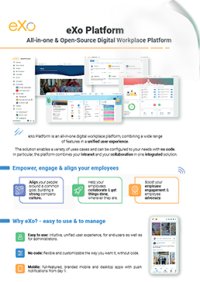

Download the eXo Platform Datasheet and discover all the features and benefits
You will find here Frequently Asked Questions about AI-Powered Intranet with all the answers in one place.
intranet is a term used with abundance whenever the subject of internal communication and collaboration is brought up which makes defining it a bit challenging. In its simplest form, an intranet is an internal website for your organization. It is used mainly for top-down communication where employees can access corporate news, policies and announcements.
An AI-powered intranet is a modern internal platform that uses artificial intelligence technologies to enhance communication, knowledge management, and employee productivity within an organization.
Traditional intranets were designed primarily to store internal documents, company policies, and announcements in a centralized portal. While useful for organizing information, these systems often rely on manual navigation and basic keyword searches, which can make it difficult for employees to find what they need quickly.
AI-powered intranets solve this problem by integrating intelligent technologies that enable the platform to understand context, learn from user behavior, and deliver personalized information automatically. Instead of acting as passive storage systems, these intranets function as interactive digital assistants that support employees throughout their workday.
An intranet portal is a secure internal website where employees can access information, tools, and communication channels in one place.
A CMS intranet is a secure internal platform that allows employees to create, manage, and share content across the organization. Think of it as your company’s digital headquarters—where communication, collaboration, and information management come together in one place.
Artificial intelligence is fundamentally changing how employees interact with internal systems. Instead of navigating complex menus or browsing through layers of folders, employees can now interact with intranet platforms through natural language queries, intelligent recommendations, and automated workflows.
The transformation can be understood through several key shifts.
AI-powered intranets transform traditional employee portals into intelligent digital workplaces that improve productivity, knowledge sharing, and employee engagement. Organizations adopting these platforms report measurable advantages that go beyond simple automation.
While AI intranets provide substantial benefits, organizations should plan carefully to avoid pitfalls. Awareness of limitations ensures effective deployment and maximizes ROI.
➝ Discover the limitations and Considerations of AI-Powered Intranets
An intranet portal serves as a powerful tool for modern organizations, offering numerous advantages that enhance productivity, communication, and employee satisfaction. Below is a detailed breakdown of its key benefits, followed by a concise comparison table for easy reference:
A truly effective intranet portal in 2025 is more than just a digital filing cabinet—it’s the central hub for communication, collaboration, and productivity in your organization. Whether you’re upgrading an old system or deploying a new one, here are the must-have features for a modern intranet
Implementing an intranet portal is a strategic undertaking that requires careful planning and execution. Here’s a step-by-step guide:
Building an intranet portal can mean two things: building from scratch or implementing an out-of-the-box solution.
🔗 Find out a detailed comparison to build or buy an intranet portal
A powerful intranet portal is only effective if employees actually use it. Low adoption rates are a common challenge. Here’s how to boost engagement:
Here are some Tips to drive adoption:
( Your e-mail address will not be published)

I am a Digital Marketing specialist specialized in SEO at eXo Platform. Passionate about new technologies and Digital Marketing. With 10 years' experience, I support companies in their digital communication strategies and implement the tools necessary for their success. My approach combines the use of different traffic acquisition levers and an optimization of the user experience to convert visitors into customers. After various digital experiences in communication agencies as well as in B2B company, I have a wide range of skills and I am able to manage the digital marketing strategy of small and medium-sized companies.