
FREE WHITE PAPER
Discover our in-depth analysis of the concept of employee engagement, its roots, and ways to improve it significantly
In 2025, improving internal communication is no longer just a support task for HR, it has become a critical driver of business performance. Organizations that prioritize effective communication can navigate the complexities of hybrid work, retain top talent, and leverage digital tools and AI to enhance productivity and innovation.

A workplace with strong internal communication ensures that information flows seamlessly, employees feel heard, and every team member understands how their work contributes to broader organizational goals.
Poor internal communication, however, can be costly. Disengagement, high turnover, lower productivity, and fragmented company culture are often direct consequences of ineffective communication.
Studies like the 2025 Global Employee Experience Trends Report show that low employee engagement is strongly associated with absenteeism, decreased output, and higher turnover, making it essential for leadership to focus on strategies to improve internal communication. Gallup also reported that engagement dipped to decade-low levels in 2024–2025, with many organizations linking this directly to gaps in communication and information sharing.
Internal communication is at the heart of employee engagement, productivity, and successful change management. It has evolved far beyond sending memos or policy updates; it now acts as the central nervous system of modern, agile organizations.
Effective communication ensures operational alignment, accelerates innovation, strengthens company culture, and keeps employees connected, especially in hybrid and remote work environments.
According to The Economist Intelligence Unit, poor communication leads to project delays or failures (44%), low morale (31%), and even lost sales (18%), while organizations with strong communication strategies outperform their peers by 3.5 times (Towers Watson).
The challenge today lies in complexity. Workforces are distributed across multiple locations and time zones, information is fragmented across dozens of apps, and digital fatigue is increasingly common.
To truly improve internal communication, organizations must focus not on communicating more, but on communicating smarter. This means creating a cohesive, engaging, and efficient flow of information that allows employees to stay informed, aligned, and empowered to collaborate effectively.
By understanding and implementing modern strategies to improve internal communication, organizations can transform this function from a routine operational task into a powerful driver of employee engagement, productivity, and long-term business success.
This guide will walk you through proven methods, practical strategies, and insights to strengthen and improve internal communication across your organization in 2025.
Internal communication (IC) refers to the strategies, processes, and tools organizations use to share information with employees, facilitate collaboration, and align teams around shared goals. It includes company-wide updates, policy announcements, team collaboration, feedback loops, and recognition programs.
Modern internal communication goes beyond simply “sending messages”; it is about creating meaningful, two-way connections that drive engagement, align behaviors with business objectives, and foster a positive organizational culture.
Effective internal communication is no longer optional, it is essential for organizational success. Studies consistently show that improving communication drives engagement, productivity, and business outcomes.
These findings demonstrate that improving internal communication is not just a “nice-to-have” but a strategic lever to boost engagement, operational efficiency, and overall business performance.
In today’s hybrid and remote work environment, improving internal communication is more complex than ever. Teams are spread across locations and time zones, information is fragmented across multiple apps, and digital fatigue is widespread. Effective communication now requires creating a cohesive, engaging, and efficient flow of information that keeps employees informed, aligned, and empowered to collaborate.
By understanding what internal communication is, why it matters, and how to leverage modern tools and strategies, organizations can transform this essential function into a key driver of engagement, productivity, and long-term success.
The Complete Guide to
Employee Engagement
Discover our in-depth analysis of the concept of employee engagement, its roots, and ways to improve it significantly
Discover our in-depth analysis of the concept of employee engagement, its roots, and ways to improve it significantly
The way we communicate at work has evolved dramatically. In 2025, improving internal communication means combining strategic leadership, modern technology, and a human-centered culture. Below are 22 actionable and up-to-date strategies designed to help organizations strengthen engagement, boost productivity, and build trust across distributed teams.
Create a unified, searchable intranet where all company information, news, policies, documents, and updates, lives in one place. A well-designed digital workplace reduces channel fragmentation, eliminates confusion, and ensures employees always know where to find accurate, up-to-date information.
Hybrid and remote work models demand digital-first communication strategies. But “digital-first” doesn’t mean robotic or impersonal,it means using technology to enhance human connection.
In 2025, successful organizations design communication around inclusivity, authenticity, and clarity. They move beyond email and embrace integrated platforms that merge chat, video, forums, and community engagement into one cohesive experience.
Trust begins with openness. When leaders communicate transparently, through live Q&As, candid updates, or “Ask Me Anything” sessions, employees feel included and valued.
Authentic leadership communication fosters alignment, reduces uncertainty, and helps employees connect emotionally with company goals.
Employees are motivated not just by KPIs, but by purpose.
Regularly linking organizational goals to a broader mission helps teams see the “why” behind their work. When leaders clearly communicate how every role contributes to a collective vision, engagement and productivity rise naturally.
Avoid chaos by setting clear rules on which internal communication tools are used for what: instant messaging for quick updates, the intranet for official news, and email for external communication. This digital etiquette reduces noise and confusion.
Gone are the days of top-down communication. Modern internal communication is conversational.
Use pulse surveys, feedback channels, and idea-sharing spaces to encourage employee voice. Acting on feedback reinforces trust and makes employees feel heard, one of the most powerful drivers of engagement.
Not every message is relevant to everyone. Advanced communication platforms now offer segmentation features that let you tailor updates to specific departments, roles, or locations.
This approach keeps messages relevant, avoids information overload, and ensures that every employee, from frontline workers to executives, receives communication that matters to them.
Design your communication ecosystem intentionally. Separate announcement channels from collaborative spaces and social interactions.
When channels have a clear purpose, employees can easily navigate between official updates, project discussions, and community engagement, leading to a more efficient digital environment.
Instant messaging enables agility, but important insights shouldn’t get lost in the noise. Link real-time communication tools to persistent knowledge bases or project hubs.
This ensures that valuable information is saved, searchable, and accessible for future reference, a key step toward long-term organizational learning.
A connected culture doesn’t happen by chance, it’s built through digital communities and spaces that celebrate recognition and belonging.
Encourage teams to share wins, give kudos, and participate in informal channels like virtual watercoolers. Recognition platforms integrated into your intranet boost morale and foster cross-departmental relationships.
Metrics like open rates or clicks tell only part of the story. In 2025, internal communication teams go deeper, tracking engagement through comments, reactions, read time, and sentiment analysis.
As McKinsey highlights, measuring how employees feel and interact with communication helps organizations refine messages and optimize impact.
Managers are the bridge between leadership and employees. Training them to become communication ambassadors ensures consistency and clarity.
According to Gallup, managers directly influence up to 70% of variance in employee engagement. Equip them with talking points, coaching tools, and access to key updates so they can cascade information effectively.
Frontline employees often miss out on internal updates due to limited access.
Ensure your platforms are mobile-friendly and offline-capable, allowing every employee, whether on the shop floor or in the field, to stay informed and connected.
Automation can dramatically improve efficiency. Routine updates such as reports, project summaries, or workflow alerts can be automated, freeing up communication teams to focus on creative and strategic initiatives.
Automated dashboards and notifications keep everyone informed without manual repetition.
Feedback should be constant, not occasional. Encourage employees to respond to announcements with quick emojis, polls, or short surveys.
These micro-feedback loops allow communicators to adjust tone, frequency, and format in real time, creating communication that truly resonates.
In global organizations, one-size-fits-all communication doesn’t work.
Offer multilingual support, localized content, and personalized updates to ensure inclusivity. Tailoring communication by culture or region builds stronger understanding and belonging.
Internal communication doesn’t exist in isolation. Integration with HR systems, CRM tools, or project management apps ensures that messages naturally appear in employees’ daily workflow.
The result is smoother collaboration and less platform switching,key to improving productivity and focus.
Artificial intelligence is transforming the digital workplace.
AI tools can summarize lengthy threads, suggest relevant content, identify subject experts, and even predict which messages need follow-up. Used responsibly, AI helps reduce noise, enhance personalization, and save time, while keeping communication transparent and secure.
Information sticks when it’s told as a story.
Videos, podcasts, infographics, and visual summaries make content more engaging and easier to digest. Storytelling connects employees emotionally to the organization’s mission, making communication not just informative, but inspiring.
Consistency and credibility depend on good governance. Define who owns which channels, who approves content, and how updates are maintained.
A structured governance model prevents outdated pages, duplicated efforts, and misinformation from spreading.
Strong communication is both directive and participatory.
Leaders share strategic direction; employees share ideas and feedback. This balance builds trust, fosters innovation, and turns communication into a collaborative process, not a one-way street.
Finally, no communication strategy should be static.
Regularly assess your channels, analyze usage data, and collect employee feedback. Retire redundant tools, simplify workflows, and continuously improve your ecosystem to keep it aligned with evolving business needs.
In 2025, organizations face a new reality: hybrid teams, digital overload, and fragmented tools make it harder than ever to keep employees informed and connected. To truly improve internal communication, businesses need more than chat apps or email threads, they need an integrated, intelligent digital workplace.
eXo Platform stands out as one of the most complete and future-ready solutions to achieve this. It brings together intranet, collaboration, knowledge sharing, recognition, and analytics into one unified environment designed to foster transparency, engagement, and alignment across all teams.
At the heart of eXo Platform is a centralized intranet, a single source of truth for all internal communications. From company announcements and project updates to shared files and team spaces, everything employees need is in one easily accessible location.
By replacing multiple disconnected tools, eXo helps reduce communication silos, increase transparency, and ensure that employees always know where to find reliable information. This unified experience strengthens collaboration and trust, especially across hybrid and distributed teams.
Improving internal communication is not just about sharing news, it’s about creating real dialogue. eXo Platform promotes two-way communication through interactive spaces, social features, and recognition tools that encourage employees to share ideas, react, and participate in the company culture.
Communities, comment threads, and live activity streams transform static announcements into vibrant, ongoing conversations. As a result, employees feel more connected, valued, and engaged, which directly contributes to stronger retention and morale.
In 2025, personalization is essential for effective internal communication. eXo Platform allows organizations to target messages by department, location, or role, ensuring that each employee receives relevant and timely information.
Global teams can also benefit from multilingual and localization features, which make communication inclusive and accessible. This not only improves comprehension but also reinforces a sense of belonging and alignment across international teams.
Recognition is a key driver of engagement and communication. eXo Platform integrates a built-in recognition system that allows employees and managers to celebrate achievements, share appreciation, and highlight contributions in a public and engaging way.
This cultural layer encourages collaboration, strengthens interpersonal relationships, and helps communication become more authentic and human. It transforms your digital workplace into a true community where information and recognition flow naturally.
To continuously improve internal communication, organizations need to measure impact. eXo Platform offers real-time analytics dashboards that track engagement, participation, and content performance.
Communication teams can identify which messages resonate most, which channels perform best, and where improvements are needed. These insights enable data-driven strategies that refine and strengthen internal communication over time.
eXo Platform connects seamlessly with other enterprise tools such as HR systems, CRM platforms, and project management software. This integration ensures that communication naturally fits into employees’ daily workflows, reducing tool fatigue and improving productivity.
Employees can access project updates, knowledge bases, and company news in one connected space, making collaboration smoother and more efficient.
Effective communication must reach everyone, whether employees work in offices, in the field, or remotely. eXo Platform’s mobile-first and offline-friendly design ensures that all workers stay informed and connected anytime, anywhere.
With push notifications, mobile communities, and responsive interfaces, frontline and remote employees can easily access essential updates and participate in company discussions.
Unlike many proprietary internal communication tools, eXo Platform is open-source, providing organizations with complete control over data, integrations, and design. Built-in security, privacy, and compliance make it a trusted choice for enterprises, governments, and global institutions.
Companies can fully customize the interface, workflows, and branding to reflect their culture and processes, ensuring a consistent, engaging employee experience across the organization.
| Feature | eXo Platform | Typical Tools |
| Centralized intranet + collaboration hub | ✅ Unified workspace | ❌ Fragmented apps |
| Built-in recognition & engagement features | ✅ Included | ⚠️ Limited add-ons |
| Multilingual & role-based targeting | ✅ Advanced | ⚠️ Basic or missing |
| Deep analytics & engagement insights | ✅ Real-time dashboards | ❌ Basic reports |
| Open-source & fully customizable | ✅ Yes | ❌ Proprietary |
| Mobile & offline access | ✅ Fully supported | ⚠️ Partial |
As organizations adapt to new ways of working, improving internal communication has become central to business success. eXo Platform doesn’t just connect people, it creates a dynamic communication ecosystem that nurtures transparency, engagement, and shared purpose.
Whether your goal is to enhance collaboration, boost employee engagement, or build a strong digital culture, eXo Platform offers the flexibility, intelligence, and scalability to make it happen.
Improving internal communication in 2025 is no longer a simple HR or corporate communications task, it’s a strategic necessity that shapes culture, productivity, and long-term success.
Organizations today face a perfect storm of hybrid work, digital overload, and evolving employee expectations. To thrive, they must go beyond emails and isolated tools to build a unified, transparent, and engaging communication ecosystem.
The 20 strategies outlined throughout this guide form a clear roadmap to achieving that goal. Yet, even the best strategy needs the right technological foundation to succeed. Without it, communication efforts can become fragmented, inconsistent, and disconnected from the organization’s broader mission.
That’s where the choice of platform becomes pivotal.
While many companies still rely on a patchwork of apps, intranets, chat tools, and file repositories, these point solutions often create more noise than clarity. Information gets lost, engagement drops, and employees feel detached.
In contrast, a unified digital workplace like eXo Platform brings everything together. It consolidates communication, collaboration, recognition, and knowledge sharing into one seamless environment.
This integration doesn’t just simplify workflows, it transforms internal communication into the connective tissue of your organization, supporting every interaction, every idea, and every success story.
By choosing a platform that prioritizes integration, engagement, and intelligence, you’re not just implementing another tool.
You’re investing in your organizational backbone, the very system that keeps your teams aligned, informed, and inspired. This investment builds resilience, fosters innovation, and creates a culture where communication is no longer a function, but a shared experience.
To improve internal communication in 2025, organizations must think holistically. It’s not about adopting more technology, it’s about adopting the right technology that empowers people to connect meaningfully and collaborate effortlessly.
eXo Platform embodies this new era of communication.
It offers a unified digital workplace that merges intranet capabilities, collaboration tools, knowledge sharing, and recognition systems, all supported by strong analytics and customization options.
This combination helps companies:
In a world where connection defines success, eXo Platform stands out as one of the best internal communication platforms to help organizations grow, engage, and thrive.
It transforms how employees interact with information, leadership, and each other, turning communication into a strategic advantage rather than a challenge.
At its core, improving internal communication is about more than implementing tools or sending updates.
It’s about creating an environment where every employee feels connected, informed, and valued, regardless of their role, location, or device.
When organizations combine a clear communication strategy with thoughtful technology and authentic leadership, they build a workplace where ideas flow freely, collaboration thrives, and engagement flourishes.
The companies that communicate best are the ones that adapt fastest, innovate boldly, and retain their best talent.
And in 2025, winning that race requires a platform built for the future of work, a platform like eXo Platform.
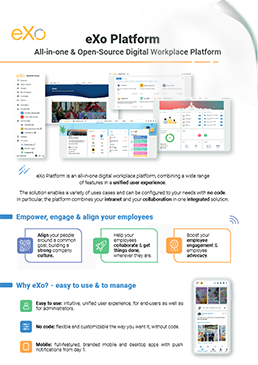

eXo Platform : The Open-Source
Digital Workplace Platform
Download the eXo Platform Datasheet and discover all the features and benefits
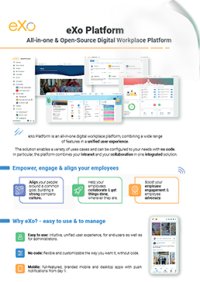

Download the eXo Platform Datasheet and discover all the features and benefits
Internal communication (IC) is the process, strategy, and set of tools that organizations use to share information, align employees with business goals, and foster engagement and collaboration. It is much more than simply sending out company announcements or newsletters—it is a deliberate, strategic function that shapes how employees experience the organization every day.
Effective internal communication creates meaningful linkages: between leadership and teams, across departments, and between on-site and remote employees. It ensures that information doesn’t just travel—it lands, resonates, and prompts action.
In practice, internal communication involves:
🤏In short, internal communication transforms information into understanding, alignment, engagement, and action.
Effective internal communication is no longer optional—it is essential for organizational success. Studies consistently show that improving communication drives engagement, productivity, and business outcomes.
🕵Quick evidence
🕺The Modern Challenge
The way we communicate at work has evolved dramatically. In 2025, improving internal communication means combining strategic leadership, modern technology, and a human-centered culture. Below are 22 actionable and up-to-date strategies designed to help organizations strengthen engagement, boost productivity, and build trust across distributed teams.
In the modern workplace, Internal Communication (IC) goes far beyond simply sharing updates—it is the lifeline that connects employees, aligns teams, and drives organizational success.
Effective Internal Communication ensures that everyone understands the company’s goals, feels included in decision-making, and has the information they need to perform their roles confidently. Research consistently shows that organizations with strong internal communication enjoy higher employee satisfaction, better retention, and improved overall performance.
As workplaces continue to evolve at a rapid pace, internal communication (IC) has moved beyond simply sending messages—it has become a strategic pillar of organizational success. Building a strong Internal Communication strategy and using the right platform is no longer optional; it’s essential. Here’s why:
👨💻The Hybrid Work Imperative
🧲Employee Engagement and Retention
🔬Accelerating Innovation
🧠Knowledge Management and Operational Efficiency
👨👩👧👦Crisis and Change Management
Here are some Key differences between internal and external communications:
➝ Find out the Key differences between internal and external communications
Selecting the right internal communications (IC) platform is a strategic decision. It’s about more than just picking a tool—it’s about enabling effective communication, engagement, and alignment across your organization.
Here’s a structured, step-by-step approach to guide your decision:
➝ Discover How to Choose the Right Internal Communications Platform
( Your e-mail address will not be published)

I am a Digital Marketing specialist specialized in SEO at eXo Platform. Passionate about new technologies and Digital Marketing. With 10 years' experience, I support companies in their digital communication strategies and implement the tools necessary for their success. My approach combines the use of different traffic acquisition levers and an optimization of the user experience to convert visitors into customers. After various digital experiences in communication agencies as well as in B2B company, I have a wide range of skills and I am able to manage the digital marketing strategy of small and medium-sized companies.