
FREE WHITE PAPER
Digital workplace is a buzzword these days. Actually different people use it to mean different things. So what is a digital workplace?
The digital workplace keeps evolving — faster than most roadmaps can keep up.
In 2025 and into 2026, that transformation is being powered by three major forces: the rapid adoption of generative AI, the persistence of hybrid work models, and a renewed focus on employee experience (EX) driven by real data and analytics.
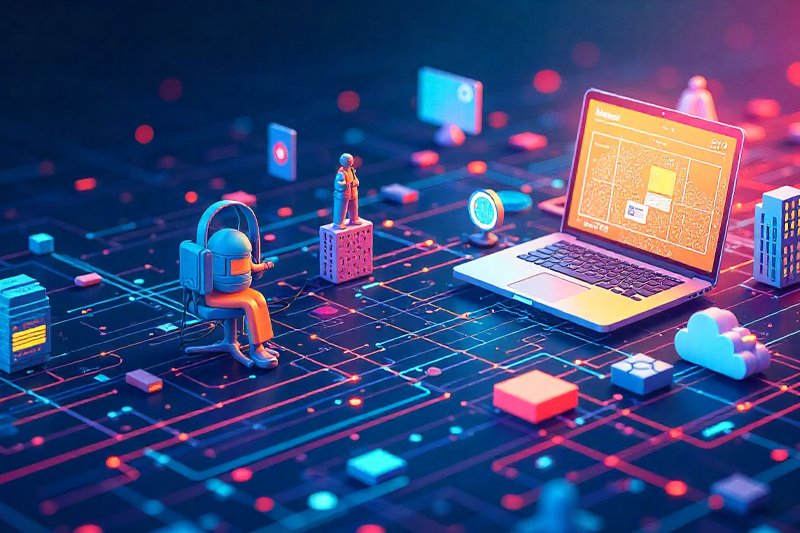
The digital workplace is no longer just a collection of tools — it has become the central nervous system of modern organizations. It connects people, information, and processes across locations, roles, and devices. What was once about productivity apps or remote collaboration is now about intelligent, human-centered ecosystems that combine AI, automation, and culture to enable seamless work and continuous innovation.
As we move beyond the reactive digital transformations triggered by the pandemic, enterprises are rethinking the purpose and design of their workplace environments. The focus is shifting toward sustainable productivity, employee well-being, and trusted AI integration that enhances — rather than replaces — human work.
In 2026, a mature digital workplace is defined not just by the technology it uses, but by how it shapes experiences. The best organizations are building environments that are empathetic, adaptive, and data-informed — places where employees feel connected, empowered, and supported no matter where or how they work.
The concept of the digital workplace has evolved from a buzzword into a strategic business imperative. It’s no longer about providing laptops and email accounts; it’s about creating a holistic, technology-enabled ecosystem designed to connect, engage, and empower a distributed and diverse workforce.
Over the past few years, disruptions such as the global shift to hybrid work and rapid AI innovation have acted as accelerators. Now, in 2026, we’re entering a more refined and intentional phase — one that balances technological advancement with human-centric design and measurable business impact.
In this article, we explore 12 major digital workplace trends shaping 2026, backed by updated data, emerging use cases, and research insights. You’ll also find examples of how organizations are implementing these trends, the key features they’re adopting, and the KPIs and roadmap you can use to guide your own digital workplace evolution.
By 2026, AI will no longer be an experimental sidekick — it will be an integrated teammate across departments.
Platforms like Microsoft 365 Copilot, Google Duet AI, and enterprise tools from OpenAI and Anthropic are transforming how employees create, learn, and make decisions.
A global consulting firm uses AI to summarize 10,000 project reports per month, saving analysts 4–6 hours weekly to focus on strategy.
AI enables employees to focus on high-value work while automating repetitive tasks, improving productivity, and reducing cognitive load.
Employees are overwhelmed by dozens of disconnected tools. The answer: a unified Employee Experience Platform (EXP) that integrates communication, knowledge, learning, and workflow automation into one intelligent hub.
A large public administration consolidated five portals into one EXP, resulting in 35% faster resource access and 20% higher employee satisfaction.
By 2026, 60% of organizations are expected to adopt EXPs as their core digital workplace layer.
The next generation of intranets is powered by semantic search and enterprise knowledge graphs that connect content, people, and expertise.
A pharmaceutical company deployed a knowledge graph to connect R&D documentation, saving researchers 30% of search time.
Knowledge accessibility is now a competitive advantage — “findability” drives productivity, compliance, and innovation.
Types of Digital workplace solutions
Digital workplace is a buzzword these days. Actually different people use it to mean different things. So what is a digital workplace?
Digital workplace is a buzzword these days. Actually different people use it to mean different things. So what is a digital workplace?
Hybrid work has stabilized, but the best companies are going further: embracing location flexibility with structured collaboration.
Microsoft’s 2025 Work Trend Index showed that employees spend 57% of their time communicating and only 43% creating. In 2026, the balance will begin shifting back toward creation.
The war for talent continues, and experience is now a measurable business metric.
Forward-thinking companies are tying employee experience metrics directly to business outcomes like customer satisfaction and retention.
A telecom operator correlated higher EX scores with a 12% improvement in customer NPS, proving that happier employees drive better customer experiences.
The digital workplace is now the “Headquarters of Culture.”
Even organizations with physical offices are prioritizing digital-first collaboration spaces — social feeds, idea hubs, and recognition walls.
Platforms like eXo Platform centralize engagement, recognition, and knowledge in a single branded hub, reinforcing culture and connectivity.
“Shadow AI” — employees using unapproved AI tools — has become one of the biggest enterprise risks of 2025–2026.
With tools like ChatGPT and Copilot available everywhere, governance is no longer optional.
Companies are implementing AI governance frameworks that define acceptable use, provide training, and monitor usage.
Recent reports show 71% of employees use unauthorized AI tools at work — governance is now a top IT priority.
Business users are no longer waiting for IT.
Low-code and no-code tools empower employees to create workflows, dashboards, and chatbots themselves.
An HR team built a self-service leave approval app in two days, cutting administrative time by 40%.
By 2026, 75% of large enterprises will use low-code platforms for at least one core business process (Forrester).
Well-being analytics are becoming embedded in the digital workplace.
Organizations now track digital fatigue, meeting overload, and focus time to proactively support mental health and productivity.
Gallup found that employees who feel cared for are 71% less likely to experience burnout — yet digital fatigue continues to rise.
As enterprise apps multiply, digital adoption platforms ensure employees can use them effectively.
DAPs provide in-app training, tooltips, and onboarding guides that adapt in real time.
A bank onboarded 3,000 new hires remotely using a DAP, resulting in 50% faster onboarding and a 25% reduction in support tickets.
Digital transformation fails when employees don’t adopt tools. DAPs close the adoption gap.
Skills are the new currency of the digital workplace.
Organizations are building skills graphs and AI-powered internal marketplaces to connect talent to opportunities.
A multinational energy company improved internal mobility by 35% using AI-driven skills graphs.
LinkedIn’s 2025 Workforce Report revealed that 83% of companies now track skills data as a core talent metric.
Digital workplaces are also becoming greener and more ethical.
Organizations are measuring their digital carbon footprint, optimizing data storage, and choosing vendors aligned with sustainability values.
By 2026, one in three organizations will include digital sustainability goals in their ESG reporting (IDC).
The Complete Guide to
Employee Engagement
Discover our in-depth analysis of the concept of employee engagement, its roots, and ways to improve it significantly
Discover our in-depth analysis of the concept of employee engagement, its roots, and ways to improve it significantly
The digital workplace is evolving rapidly, driven by a combination of technological advances, changing work patterns, and new expectations from employees. Several macro trends are shaping this transformation:
AI is no longer a novelty or experimental tool. Leading organizations are embedding generative AI directly into collaboration platforms, knowledge systems, and automation workflows. This integration allows employees to generate insights, draft content, and automate routine tasks seamlessly within the tools they already use. The result is faster decision-making and a more intelligent, responsive workplace.
Companies that strategically align technology, workforce skills, and modern ways of working consistently outperform others. These “frontier firms” leverage AI and integrated platforms to streamline workflows, enhance productivity, and create competitive advantages. Organizations that fail to keep pace risk falling behind in efficiency and employee satisfaction.
Employees are experiencing more fragmented workdays than ever. With an abundance of tools, notifications, and task-switching, cognitive load skyrockets, leading to stress and reduced productivity. Integrated digital platforms that consolidate communication, collaboration, and workflow management help reduce this overload and allow employees to focus on high-value work.
The rapid adoption of AI tools, including unauthorized or “shadow” AI applications, is creating significant governance and compliance challenges. Organizations need frameworks to monitor AI usage, ensure data privacy, and mitigate security risks, while still enabling innovation.
EX is no longer just a human resources initiative—it’s a strategic lever for retention, well-being, and productivity. Modern EX platforms combine collaboration, learning, and performance management to create holistic environments where employees can thrive.
Generative AI and integrated platforms are delivering tangible improvements across a wide range of organizational functions:
| Function | Challenge | AI/Platform Solution | Outcome |
|---|---|---|---|
| Knowledge Work | Employees spend hours reading reports and synthesizing data | AI-assisted summarization and content synthesis | Faster turnaround times, fewer redundant meetings, improved decision-making |
| Meetings | Overloaded calendars reduce deep work | Asynchronous video tools paired with AI-generated summaries | Lower meeting frequency, better focus, and increased productivity |
| Frontline Operations | Quick access to procedures and guidance is difficult | Mobile Employee Experience Platforms (EXP) with micro-learning modules | Reduced errors, faster onboarding, and better task execution |
| HR & Talent | Limited visibility into skills and career paths | Skills graphs and internal talent marketplaces | Higher internal mobility, better retention, and smarter talent allocation |
| Customer Support | Slow response times frustrate customers | AI-augmented agent desktops | Faster issue resolution, shorter handle times, higher first-contact resolution rates |
By aligning AI, digital platforms, and employee experience strategies, organizations can create a more productive, resilient, and human-centered workplace.
| Trend | Focus Area | Key Benefit |
|---|---|---|
| Generative AI | Knowledge Work | Smarter automation & creativity |
| Employee Experience Platforms (EXP) | Unified Work Hub | Reduced tool fatigue |
| Knowledge Graphs & Search | Information Access | Faster decisions |
| Work from Anywhere | Flexibility | Productivity + well-being |
| EX as KPI | HR & Culture | Retention & engagement |
| Digital HQ | Collaboration | Connected culture |
| Shadow AI Governance | Compliance | Security & trust |
| Low-Code Automation | Business Agility | Faster innovation |
| Well-Being Analytics | People Analytics | Prevent burnout |
| Digital Adoption Platforms | Learning | Higher ROI on tools |
| Skills Intelligence | Talent Management | Internal mobility |
| Sustainability & Ethics | Corporate Strategy | Responsible digital growth |
These trends reflect a shift from simply adopting new tools to using technology strategically to empower employees and strengthen organizational resilience.
Successfully building a 2026-ready digital workplace requires a phased, structured approach:
| Risk | Mitigation |
|---|---|
| Shadow AI & data leakage | Provide approved tools, clear policies, DLP solutions, training, and ongoing monitoring |
| Over-automation & deskilling | Ensure AI augments rather than replaces critical thinking; invest in reskilling programs |
| Fragmented tech stack | Prioritize unified EXP platforms with open integrations |
| Privacy & surveillance concerns | Use aggregated or anonymized analytics and maintain transparency to secure employee buy-in |
The digital workplace of 2026 is not just a set of tools — it’s a strategic platform. By combining AI, unified platforms, employee experience initiatives, and strong governance, organizations can:
In essence, the workplace of the future will be intelligent, safe, and human-centered, turning technology into a true enabler of both performance and employee well-being.
The digital workplace is no longer just a collection of tools or technologies. By 2026, it has become a core organizational capability — a combination of AI, automation, knowledge management, employee experience platforms (EXP), and culture. Success in this era is defined not by the tools you adopt, but by how you align leadership, governance, skills, and measurable employee outcomes around them.
AI assistants, knowledge graphs, and unified platforms are powerful enablers, but their true value comes from how work is designed, measured, and experienced. Forward-looking organizations focus on outcomes rather than tool adoption alone.
They experiment cautiously, establish strong governance, scale proven pilots, and continuously refine processes to maximize impact. Research from McKinsey, Microsoft, Gartner, and Deloitte confirms this approach: when executed thoughtfully, it unlocks massive opportunities, while missteps can amplify risks.
The trajectory of the modern workplace is clear: it is becoming more intelligent, integrated, and human-centric. Technology is no longer the end goal; it is a means to:
The organizations that will thrive in the next decade are those that strategically integrate these trends not for novelty, but for their ability to enhance the employee experience, drive sustainable growth, and create a safe, intelligent, and human-centered workplace.
In short, the future of work is digital, but its heart remains profoundly human. Treat your digital workplace as an outcomes program, not a technology purchase, and you position your organization for long-term success.
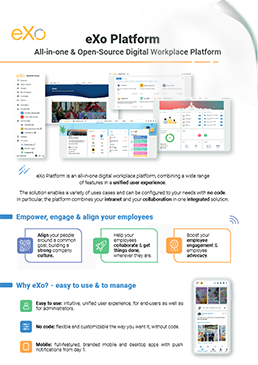

eXo Platform : The Open-Source
Digital Workplace Platform
Download the eXo Platform Datasheet and discover all the features and benefits

Download the eXo Platform Datasheet and discover all the features and benefits
You will find here Frequently Asked Questions about digital workplace with all the answers in one place.
The digital workplace is an overarching concept. It includes everything—from the software employees use to chat and share documents, to the platforms that integrate those tools, to the cultural processes that make work effective.
The digital workplace is no longer just a “nice-to-have” — it has become a strategic necessity for organizations of all sizes. Work is hybrid, distributed, and fast-changing, and employee expectations are higher than ever. A modern digital workplace ensures productivity, engagement, and resilience.
Here are the main reasons why it matters today:
➝ See the full explanation of why the digital workplace matters
The digital workplace isn’t a single app but an ecosystem of platforms that together support communication, collaboration, and productivity. Each category plays a unique role in shaping the employee experience.
Main categories include:
A well-designed digital workplace goes beyond apps — it’s the foundation of modern work. It improves productivity, culture, and resilience while reducing friction for employees.
Key benefits include:
( Your e-mail address will not be published)

I am a Digital Marketing specialist specialized in SEO at eXo Platform. Passionate about new technologies and Digital Marketing. With 10 years' experience, I support companies in their digital communication strategies and implement the tools necessary for their success. My approach combines the use of different traffic acquisition levers and an optimization of the user experience to convert visitors into customers. After various digital experiences in communication agencies as well as in B2B company, I have a wide range of skills and I am able to manage the digital marketing strategy of small and medium-sized companies.