Discover the new generation
company intranet
company intranet
Internal communication has become a strategic asset essential for collaboration, productivity, and organizational alignment. As workplaces shift toward hybrid and remote models, information flows are increasingly digital and distributed, creating both opportunities and vulnerabilities.

Secure internal communication (SIC) protects sensitive information from unauthorized access, leaks, and cyber threats, while allowing employees to share ideas, make decisions, and collaborate seamlessly. Achieving the right balance between openness and security is critical for business continuity, regulatory compliance, and competitive advantage.
Information is now the most valuable currency in a hyper-connected, data-driven business landscape. While organizations fortify their defenses against external cyber threats, unsecured internal communication channels often represent the most overlooked vulnerability.
According to the 2023 IBM Cost of a Data Breach Report, 95% of organizations experienced multiple breaches, with stolen credentials and human error frequently contributing. The channels through which critical information flows have become prime targets for cybercriminals, making Secure Internal Communications (SIC) a core pillar of organizational integrity, operational resilience, and strategic growth.
As professional and personal digital spaces continue to converge, secure communication is no longer merely an IT requirement. It safeguards the mechanisms that enable collaboration, innovation, and informed decision-making.
Companies that fail to secure internal communication risk financial, operational, and reputational damage, while those that implement robust SIC strategies gain a competitive edge, transforming potential vulnerabilities into strategic advantages.
This guide explores why secure internal communication is crucial in 2025, the evolving threats facing enterprises, and the best strategies and technologies to ensure information flows safely and efficiently.
By mastering SIC, organizations can protect their most critical asset, information, while fostering collaboration, trust, and sustainable growth.
Secure internal communication (SIC) is the framework of policies, protocols, and technologies designed to ensure that all information exchanged within an organization remains confidential, intact, and accessible only to authorized individuals.
It is not limited to messaging; it spans every form of digital interaction, including chat, email, video conferencing, document sharing, collaborative workspaces, and internal social feeds.
At its core, SIC creates a trusted digital environment where business can flow freely while minimizing exposure to both external threats and internal risks.
In 2025, secure internal communication goes far beyond basic password protection. Modern organizations require a multi-layered approach that combines technology, governance, and employee awareness.
All messages and file exchanges are encrypted from sender to receiver, ensuring that only authorized parties can access the content. This prevents eavesdropping, interception, or unauthorized sharing of sensitive information.
Robust IAM practices ensure that users are who they claim to be and can access only the information relevant to their role. Multi-Factor Authentication (MFA), Single Sign-On (SSO), and role-based access control are critical elements that reduce the risk of unauthorized access.
Organizations must carefully manage where their data reside, whether on-premises, in private clouds, or across hybrid environments. Data sovereignty ensures compliance with local regulations and minimizes the risk of cross-border breaches or jurisdictional issues.
Maintaining detailed logs of who accessed which information and when is essential for compliance, security investigations, and operational transparency. Audit trails not only protect against internal misuse but also demonstrate accountability to regulators and stakeholders.
Modern SIC relies on secure intranets, authenticated portals, and collaboration platforms that integrate encryption, access controls, and monitoring tools. These platforms provide a seamless user experience while maintaining enterprise-grade security standards.
Technology alone is not enough. Organizations must enforce clear policies around acceptable communication tools, data handling, and employee responsibilities. Training employees on these policies ensures that security becomes a cultural norm rather than a reactive measure.
👉In essence, secure internal communication is about creating a digital workspace that balances accessibility with protection, enabling teams to collaborate efficiently while safeguarding the organization’s most critical information. In 2025, it has evolved into a strategic enabler: it reduces risk, supports regulatory compliance, fosters employee trust, and underpins operational resilience in an increasingly hybrid and data-driven work environment.
Every piece of internal communication,from strategy memos and HR notifications to financial updates and product roadmaps, may contain sensitive information. If this content is intercepted or exposed, the consequences can range from reputational damage to legal liability.
Secure internal communication (SIC) is not just a defensive measure; it is a strategic necessity that protects critical assets, supports organizational agility, and fosters trust across the enterprise.
The modern workplace is evolving rapidly. Hybrid work models, accelerated digital transformation, and what experts call “organizational velocity”, the speed at which a company aligns its people to turn strategy into action, have all expanded the attack surface for cyber threats. This makes the need for SIC more urgent than ever.
The need for secure internal communication goes beyond simply avoiding hacks or breaches. It is a multidimensional requirement that underpins the organization’s strategy, growth, and culture. By embedding SIC into everyday operations, companies not only protect themselves from threats but also empower employees, enhance collaboration, and turn information security into a competitive advantage.
Trade secrets, R&D findings, product roadmaps, and financial data are central to a company’s competitive advantage. Leaks of this information can compromise market positioning, erode revenue, and give competitors an edge.
Regulations like GDPR, HIPAA, SOX, and CCPA impose strict requirements on data handling and privacy. A single unencrypted internal message containing personal or financial data can result in fines reaching millions of dollars.
When official tools are clunky or inconvenient, employees often resort to consumer apps such as WhatsApp, Telegram, or personal cloud services. These tools lack corporate oversight, exposing sensitive information to uncontrolled risks.
A breach of internal communication can instantly erode customer trust and investor confidence. According to the 2024 Edelman Trust Barometer, 74% of consumers consider the protection of customer data a key factor in building trust.
As organizations adopt AI tools, cloud platforms, and hybrid work models, secure communication becomes the glue that holds these initiatives together while minimizing exposure to cyber risks.
Employees are more likely to innovate, share feedback, and report potential issues when they are confident that their conversations and data are protected. Psychological safety is critical for encouraging open communication and sustaining a resilient, innovative workplace.
As organizations accelerate digital transformation and embrace hybrid work, internal communication channels have become both vital and vulnerable. Securing these channels is not simply a technical requirement; it is a strategic necessity. Internal communications face a complex threat landscape shaped by human error, technological gaps, governance weaknesses, and rapidly evolving cyberattacks.
Employees remain the most significant vector for security incidents in internal communication environments. Human behavior, whether accidental or malicious, continues to play a central role in data breaches and information leaks.
 Phishing and AI-Powered Attacks
Modern attackers increasingly leverage AI and large language models to craft highly convincing, jargon-rich phishing emails and internal messages that appear to come from executives or trusted colleagues. These sophisticated attacks make it increasingly difficult for employees to distinguish legitimate communication from fraudulent messages, significantly increasing the risk of credential theft and unauthorized access.
Insider Threats (Accidental or Malicious) Insider threats remain a major concern. Accidental leaks, negligent sharing of confidential files, or malicious activity by current or departing employees account for a significant portion of breaches. According to recent studies, approximately 25% of data breaches involve internal actors, highlighting the importance of access controls, monitoring, and employee awareness.
Credential Mismanagement Weak or reused passwords, unprotected devices, and improper handling of access credentials can lead to account takeovers and unauthorized data exposure. Credential mismanagement remains one of the most common entry points for attackers targeting internal communication systems.
The tools and platforms used for internal communication can themselves introduce vulnerabilities if they are not properly managed, secured, and governed.
Shadow IT Employees often adopt unapproved consumer applications for convenience, such as personal messaging apps or cloud storage services. These shadow IT tools typically lack end-to-end encryption, audit logging, or corporate oversight, creating invisible security gaps that expose sensitive information.
Unpatched Systems Outdated software, unsecured file-sharing links, and misconfigured communication platforms are common vulnerabilities. When systems are not regularly patched and updated, attackers can exploit known weaknesses to access internal conversations and documents.
Risky Third-Party Integrations Third-party applications and integrations can introduce hidden attack vectors if they are not adequately vetted, monitored, or secured. Poorly managed APIs or external connectors may expose sensitive credentials or allow unauthorized data access.
Even the most advanced security technologies cannot protect internal communication without strong governance and clearly defined processes.
Lack of Clear Security Policies Without documented and enforced communication security policies, employees may unknowingly expose sensitive information. Ambiguity around acceptable tools, data sharing rules, and communication practices increases organizational risk.
Inadequate Access Reviews Poorly managed permissions and infrequent access reviews can result in excessive or outdated access rights. Employees may retain access to sensitive information long after it is needed, increasing the likelihood of accidental or intentional misuse.
Weak Offboarding Procedures Failure to promptly deactivate accounts and revoke access during employee departures leaves critical information accessible to unauthorized users. Weak offboarding processes are a common source of internal data leaks.
The threat landscape for internal communication continues to evolve rapidly, particularly with the rise of AI-driven attacks and more aggressive cybercriminal tactics.
AI-Powered Phishing AI enables attackers to generate highly credible, personalized phishing messages at scale. These messages are increasingly difficult to detect and can bypass traditional security awareness measures.
Business Email Compromise (BEC) BEC attacks involve fraudulent impersonation of executives or senior leaders to manipulate employees into authorizing financial transactions or sharing sensitive information, often resulting in direct financial loss.
Ransomware 2.0 (Data Leakage Threats) Modern ransomware attacks no longer focus solely on encrypting files. Attackers now threaten to publicly leak sensitive internal conversations, documents, and proprietary data, amplifying reputational and regulatory damage.
For large, distributed organizations, the risks associated with insecure internal communication are magnified by scale, complexity, and regulatory exposure.
Distributed Global Workforces Enterprises operate across multiple regions, time zones, and employment models, including contractors and third-party partners. Ensuring secure, authenticated, and compliant communication across such diverse environments is a significant challenge.
Siloed Systems Different departments often use separate tools, workflows, and communication platforms. This fragmentation makes it difficult to enforce consistent security standards, monitor activity, and maintain visibility across the organization.
Complex Compliance Requirements Large enterprises must comply with a complex web of regulations such as GDPR, CCPA, HIPAA, and industry-specific standards. Unsecured or poorly governed communication channels can easily result in regulatory breaches and multi-million-dollar penalties.
Addressing these challenges requires a holistic approach that combines advanced security technology, strict governance policies, employee education, and secure communication platforms. Only by understanding and mitigating these threats can organizations maintain the confidentiality, integrity, and availability of their internal communications in 2025 and beyond.
| Threat Category | Specific Risks / Examples | Potential Impact | 2025 Considerations |
| Human Factor | Phishing attacks, AI-powered phishing, weak or reused passwords, accidental data sharing, insider threats (malicious or negligent) | Data leakage, credential theft, financial fraud, reputational damage | AI enables highly convincing fraudulent messages; approximately 25% of breaches involve internal actors |
| Technology & Tools | Use of unauthorized apps (Shadow IT), unpatched software vulnerabilities, unsecured file-sharing links, misconfigured applications, risky third-party integrations | Loss of data control, malware infiltration, regulatory non-compliance | End-to-end encryption and vetted integrations are critical; consumer apps create invisible security gaps |
| Process & Governance | Lack of clear security policies, inadequate access reviews, poor offboarding procedures, insufficient audit trails | Unauthorized access, data sprawl, inability to demonstrate compliance | Strong policies, role-based access controls, and audit logs are essential to meet regulations such as GDPR, HIPAA, and SOX |
| Emerging Threats | Business Email Compromise (BEC), ransomware 2.0, AI-powered social engineering | Financial loss, sensitive data leaks, public exposure of internal conversations, brand damage | Ransomware now threatens both data encryption and public leaks; AI-driven phishing is increasingly difficult to detect |

The Complete Guide to
Employee Engagement
Discover our in-depth analysis of the concept of employee engagement, its roots, and ways to improve it significantly



Discover our in-depth analysis of the concept of employee engagement, its roots, and ways to improve it significantly
Modern enterprises require robust technological solutions to protect sensitive internal communications. A secure communication platform must go beyond basic encryption to provide end-to-end security, governance, and compliance while enabling seamless collaboration. The following features are considered essential for safeguarding internal communications in 2025:
Data should be encrypted on the sender’s device and only decrypted by the intended recipient. This ensures that messages, files, and discussions remain private, even from administrators or platform operators, preventing interception or unauthorized access during transit.
Protects data in transit across networks, ensuring that information exchanged between users and servers cannot be intercepted or altered by malicious actors.
MFA adds an additional layer of verification beyond passwords, reducing the risk of account compromise. SSO simplifies secure access across multiple platforms, enhancing user experience without compromising security.
Restrict access to sensitive content based on roles, teams, or attributes. Granular permissions allow organizations to define who can view, edit, or share specific documents, channels, or workspaces, minimizing the risk of unauthorized exposure.
Comprehensive logs track who accessed or modified information and when. Audit trails support regulatory compliance, internal investigations, and security incident analysis.
Data at rest must be encrypted to protect against theft or unauthorized access. Organizations should also have control over where their data is stored, whether on-premises, private cloud, or specific geographic regions, to meet regulatory requirements and data sovereignty standards.
Internal communication platforms often need to connect with enterprise systems such as HRIS, CRM, or document management solutions. Secure APIs and pre-built integrations ensure these connections do not introduce vulnerabilities or expose sensitive credentials.
Modern security frameworks operate on a “never trust, always verify” principle. No user or device is inherently trusted, and every access request is verified continuously to prevent lateral movement of threats within the network.
Platforms should include tools for enforcing data retention, deletion, and compliance policies automatically. This ensures adherence to GDPR, HIPAA, ISO 27001, and other industry regulations without requiring constant manual oversight.
| Feature | Purpose / Security Benefit |
| End-to-End Encryption (E2EE) | Protects messages and files in transit and at rest; prevents unauthorized access even by admins |
| TLS/SSL Encryption | Secures data in transit against interception or tampering |
| Multi-Factor Authentication (MFA) & SSO | Strengthens login security, reduces password risks, and simplifies secure access |
| Role-Based & Granular Access Controls (RBAC/ABAC) | Limits access to authorized personnel; enforces least-privilege policies |
| Audit Logs & Activity Tracking | Tracks changes, accesses, and user activity for compliance and forensic purposes |
| Encrypted Storage & Data Residency | Protects stored data; ensures compliance with data sovereignty regulations |
| Secure Integrations & API Management | Connects safely with other enterprise systems without exposing sensitive credentials |
| Zero-Trust Security Model | Continuous verification of users and devices, reducing insider and lateral threat risks |
| Automated Compliance | Enforces data retention, deletion, and privacy policies automatically |
✍🏻By integrating these features into a unified platform, organizations can protect sensitive information, reduce the risk of breaches, and support regulatory compliance, all while maintaining efficient collaboration across distributed and hybrid teams. These technological foundations turn secure internal communication from a compliance necessity into a strategic enabler for business resilience and growth.
Implementing secure internal communication (SIC) requires more than selecting the right technology. It demands a combination of robust platforms, clear governance, and continuous employee engagement. Organizations that embed security into daily workflows reduce risk, improve compliance, and foster a culture of trust across the enterprise.
Fragmented communication channels increase security risk and encourage the use of unauthorized tools. Organizations should centralize internal communication on a secure intranet or collaboration platform that unifies messaging, file sharing, project collaboration, and internal news. Centralization reduces reliance on unsecured consumer apps, ensures consistent application of security policies, and provides audit logs and reporting capabilities necessary for governance and compliance.
Authentication is the first line of defense in secure internal communication. Enforcing Multi-Factor Authentication (MFA) and Single Sign-On (SSO) strengthens access security while simplifying the user experience. Role-based access controls and the principle of least privilege ensure that employees can access only the information required for their role, reducing the risk of unauthorized exposure and limiting the impact of compromised accounts.
Human error remains one of the leading causes of internal security incidents. Continuous security awareness programs help employees recognize phishing attempts, social engineering tactics, and suspicious behavior. Regular training sessions, combined with simulated phishing attacks, reinforce best practices and ensure employees are prepared to respond safely in real-world scenarios.
Comprehensive monitoring and audit trails are essential for maintaining control over internal communication channels. Organizations should regularly review access logs, permission changes, and usage patterns to detect unusual activity. Monitoring supports incident investigation, regulatory compliance, and early identification of potential breaches or insider misuse.
Outdated software and unpatched vulnerabilities are common entry points for attackers. Communication platforms, integrations, and underlying infrastructure must be updated consistently to address security flaws. Regular patching reduces exposure to known vulnerabilities and ensures systems remain aligned with current security standards.
As hybrid and remote work become standard, secure connectivity is critical. Virtual Private Networks (VPNs) encrypt communications for remote users, protecting data in transit over public networks. Zero-Trust security models further strengthen protection by continuously verifying users and devices, ensuring no access is granted by default, even within the corporate perimeter.
Third-party tools and integrations can introduce hidden security risks if not properly evaluated. Organizations should conduct thorough security and compliance assessments before integrating external applications. Access permissions should be limited to business needs, and integrations should adhere to the same encryption and authentication standards as internal systems.
Security succeeds when technology, policy, and culture work together. Even the most advanced platforms cannot compensate for unclear policies or disengaged employees. Clear communication security policies, strong leadership commitment, and ongoing education ensure that secure internal communication becomes a shared responsibility and an integral part of the organizational culture.
💡By combining these practices, organizations can transform secure internal communication from a defensive necessity into a strategic enabler for collaboration, innovation, and operational resilience. In 2025, following these best practices ensures that internal communication remains confidential, compliant, and trusted, supporting both productivity and long-term business success.
Securing internal communication is not only an IT responsibility, it requires active engagement and oversight from business leaders. By adopting practical, proactive measures, leaders can reduce risk, reinforce compliance, and foster a culture of security across the organization. Key practices include:
Human error remains one of the top causes of internal breaches. Leaders should ensure that employees:
Centralized identity and access management ensures that authentication and permissions are consistently enforced across all communication channels. Best practices include:
Role changes, promotions, or departures can create inadvertent security gaps. Leaders should ensure that:
All internal communication, whether via chat, file sharing, or collaboration platforms, should be encrypted:
By consistently applying these practical measures, business leaders can strengthen internal communication security, reduce the risk of breaches, and ensure that employees can collaborate confidently and safely. These steps also reinforce regulatory compliance, protect intellectual property, and support a culture where security is a shared responsibility rather than an afterthought.
From Safety Net to Rocket Fuel for Growth
Secure internal communication (SIC) is no longer just a compliance or IT concern. In 2025, it has become a strategic business capability. When internal communications are confidential, reliable, and accessible only to authorized users, organizations unlock resilience, efficiency, innovation, and sustained growth.
A strong SIC strategy acts as both a 🛡️ safety net, protecting critical information, and 🚀 rocket fuel, accelerating collaboration and performance across the enterprise.
Secure internal communication protects business-critical data from leaks, breaches, and unauthorized access. By ensuring information integrity and controlled access, organizations reduce operational disruptions and remain agile during crises, change initiatives, or external threats.
Centralized and secure communication platforms eliminate fragmented tools and duplicated work. Employees spend less time searching for information or validating sources, enabling faster decisions and smoother collaboration across teams, locations, and time zones.
Trust fuels performance. When employees know their conversations are protected, they communicate more openly, share ideas freely, and report issues early. Secure internal communication creates psychological safety, strengthening transparency, engagement, and organizational alignment.
Innovation depends on confidentiality. Secure channels allow teams to collaborate on sensitive projects, such as product roadmaps, strategy, and R&D, without fear of leaks. This accelerates experimentation and execution while safeguarding intellectual property.
In a digital-first economy, secure collaboration is a differentiator. Organizations with strong SIC practices protect their intellectual assets, meet compliance requirements, integrate acquisitions faster, and retain top talent, turning security into a long-term competitive advantage.
Employees increasingly expect a modern and secure digital workplace. Platforms that protect data while enabling seamless collaboration reduce frustration and build confidence. Prioritizing SIC strengthens employee satisfaction, loyalty, and long-term retention.
During expansion, restructuring, or mergers, secure communication spaces are critical. Controlled access, encryption, and audit trails allow teams from different entities to collaborate safely, supporting rapid integration without increasing risk.
Without proper safeguards, internal communication remains exposed to common threats such as weak credentials, unencrypted data transfers, shadow IT tools, and lack of monitoring. Addressing these risks with secure platforms, clear policies, employee awareness, and continuous oversight transforms SIC from a liability into a strategic asset.
🎯 In Summary: Secure internal communication is not just about protection, it’s about performance. When treated as both a safety net and a growth accelerator, SIC empowers organizations to move faster, innovate confidently, and build lasting trust, essential capabilities for thriving in 2025 and beyond.
The modern corporate intranet has evolved far beyond a static repository of HR policies or a simple internal news bulletin. Today, it serves as the central nervous system for secure internal communication, acting as a controlled, centralized environment where work happens and sensitive information is protected. By consolidating communication channels, knowledge, and collaboration tools, a secure intranet minimizes security risks while enhancing productivity.
A secure intranet provides IT and security teams with a unified dashboard to manage permissions, enforce role-based access, and monitor activity. Employees are granted access only to the information relevant to their role, reducing the risk of accidental or malicious exposure.
Instead of relying on fragmented consumer-grade tools, such as personal WhatsApp, unapproved cloud storage, or email threads, teams can collaborate safely within the intranet. Messaging, document sharing, video calls, and project updates all occur inside a perimetered environment, ensuring that sensitive data remains under corporate oversight.
Information stored within a secure intranet is encrypted, version-controlled, and backed up according to corporate policies. This approach eliminates the chaos of scattered emails and uncontrolled file sharing while maintaining audit trails for compliance and forensic analysis.
A well-designed intranet centralizes tools, reducing the need to log into multiple platforms for chat, documents, or announcements. This streamlined experience not only boosts productivity but also encourages adoption of secure tools over risky alternatives.
Secure intranets enforce retention policies, provide detailed logs of user activity, and maintain records for regulatory compliance. Organizations can track who accessed which information, when, and what actions were taken, ensuring both accountability and legal adherence.
👉🏻By serving as a “walled garden” for corporate communication, a secure intranet drastically reduces an organization’s attack surface. It transforms internal communication from a potential vulnerability into a strategic asset, providing a unified, auditable, and secure platform for collaboration, knowledge sharing, and day-to-day operations.
Choosing the right platform for secure internal communication is critical. The wrong choice can introduce vulnerabilities, reduce adoption, and undermine compliance efforts. A strategic approach ensures that security is baked into the platform without compromising usability, collaboration, or organizational growth.
Security should be the foundation, not an afterthought. Look for platforms that provide:
Organizations vary in their security posture, data residency needs, and IT policies. Choose a platform that supports:
A secure platform must integrate seamlessly with your existing infrastructure:
Continuous monitoring and auditability are key to maintaining security:
A secure platform that employees circumvent is ineffective. Prioritize usability alongside security:
Security should be precise, not all-or-nothing:
Finally, the platform’s provider must be reliable:
👉By evaluating platforms across these dimensions, security, deployment flexibility, integration, usability, governance, and vendor reliability, organizations can select a solution that protects sensitive information, enables seamless collaboration, and supports compliance, all while fostering a positive employee experience. In 2025, a secure internal communications platform is not merely a tool; it is the strategic backbone of safe, productive, and resilient workplaces.
In today’s enterprise landscape, secure internal communication is more than a technical necessity, it is a strategic enabler for innovation, collaboration, and organizational resilience. While many organizations rely on patchwork solutions that are fragmented, unsecured, or difficult to govern, eXo Platform offers a unified, secure, and future-ready digital workplace designed to meet the demands of modern enterprises.
eXo Platform is built from the ground up with security as a core principle:
Different organizations have different compliance and infrastructure requirements. eXo Platform offers:
Unlike fragmented tools that force employees to juggle multiple apps for chat, file sharing, communities, and knowledge management, eXo Platform provides:
Trusted by global organizations in banking, healthcare, government, and other regulated industries, eXo Platform can scale to support thousands of employees and multiple geographies while maintaining security and compliance.
The platform’s open, API-first architecture allows seamless integration with existing enterprise systems and emerging technologies like AI, without compromising security. It provides a solid foundation for adapting to evolving business needs and digital transformation initiatives.
| Aspect | Typical Intranet / Collaboration Tools | eXo Platform |
| Security Model | Perimeter-based, limited internal encryption | Zero-Trust & E2EE for critical communications |
| Deployment | Usually cloud-only, limited control | Cloud, on-premises, or hybrid deployment |
| Unified Experience | Separate tools for chat, docs, and communities | Fully integrated suite in one secure environment |
| Compliance Support | Basic audit logs; limited automated retention | Advanced auditing & automated data lifecycle management (GDPR, HIPAA, etc.) |
| Strategic Value | Viewed as a utility or cost | Positioned as a secure platform driving growth, innovation, and operational resilience |
👉By providing robust security, seamless collaboration, regulatory compliance, and employee engagement in a single platform, eXo Platform transforms internal communication from a cost center into a strategic growth driver. Organizations no longer need to compromise between security and productivity, they can have both, enabling innovation, operational efficiency, and trust across employees, partners, and customers.
Secure internal communication is evolving rapidly, driven by technological innovation, changing workplace dynamics, and emerging cyber threats. Organizations must anticipate these trends to stay ahead of attackers and ensure long-term resilience. Key developments shaping the future of SIC include:
Artificial intelligence is becoming an integral part of internal communication security. AI can:
The Zero-Trust paradigm assumes that no user or device can be trusted by default, even within the corporate network. Access decisions are continuously verified based on:
This approach significantly reduces internal and lateral attack surfaces.
Emerging decentralized models, including self-sovereign identity (SSI) and distributed communication protocols, reduce reliance on central systems and password databases. Employees control verifiable credentials, enhancing privacy while minimizing the impact of centralized breaches.
As quantum computing becomes a potential threat, organizations are exploring post-quantum cryptography to safeguard communications against future decryption attacks. Platforms will continue to adopt advanced encryption methods to ensure data remains secure for years to come.
Security decisions will increasingly be dynamic and context-driven. Access will be granted based not only on role, but also on the security posture of the device, location, and request context. Simultaneously, AI will deliver hyper-personalized experiences, providing employees with relevant information securely while respecting strict permission boundaries.
Forward-looking digital workplaces are embedding AI deeply into secure communication workflows. By orchestrating threat detection, automating sensitive data tagging, and predicting risks, AI transforms security from reactive to proactive. Organizations gain real-time insights into potential vulnerabilities, enabling faster response and continuous protection.
By 2026 and beyond, secure internal communication will increasingly blend human oversight with AI-driven orchestration, decentralized identity management, and advanced cryptography. Organizations that adopt these trends early will not only protect sensitive information but also empower employees to collaborate confidently, accelerating innovation, operational efficiency, and trust in the digital workplace.
Secure internal communication is no longer a technical luxury, it is a non-negotiable foundation for modern organizations. Protecting sensitive corporate data, enabling seamless collaboration, and fostering employee engagement are essential for operational resilience, regulatory compliance, and competitive advantage.
In today’s environment of distributed workforces and sophisticated cyber threats, relying on fragmented tools or consumer-grade apps creates significant strategic risk. Human errors, unencrypted channels, shadow IT, and evolving attack vectors can compromise intellectual property, employee privacy, and customer trust. Organizations must therefore adopt comprehensive strategies, clear policies, and robust technology platforms that ensure information remains confidential, intact, and accessible only to authorized personnel.
Secure internal communication serves as both a safety net and a growth engine:
Investing in a platform like eXo Platform transforms security from a cost into a strategic enabler:
Choosing eXo Platform is not just implementing software, it is building a trusted digital headquarters where sensitive information stays protected, employees collaborate confidently, and the organization is poised to grow securely and fearlessly.
Secure internal communication is both the foundation of trust and the catalyst for innovation. Organizations that embrace it strategically are prepared not only to defend against current threats but also to thrive in the evolving digital workplace of 2025 and beyond.
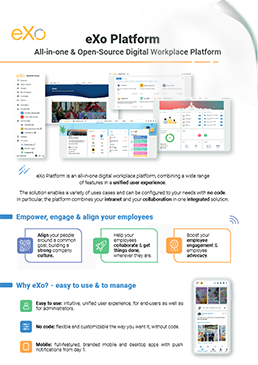

eXo Platform : The Open-Source
Digital Workplace Platform
Download the eXo Platform Datasheet and discover all the features and benefits

Download the eXo Platform Datasheet and discover all the features and benefits
Internal communication (IC) is the process, strategy, and set of tools that organizations use to share information, align employees with business goals, and foster engagement and collaboration. It is much more than simply sending out company announcements or newsletters—it is a deliberate, strategic function that shapes how employees experience the organization every day.
Effective internal communication creates meaningful linkages: between leadership and teams, across departments, and between on-site and remote employees. It ensures that information doesn’t just travel—it lands, resonates, and prompts action.
In practice, internal communication involves:
🤏In short, internal communication transforms information into understanding, alignment, engagement, and action.
Effective internal communication is no longer optional—it is essential for organizational success. Studies consistently show that improving communication drives engagement, productivity, and business outcomes.
🕵Quick evidence
🕺The Modern Challenge
The way we communicate at work has evolved dramatically. In 2025, improving internal communication means combining strategic leadership, modern technology, and a human-centered culture. Below are 22 actionable and up-to-date strategies designed to help organizations strengthen engagement, boost productivity, and build trust across distributed teams.
In the modern workplace, Internal Communication (IC) goes far beyond simply sharing updates—it is the lifeline that connects employees, aligns teams, and drives organizational success.
Effective Internal Communication ensures that everyone understands the company’s goals, feels included in decision-making, and has the information they need to perform their roles confidently. Research consistently shows that organizations with strong internal communication enjoy higher employee satisfaction, better retention, and improved overall performance.
As workplaces continue to evolve at a rapid pace, internal communication (IC) has moved beyond simply sending messages—it has become a strategic pillar of organizational success. Building a strong Internal Communication strategy and using the right platform is no longer optional; it’s essential. Here’s why:
👨💻The Hybrid Work Imperative
🧲Employee Engagement and Retention
🔬Accelerating Innovation
🧠Knowledge Management and Operational Efficiency
👨👩👧👦Crisis and Change Management
Here are some Key differences between internal and external communications:
➝ Find out the Key differences between internal and external communications
Selecting the right internal communications (IC) platform is a strategic decision. It’s about more than just picking a tool—it’s about enabling effective communication, engagement, and alignment across your organization.
Here’s a structured, step-by-step approach to guide your decision:
➝ Discover How to Choose the Right Internal Communications Platform
( Your e-mail address will not be published)

I am a Digital Marketing specialist specialized in SEO at eXo Platform. Passionate about new technologies and Digital Marketing. With 10 years' experience, I support companies in their digital communication strategies and implement the tools necessary for their success. My approach combines the use of different traffic acquisition levers and an optimization of the user experience to convert visitors into customers. After various digital experiences in communication agencies as well as in B2B company, I have a wide range of skills and I am able to manage the digital marketing strategy of small and medium-sized companies.