
How to improve internal communication and knowledge sharing in educational institutions with eXo Platform

Organisations across different industries are constantly looking to adapt to technological advancements and the emergence of new generations (millennials and Gen Z). As a result, digital workplace solutions have progressively gained popularity as they provide these organisations with an all-in-one solution capable of improving communication and collaboration, and streamlining business processes.
How educational institutions can use eXo Platform to improve communication and knowledge sharing

Content

In previous blog posts as well as on our website, we have discussed how our solution can help businesses across different industries.
In this blog post, we will discuss the different challenges facing educational institutions and how eXo Platform, with its multidimensional approach, can help address these challenges.

1. Challenges

Educational institutions of all levels are always looking to attract the best prospects (whether to work within the campus or enrol on a specific programme) and to provide them with the right tools to succeed. The formative nature of educational institutions, coupled with the high expectations of tech-savvy users, makes it essential to have solutions capable of meeting these needs.
Below are the main challenges facing the education sector:

Disconnection

Relying on traditional tools such as email and static intranet portals for communication between faculty members and students can lead to disengagement. The availability of a multitude of business applications and social media platforms encourages users to visit these sites to communicate. Facebook groups are often created for a specific course in which different types of content can be exchanged. Although practical for small teams, these groups act as a limited short-term fix for a more complex problem and do not provide faculty staff and students with a central place to communicate.

Knowledge dispersion

Finding a way to store knowledge in a centralised location and make it accessible for users is the main challenge facing educational institutions. Not having an internal knowledge base capable of storing all types of data (files, training videos etc.) contributes to the dispersion of knowledge and an increase in the amount of time spent looking for information. Cloud storage platforms such as Dropbox, Google Drive and OneDrive are often used by individual users or groups to collaborate and exchange documents. This constitutes an issue in terms of knowledge accessibility as well as data security, as faculty administrators do not have control over the shared documents.

Onboarding and continuous learning

Whether in a business or educational context, onboarding is often a challenging task for organisations. New students or workers have to familiarise themselves with their new surroundings to facilitate their integration into the campus. The absence of a solution capable of conveying campus news and policies can make the onboarding process harder and longer. Furthermore, if an onboarding space dedicated tor newcomers is not available, students/workers may find it hard to access training materials.

2. Benefits

To address the challenges mentioned above, educational institutions often turn to digital workplace solutions. The vast array of features included within solutions such as eXo Platform brings a number of benefits to these institutions. Below are the main benefits, along with some examples of use.

Improved communication and collaboration

eXo Platform allows educational institutions to improve internal communication and collaboration between faculty members, students, alumni and business partners. With a large number of built-in functionalities – such as an enterprise social network (ESN), a knowledge management system (KMS), intranet portal and instant messaging, eXo Platform appeals to the education sector.

Intranet portals, with their top-down capabilities, allow faculty members (typically communication and HR specialists) to post news and announcements. This keeps users aware of the latest developments within the organisation and further improves engagement.
An ESN, on the other hand, allows users to post different types of content on an activity stream., and to interact with their peers via likes, comments and shares. This improves the organisational culture (a top priority in the education sector) and breaks down barriers between faculty members and students.
Within eXo Platform, users have the opportunity to create spaces dedicated to courses, cohorts or shared interests in which they can communicate and collaborate via the spaces activity stream or using the chat application. This eliminates their reliance on other tools, such as email or social media platforms.

Improved knowledge sharing

An integrated knowledge management system focuses on locating, capturing and storing all types of knowledge, and making this available for users. Typical users within this context include faculty members, students, alumni and business partners.
A rich knowledge base with an effective search function helps users find what they are looking for in a quick and timely manner. This significantly reduces the time spent looking for information, thus improving the overall performance of the institution and its students.

Onboarding and continuous learning

One of the most sought-after functionalities in a digital workplace is interoperability. A solution capable of integrating third-party applications, in this case e-learning platforms, facilitates onboarding and ongoing training. This way, students can access e-learning platforms and different training materials directly from eXo Platform.
Users can also learn more about the institution news and policies via the portal or dedicated spaces for newcomers in their ESN.
In summary, a disengaged workforce and students, a lack of communication and a decrease in overall productivity represent the main challenges facing educational institutions. In this blog post, we have discussed how our solution can help these institutions overcome these challenges.
Follow our blog to discover more about eXo Platform and to keep up to date with the latest product and industry news.
FREE DATASHEET

eXo Platform  : The Open-Source

Digital Workplace Platform

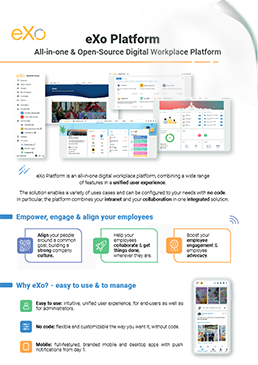
Download the eXo Platform  Datasheet and discover all the features and benefits

book-datasheet-7
cta-rectangle-rose
FREE DATASHEET

Download the eXo Platform Datasheet and discover all the features and benefits
FAQs

You will find here Frequently Asked Questions about internal communication with all the answers in one place.

Internal communication (IC) is the process, strategy, and set of tools that organizations use to share information, align employees with business goals, and foster engagement and collaboration. It is much more than simply sending out company announcements or newsletters—it is a deliberate, strategic function that shapes how employees experience the organization every day.


Effective internal communication creates meaningful linkages: between leadership and teams, across departments, and between on-site and remote employees. It ensures that information doesn’t just travel—it lands, resonates, and prompts action.


In practice, internal communication involves:


  • Channels: Email, intranet, chat platforms, mobile apps.
  • Content: Strategic updates, culture stories, knowledge sharing, role-specific information.
  • Rituals: All-hands meetings, team check-ins, feedback loops.
  • Measurement: Engagement, clarity, alignment, and effectiveness of communication.


🤏In short, internal communication transforms information into understanding, alignment, engagement, and action.


Find out the full definition of internal communication

Effective internal communication is no longer optional—it is essential for organizational success. Studies consistently show that improving communication drives engagement, productivity, and business outcomes.


🕵Quick evidence

🕺The Modern Challenge


Find out Why Improving Internal Communication Matters

The way we communicate at work has evolved dramatically. In 2025, improving internal communication means combining strategic leadership, modern technology, and a human-centered culture. Below are 22 actionable and up-to-date strategies designed to help organizations strengthen engagement, boost productivity, and build trust across distributed teams.


  1. Build a Single Source of Truth (Central Intranet)
  2. Create a Digital-First, Human-Centric Communication Strategy
  3. Lead with Transparency and Authenticity
  4. Define and Share a Clear Purpose
  5. Establish Clear Communication Guidelines
  6. Foster Two-Way Dialogue
  7. Use Role- and Location-Based Targeting
  8. Keep Channels Organized and Purposeful
  9. Combine Real-Time Chat with Long-Term Knowledge Sharing
  10. Build Digital Communities and Recognition Spaces
  11. Measure Engagement with Meaningful Metrics
  12. Empower Managers as Communication Champions
  13. Optimize for Mobile and Frontline Workers
  14. Automate Routine Communications
  15. Enable Continuous Feedback Loops
  16. Localize and Personalize Messages
  17. Integrate Communication with Business Tools
  18. Leverage AI for Smarter Communication
  19. Use Storytelling and Multimedia to Engage
  20. Adopt a Clear Governance Model
  21. Balance Top-Down and Bottom-Up Communication
  22. Continuously Audit and Improve Communication Channels


Find out 22 Tips to Improve Internal Communication

In the modern workplace, Internal Communication (IC) goes far beyond simply sharing updates—it is the lifeline that connects employees, aligns teams, and drives organizational success.


Effective Internal Communication ensures that everyone understands the company’s goals, feels included in decision-making, and has the information they need to perform their roles confidently. Research consistently shows that organizations with strong internal communication enjoy higher employee satisfaction, better retention, and improved overall performance.


  1. Aligning Employees with Strategy
  2. Engaging a Diverse Workforce
  3. Saving Time and Reducing Confusion
  4. Supporting Culture and Values
  5. Breaking Down Silos and Encouraging Knowledge Sharing


Discover the advantages of internal communication

As workplaces continue to evolve at a rapid pace, internal communication (IC) has moved beyond simply sending messages—it has become a strategic pillar of organizational success. Building a strong Internal Communication strategy and using the right platform is no longer optional; it’s essential. Here’s why:


‍👨‍💻The Hybrid Work Imperative

🧲Employee Engagement and Retention

🔬Accelerating Innovation

🧠Knowledge Management and Operational Efficiency

👨‍👩‍👧‍👦Crisis and Change Management


Find out Why Internal Communications is important

Here are some Key differences between internal and external communications:

 
  • The audience
  • The goal
  • The frequency
  • The flow
  • The means
   

Find out the Key differences between internal and external communications

Selecting the right internal communications (IC) platform is a strategic decision. It’s about more than just picking a tool—it’s about enabling effective communication, engagement, and alignment across your organization.


Here’s a structured, step-by-step approach to guide your decision:


  1. Assess Your Current State
  2. Define Clear Goals
  3. Map Your Users
  4. Identify Must-Have Features
  5. Establish Budget and Total Cost of Ownership
  6. Create a Vendor Shortlist
  7. Test with a Proof of Concept (PoC)
  8. Plan for Adoption
  9. Define Governance and Metrics
  10. Go Live and Continuously Improve

Discover How to Choose the Right Internal Communications Platform

5/5 - (1 vote)
I am a product marketing specialist at eXo. My role is to assist marketing and sales teams in their operations and present our digital workplace solution to the world. I mainly blog about the latest tech trends, digital transformation, internal communication and how to navigate through eXo Platform.
Related posts
  • All
  • eXo
  • Digital workplace
  • Employee engagement
  • Open source
  • Future of work
  • Internal communication
  • Collaboration
  • News
  • intranet
  • workplace
  • Knowledge management
  • Employee experience
  • Employee productivity
  • onboarding
  • Employee recognition
  • Change management
  • Cartoon
  • Digital transformation
  • Infographic
  • Remote work
  • Industry trends
  • Product News
  • Thought leadership
  • Tips & Tricks
  • Tutorial
  • Uncategorized
Leave a Reply

( Your e-mail address will not be published)

guest
0 Comments
Commentaires en ligne
Afficher tous les commentaires

I am a product marketing specialist at eXo. My role is to assist marketing and sales teams in their operations and present our digital workplace solution to the world. I mainly blog about the latest tech trends, digital transformation, internal communication and how to navigate through eXo Platform.