
FREE WHITE PAPER
Digital workplace is a buzzword these days. Actually different people use it to mean different things. So what is a digital workplace?
A modern digital workplace is the set of people, processes and cloud-native tools that let employees do meaningful work anywhere — with secure access to information, purposeful collaboration, and AI-enhanced productivity. It matters because it increases agility, retention and business resilience.
The workplace of 2025 is no longer a single physical building. It’s a hybrid, distributed, digitally-enabled experience where employees expect the same simplicity and usefulness from work tools that they get from consumer apps. Organizations that design a modern digital workplace intentionally — aligning tools, culture and operations — win in productivity, engagement and innovation.
Recent analyst research highlights that improving the digital employee experience (DEX) is a top priority for IT and business leaders because it directly impacts speed, cost and employee retention.
At the heart of this transformation is the Modern Digital Workplace (MDW): a holistic ecosystem of people, processes, and cloud-native tools that allows employees to do meaningful work anywhere. It combines secure access to information, purposeful collaboration, and AI-enhanced productivity to create an environment where employees can thrive. By intentionally aligning tools, culture, and operations, organizations can boost productivity, engagement, innovation, and overall business resilience.
The shift toward the Modern Digital Workplace is more than a trend or a move to remote work—it represents a fundamental reimagining of work itself. Traditional models—commuting to a central office, sitting at assigned desks, and collaborating only with nearby colleagues—have given way to an era where agility, connectivity, and intelligence define professional life. Global events like the COVID-19 pandemic accelerated this transformation, while advancements in digital tools have made it possible to work effectively from anywhere.
Recent analyst research underscores the importance of the digital employee experience (DEX), highlighting that improving DEX is a top priority for IT and business leaders. A better digital workplace directly impacts speed, operational costs, employee satisfaction, and retention, making it a strategic business imperative.
This guide offers a comprehensive exploration of the Modern Digital Workplace, starting with its definition and core concepts to explain exactly what the Modern Digital Workplace is and how it fundamentally reshapes the way we work.
It examines the business case for investing in a modern digital workplace, highlighting the tangible benefits organizations can achieve in productivity, engagement, and resilience. The guide also covers the key features and tools that enable distributed work, presenting up-to-date technologies, platforms, and capabilities that make seamless collaboration and secure access possible.
To bring these ideas to life, it includes real-world use cases and studies that showcase successful Modern Digital Workplace implementations. Readers will also find best practices and implementation tips, offering strategies for aligning technology, culture, and processes to create a thriving digital work environment.
Finally, the guide provides practical guidance for migration, including a ready-to-use checklist to help organizations transition smoothly from traditional workplaces to fully modern, digitally empowered ecosystems.
In short, the Modern Digital Workplace is not just about where work happens—it’s about how work happens, empowering employees to perform their best, collaborate effortlessly, and contribute to business resilience and growth. Whether you are an IT leader, HR professional, or business executive, understanding and embracing the Modern Digital Workplace is critical to staying competitive in today’s fast-evolving work environment.
A Modern Digital Workplace (MDW) is far more than a collection of software applications. It is a people-first ecosystem that integrates technology, culture, and processes to create a unified, engaging, and efficient work environment.
Think of it as the digital equivalent of a physical office—designed to enable communication, collaboration, knowledge sharing, and productivity for a geographically dispersed and diverse workforce.
At its heart, the Modern Digital Workplace empowers employees to deliver meaningful outcomes, not just run apps, wherever they are, while maintaining security, governance, and predictable performance.
Formally, the Modern Digital Workplace (MDW) can be defined as an always-connected environment that provides instant, secure, and personalized access to the data, applications, and collaboration workspaces employees need to perform their tasks from any device, at any time. It is the everyday digital ecosystem that enables work—seamless, flexible, and adaptive to the modern professional landscape.
The Modern Digital Workplace is a multi-layered ecosystem that combines tools, platforms, and services into a cohesive, integrated experience:
The ultimate goal of the Modern Digital Workplace is to enable employees to focus on outcomes, not just applications. By bringing together all the tools, data, and collaboration spaces into a seamless, intuitive environment, the Modern Digital Workplace supports productivity, innovation, and engagement across the organization. It mirrors the simplicity, connectivity, and responsiveness of modern consumer applications, while meeting enterprise standards for security, compliance, and performance.
In essence, the Modern Digital Workplace functions as the digital “central nervous system” of an organization, connecting people, processes, and technology to create a flexible, intelligent, and human-centered work environment. It allows employees to work effectively from anywhere, on any device, and at any time, turning digital tools into real business outcomes.
The Modern Digital Workplace (MDW) is no longer a “nice-to-have”—it has become a strategic imperative for organizations that want to thrive in today’s fast-evolving business landscape. Its impact goes far beyond technology: it directly influences employee experience, business outcomes, productivity, resilience, and cost efficiency.
At its core, the Modern Digital Workplace enhances the Digital Employee Experience (DEX), which has a direct correlation with engagement, retention, and decision-making speed. Organizations that invest in improving DEX see tangible results: employees are more engaged, turnover decreases, and decisions are made faster. Analysts consistently report that a strong digital workplace positively affects both employee and customer outcomes, making it a critical lever for business success.
The Modern Digital Workplace also plays a vital role in attracting and retaining top talent. Modern employees, particularly Millennials and Gen Z, value flexibility, technological enablement, and a positive work culture. Companies with a mature digital workplace are perceived as forward-thinking and more appealing to high-performing talent. Research from Slack’s Future Forum highlights that flexibility and well-supported digital tools are among the top drivers of employee satisfaction and retention.
A modern digital workplace breaks down information silos and integrates tools, enabling employees to spend less time navigating apps, searching for information, or scheduling meetings—and more time on high-value work. Studies by PwC show that 83% of employers consider the shift to remote work successful, largely thanks to digital tools.
Generative AI and AI copilots add another layer of productivity. Analysts estimate that widespread adoption of AI in the workplace could generate trillions in value, as AI streamlines workflows, automates routine tasks, and provides intelligent insights. Preparing the Modern Digital Workplace to host AI-powered processes is now a key factor in maximizing workforce efficiency.
A Modern Digital Workplace connects knowledge workers and frontline staff—from corporate offices to factories, shops, and field teams—reducing information gaps and operational risks. By unifying access to tools and knowledge, organizations foster collaboration across all levels and locations, ensuring that every employee can contribute effectively.
The pandemic demonstrated that organizations with mature digital workplaces could pivot quickly in response to global disruptions. A robust Modern Digital Workplace enables business agility, allowing employees to work securely from anywhere and maintaining operational continuity under changing circumstances.
Cloud-native platforms further enhance efficiency and resilience. Consolidating tools reduces operational costs, accelerates feature delivery, and simplifies business continuity during disruptions. Additionally, a centralized digital environment with Zero Trust security models and consistent policies is often more secure than fragmented traditional IT systems, reducing the risk of data breaches.
In today’s competitive landscape, the Modern Digital Workplace is not just about tools—it’s about outcomes. It drives employee engagement, productivity, and innovation while enhancing business resilience, security, and cost efficiency. For organizations looking to attract top talent, respond quickly to change, and maximize operational performance, investing in a well-designed Modern Digital Workplace is no longer optional—it is essential.
The Modern Digital Workplace is evolving rapidly. Today, it’s no longer just about basic collaboration or document sharing—it’s an intelligent, integrated, employee-centric ecosystem that connects people, processes, and technology. The following features distinguish a truly modern digital workplace from legacy intranet and collaboration stacks, reflecting the latest trends and vendor innovations.
At the heart of the Modern Digital Workplace is a central communication hub where work happens. Tools like Microsoft Teams, Slack, or Zoom go beyond simple chat or video calls—they integrate meetings, file collaboration, task management, and third-party apps into a single, seamless workspace. Persistent chat, asynchronous video, and social-style feeds support both structured work and company culture, enabling employees to communicate and collaborate effortlessly.
Modern workplaces prioritize the employee experience, bringing communications, learning, wellbeing, and insights into the flow of work rather than as separate portals. Platforms like Microsoft Viva exemplify this shift:
These integrated experiences enhance engagement, productivity, and overall satisfaction, directly impacting business outcomes.
Generative AI, copilots, and automation are transforming productivity. AI can summarize meetings and documents, power intelligent search that understands intent, and automate repetitive workflows through RPA and low-code platforms. Embedding AI at the interface level ensures employees get insights and assistance exactly where they need it, increasing speed and reducing friction.
Modern workplaces leverage semantic search and knowledge graphs to connect people, documents, and answers. AI-powered search proactively surfaces authoritative information, experts, and context, transforming collective data into actionable intelligence and helping employees find what they need in seconds.
Tools that surface relevant data directly in the flow of work—like task cards in chat, CRM widgets in documents, or approval prompts in email—reduce app-switching and streamline workflows. A composable architecture with APIs, connectors, and low-code components lets organizations assemble best-of-breed services instead of being locked into a single platform.
Real-time telemetry on end-user performance, device health, app latency, and feature adoption allows organizations to measure and improve the digital employee experience (DEX). Insights from workplace analytics help optimize workflows, identify friction points, and prioritize training or fixes for maximum impact.
Security is foundational. Modern workplaces implement Zero Trust models, combining Single Sign-On (SSO), conditional access, endpoint posture checks, and encryption to protect distributed employees and corporate data. Centralized, consistent security policies reduce risk while enabling secure hybrid and remote work.
Especially for frontline and remote employees, mobile-first design ensures productivity on the go. Offline capabilities allow employees to continue work even without connectivity, syncing changes automatically when back online.
Platforms like Microsoft Power Platform, ServiceNow, or UiPath empower non-technical employees to automate workflows and build simple apps, increasing operational efficiency without relying solely on IT.
A modern digital workplace also supports Environmental, Social, and Governance goals by reducing paper usage, travel, and energy consumption, while promoting digital accessibility and sustainability practices.
🤏In short: A modern digital workplace integrates communication, collaboration, knowledge, AI, automation, and security into a seamless, employee-centric ecosystem. It enables smarter, faster, and more resilient work while empowering employees to focus on high-value outcomes rather than mundane tasks.
Investing in a Modern Digital Workplace (MDW) delivers significant advantages for both employees and organizations. By integrating technology, processes, and culture into a seamless ecosystem, the Modern Digital Workplace enhances productivity, engagement, resilience, and decision-making.
A well-designed Modern Digital Workplace (MDW) empowers employees to work smarter and feel more connected. It provides greater flexibility and autonomy, enabling people to work effectively from anywhere, whether in the office, at home, or on the frontline. By reducing friction such as app-switching and complex searches, the Modern Digital Workplace (MDW) helps minimize digital exhaustion and allows employees to focus on meaningful work.
Integrated learning tools and career development platforms foster continuous skill growth, while social and collaboration features strengthen connection and culture, helping employees feel valued, recognized, and engaged.
For organizations, the Modern Digital Workplace (MDW) translates into tangible business outcomes. Productivity increases as employees spend less time navigating tools and more time on high-value tasks, with AI-powered automation providing additional efficiency gains. Streamlined processes and integrated collaboration platforms support faster decision-making, as teams can access unified data, dashboards, and insights in real time.
The Modern Digital Workplace (MDW) also enhances operational resilience. Cloud-native infrastructure, real-time telemetry, and intelligent incident response allow organizations to adapt quickly to disruptions. Consolidation of tools reduces redundancy, lowers support overhead, and improves cost efficiency.
Additional benefits include enhanced security, with centralized control, endpoint protection, and robust protocols reducing the risk of data breaches, and faster innovation, as silos are broken down and cross-functional collaboration is simplified.
In short, the Modern Digital Workplace creates a win-win scenario. Employees enjoy a flexible, engaging, and productive environment, while organizations benefit from higher retention, faster innovation, improved decision-making, operational resilience, and cost savings. By fostering both human and business outcomes, the Modern Digital Workplace (MDW) is a strategic investment that supports sustainable growth and prepares organizations for the future of work.
A Modern Digital Workplace (MDW) is built on an integrated ecosystem of tools that enable productivity, collaboration, knowledge sharing, security, and employee engagement. While the specific platforms may vary depending on organizational needs and compliance requirements, the core categories of tools and their functions remain consistent across successful implementations.
At the heart of the Modern Digital Workplace is a robust communication and collaboration layer. This includes real-time messaging, video conferencing, persistent chat, and social-style feeds that support both structured project work and cultural engagement. The goal is to break down silos, streamline decision-making, and keep employees connected regardless of location.
Employee experience platforms integrate learning, wellbeing, recognition, and company culture into the daily workflow. Instead of being separate portals, these tools provide insights, personalized recommendations, and pathways for skill development directly in the flow of work, helping employees stay engaged, productive, and supported.
A modern digital workplace relies on intelligent knowledge management to surface the right information at the right time. Semantic search, knowledge graphs, and interconnected data layers help employees find authoritative documents, policies, and subject matter experts quickly, reducing time wasted searching and improving decision-making.
Automation is essential for reducing repetitive tasks and streamlining operations. Low-code/no-code platforms allow teams to create workflows, approvals, and simple applications without relying on IT. This empowers employees to solve problems efficiently while maintaining consistency and governance.
Security underpins every aspect of a modern digital workplace. Identity management, conditional access, endpoint protection, and Zero Trust principles ensure that employees can access the resources they need safely, whether on corporate networks, personal devices, or remote locations.
Monitoring and optimizing the digital experience is critical. Analytics provide insights into workflow efficiency, tool adoption, and employee engagement, enabling organizations to prioritize improvements, training, and support where it matters most.
For deskless or frontline employees, mobile-first applications ensure that communications, task management, and shift coordination are seamless and accessible anytime, anywhere. Offline capabilities and instant synchronization are key for operational continuity.
| Tool Category | Purpose | Key Benefits |
|---|---|---|
| Communication & Collaboration | Connect teams, enable real-time and asynchronous collaboration | Faster decision-making, stronger team cohesion |
| Employee Experience & Engagement | Integrate learning, wellbeing, recognition | Higher retention, engagement, and skill growth |
| Knowledge Management & Search | Surface relevant information and experts | Reduced search time, better-informed decisions |
| Workflow Automation & Low-Code | Streamline repetitive tasks and processes | Increased productivity, empowered employees |
| Security & Access Management | Protect data and endpoints | Reduced risk, secure hybrid work |
| Analytics & DEX | Monitor and optimize employee workflows | Continuous improvement, data-driven insights |
| Frontline & Mobile-First | Support deskless workforce with mobile access | Operational efficiency, inclusive communication |
Types of Digital workplace solutions
Digital workplace is a buzzword these days. Actually different people use it to mean different things. So what is a digital workplace?
Digital workplace is a buzzword these days. Actually different people use it to mean different things. So what is a digital workplace?
Implementing a Modern Digital Workplace (MDW) is not just about technology—it’s a cultural and organizational transformation. Successful adoption requires careful planning, governance, and continuous iteration. The following best practices guide organizations in creating an effective, user-centered, and secure digital workplace.
Before selecting platforms or applications, define 3–5 measurable business outcomes. These might include reducing time-to-hire, improving customer response times, or cutting down unnecessary meetings. Map every tool and capability to these outcomes to ensure the Modern Digital Workplace (MDW) drives real business value rather than just adding software complexity.
A Modern Digital Workplace is a business transformation initiative, not just an IT project. Executive leaders must champion the change, allocate resources, and communicate its importance across the organization. Leadership visibility signals commitment and motivates adoption at all levels.
Roll out tools and processes gradually, starting with a pilot group. Gather feedback, iterate, and expand incrementally. Focus on solving specific user pain points first, ensuring the workplace is intuitive, accessible, and aligned with employee workflows.
A poor DEX leads to low adoption and shadow IT. Track metrics such as login friction, feature usage, performance, and overall engagement. Use telemetry and analytics to identify bottlenecks, prioritize fixes, and continuously refine the experience.
Tools alone won’t change behavior—culture drives adoption. Encourage employees to use digital platforms as the primary hub for communication and collaboration, replacing fragmented email chains with open, accessible channels. Promote knowledge sharing, transparency, and trust, empowering employees to manage their work effectively.
Define who owns the Modern Digital Workplace strategy, often a cross-functional team combining IT, HR, and communications. Implement policies for content management, security, tool usage, and compliance. Use a Center of Excellence (CoE) model to provide guidance, enforce standards, and enable rapid provisioning for teams while maintaining safety and control.
Ensure the Modern Digital Workplace (MDW) works across all devices and bandwidth conditions. Mobile-first and offline-capable design is critical for deskless or frontline employees, enabling productivity wherever work happens.
People naturally resist change. Provide continuous, role-based training and communicate the personal and organizational benefits of new tools. Establish champion programs, feedback loops, and recognition mechanisms to encourage engagement and reinforce adoption.
Use APIs, connectors, and open standards to avoid vendor lock-in. A composable architecture allows organizations to integrate best-of-breed tools, innovate rapidly, and adapt the Modern Digital Workplace (MDW) as business needs evolve.
Embed security from day one. Implement Zero Trust principles, multi-factor authentication, endpoint management, and data governance policies. Especially for regulated industries, define data residency and retention rules early to ensure compliance while enabling distributed work.
A successful Modern Digital Workplace is less about technology and more about people, processes, and culture. Leading with outcomes, prioritizing the employee experience, fostering a digital-first culture, and enforcing thoughtful governance ensures adoption, productivity, and long-term resilience. The Modern Digital Workplace (MDW) is a journey, not a destination, requiring continuous iteration and alignment with evolving business goals.
Transitioning to a Modern Digital Workplace (MDW) can be challenging, but thoughtful planning, tactical steps, and early wins can make the process smooth, engaging, and effective. The following tips and tricks focus on practical, actionable strategies to maximize adoption and minimize disruption.
Migration is the perfect opportunity to declutter your digital environment. Archive or delete outdated files, inactive user accounts, and redundant tools before moving to the new platform. This ensures employees enter a streamlined, organized workspace and prevents digital clutter from slowing adoption.
Effective communication is key. Create a central project hub to share updates, timelines, and guidance. Don’t just announce a new tool—explain why it matters and how it will make employees’ work easier, more productive, and more enjoyable. Transparency builds trust and reduces anxiety.
Identify tech-savvy, influential employees in each department to act as first-line support and advocates for the new platform. These champions can demonstrate best practices, provide peer support, and help reinforce adoption across teams.
Avoid migrating all teams and data at once. Start with a small, willing pilot group, learn from their experience, and refine the rollout process. Gradually expand to other departments or functions, allowing time for feedback and adjustment between waves.
Acknowledge and publicize innovative uses of the new platform. Highlight teams or individuals who solve problems, streamline workflows, or improve collaboration using the Modern Digital Workplace (MDW). Recognition reinforces positive behavior and builds momentum for broader adoption.
Look for opportunities to reduce redundancy and streamline processes:
Meetings can drain productivity. Encourage asynchronous updates like short video highlights or status summaries. Adjust default meeting lengths to 25 or 50 minutes to allow time for focus work between sessions.
Maintain search hygiene by requiring basic metadata on documents, such as ownership, update cadence, and relevant tags. This ensures employees find the right information quickly and reduces wasted time.
If your Modern Digital Workplace (MDW) includes AI-powered tools, define rules for explainability and accountability. Always display source links for generated answers and ensure employees understand how AI recommendations are derived.
Provide role-specific, bite-sized training and create a knowledge base with “how-to” guides. Host open office hours or drop-in sessions for employees to ask questions, experiment, and gain confidence with the new platform.
Migration and adoption are more about people than technology. By starting clean, communicating clearly, empowering champions, phasing the rollout, celebrating wins, and automating routine work, organizations can ensure a smooth transition to a Modern Digital Workplace. Focusing on practical, tactical steps ensures that employees quickly see the value of the new environment, boosting productivity, engagement, and satisfaction.
Selecting the right Modern Digital Workplace (MDW) platform is a strategic decision that can significantly impact productivity, employee engagement, and business outcomes. The process goes beyond comparing software features; it requires understanding your organization’s workflows, goals, and long-term vision. The following framework provides a practical, step-by-step approach.
Begin by mapping your existing tools, workflows, and employee experiences. Identify pain points using support tickets, surveys, or interviews, focusing on the top challenges that affect productivity and collaboration. Understand which tools work well and which create friction. Document key workflows, skill gaps, and inefficiencies to provide a clear baseline for comparison.
Clarify the strategic objectives your Modern Digital Workplace should support. Are you aiming to improve remote collaboration, accelerate innovation, enhance customer service, or boost employee retention? By aligning tool selection with measurable business outcomes, you ensure that the platform delivers tangible value rather than just introducing new features.
A modern digital workplace must connect seamlessly with your existing systems—whether ERP, CRM, HR platforms, or legacy applications. Evaluate each solution’s integration capabilities, APIs, and ability to adapt to future acquisitions or regional variations. Security and compliance are equally critical: verify that the platform meets regulatory requirements, enforces identity management, and supports robust data governance.
Decide whether your organization benefits more from specialized, best-of-breed tools or a unified, all-in-one suite.
Avoid choosing a platform based solely on slides or vendor demos. Conduct a 6–12 week pilot with representative users, including frontline staff. Measure both hard metrics (time saved, reduction in support tickets, workflow efficiency) and soft metrics (user satisfaction, ease of use, adoption rates). Use this feedback to refine your approach and inform the final decision.
An intuitive, user-friendly platform ensures higher adoption and engagement. Evaluate the learning curve, accessibility across devices, and the overall digital employee experience. Factor in the total cost of ownership (TCO), including licensing, migration, training, support, and potential customization, rather than focusing solely on upfront costs.
Choosing the right Modern Digital Workplace is a strategic, multi-step process. By understanding your current environment, defining clear business goals, evaluating integration and security, deciding on composability versus all-in-one solutions, and validating with pilots, organizations can select a platform that not only supports work today but also scales for future needs.
| Step | Action | Key Considerations |
|---|---|---|
| 1. Assess Current State 🔍 | Map existing tools, workflows, and pain points | Identify inefficiencies, redundancies, and employee frustrations |
| 2. Define Business Goals 🎯 | Clarify strategic objectives for the MDW | Align platform capabilities with outcomes like collaboration, innovation, or retention |
| 3. Evaluate Integration & Security 🔗🛡️ | Assess APIs, system connectivity, and compliance | Ensure seamless integration with ERP, CRM, HR, and legacy systems; meet regulatory and security requirements |
| 4. Choose Composability vs All-in-One 🧩 | Decide between best-of-breed vs unified suites | Consider flexibility, standardization needs, future acquisitions, and platform dominance |
| 5. Pilot and Validate 🛠️ | Run a small-scale pilot with representative users | Measure both hard metrics (time saved, ticket reduction) and soft metrics (user satisfaction, adoption) |
| 6. Prioritize UX & TCO 💡💰 | Evaluate usability and total cost | Focus on intuitive interfaces, cross-device access, learning curve, migration, training, and long-term operational costs |
| 7. Gather Feedback & Iterate 🔄 | Continuously refine before full rollout | Use pilot results and ongoing user feedback to optimize platform adoption and impact |
Migrating to a Modern Digital Workplace (MDW) is a complex, multi-phase initiative. Success requires careful planning, clear KPIs, and a structured rollout. The following approach provides a practical, step-by-step roadmap for planning, executing, and optimizing your migration.
Before any migration begins, set the foundation:
Early wins help build momentum and confidence among employees:
Pilot programs allow testing and refinement before a full rollout:
After successful pilots, expand and fine-tune your Modern Digital Workplace (MDW):
A successful Modern Digital Workplace migration is structured, phased, and outcome-driven. By planning carefully, focusing on early wins, piloting thoughtfully, and scaling with telemetry insights, organizations can achieve a smooth transition that improves productivity, engagement, and long-term business resilience.
A Modern Digital Workplace (MDW) is a powerful enabler of productivity and engagement—but it also introduces new risks if not governed carefully. Effective risk management and governance are essential for security, compliance, and operational efficiency.
📜Guiding Principle: A Modern Digital Workplace is not a one-time purchase. Treat it as an ongoing program: measure, iterate, and improve continuously. Focus on clear outcomes, involve employees (including frontline staff), and plan for emerging trends like AI integration and composable platforms. Platforms that simplify workflows and deliver contextual experiences will drive the greatest productivity and engagement gains.
Measuring ROI in a Modern Digital Workplace requires tracking both quantitative and qualitative outcomes:
👍Best Practice: Combine telemetry data, surveys, and observational studies to capture a holistic view of both hard and soft benefits. Continuously iterate based on feedback to maximize returns.
To kickstart a Modern Digital Workplace program, organizations can start with small, high-impact initiatives:
These pilots provide measurable outcomes, build momentum, and create a culture of continuous improvement, ensuring that your Modern Digital Workplace evolves effectively rather than being a static technology deployment.
The Modern Digital Workplace is no longer just a concept—it is the new operating model for agile, forward-looking organizations. It represents a strategic framework that integrates technology, culture, and processes to create a work environment that is resilient, human-centric, and future-ready. By combining secure, cloud-native tools with AI-enhanced productivity and intentional cultural alignment, organizations can empower employees to work smarter, collaborate seamlessly, and innovate continuously.
Adopting a Modern Digital Workplace is a journey, not a destination. It requires continuous evolution, measurement, and improvement, with a focus on outcomes rather than tools. Organizations that invest thoughtfully in this transformation gain a more engaged and productive workforce, faster decision-making, operational resilience, and a stronger competitive advantage in an unpredictable world.
The question for businesses today is no longer whether to embrace a Modern Digital Workplace—it is how quickly and effectively they can transition to this model. Those that succeed will secure their position in the future of work, harnessing the full potential of technology, people, and processes to thrive in the ever-changing business landscape.
The platform must connect to existing business applications—like HR systems, CRM, ERP, and workflow tools—through pre-built connectors and flexible APIs. This ensures a seamless flow of information and reduces duplicate work.
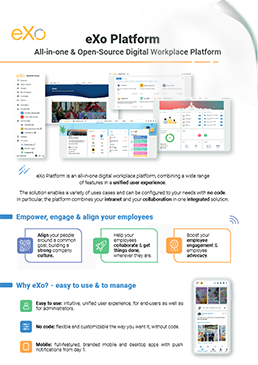

eXo Platform : The Open-Source
Digital Workplace Platform
Download the eXo Platform Datasheet and discover all the features and benefits

Download the eXo Platform Datasheet and discover all the features and benefits
You will find here Frequently Asked Questions about modern digital workplace with all the answers in one place.
A Modern Digital Workplace is a connected ecosystem of people, processes, and cloud-native tools that enable employees to work effectively from anywhere. It integrates communication, collaboration, knowledge sharing, automation, and security into a single, seamless experience — empowering teams to focus on meaningful outcomes rather than juggling multiple apps.
A digital workplace is a next generation of intranet solutions or intranet 2.0 that is based on three pillars: communication, collaboration and information. In a way this definition is true but it doesn’t cover the whole spectrum of the term.
Here are some definitions of digital workplace:
The Digital Workplace Experience (DWX) is the holistic sum of how people in an organization engage with its digital tools, platforms, and services throughout their journey—from onboarding, through learning, through day-to-day work, through collaboration, up to career growth. It’s not merely about having technology; it’s about how that technology is designed, how the systems connect, how people feel, how easy it is to get work done, and how the organization supports employees in that flow.
➝ See the full definition of digital workplace experience (DWX)
The Modern Digital Workplace (MDW) is no longer a “nice-to-have”—it has become a strategic imperative for organizations that want to thrive in today’s fast-evolving business landscape. Its impact goes far beyond technology: it directly influences employee experience, business outcomes, productivity, resilience, and cost efficiency.
👥Driving Employee Experience and Business Outcomes
🤖Productivity, Efficiency, and AI Integration
🤝Inclusion Across Hybrid and Frontline Teams
💰Agility, Resilience, and Cost Optimization
The Modern Digital Workplace is evolving rapidly. Today, it’s no longer just about basic collaboration or document sharing—it’s an intelligent, integrated, employee-centric ecosystem that connects people, processes, and technology. The following features distinguish a truly modern digital workplace from legacy intranet and collaboration stacks, reflecting the latest trends and vendor innovations.
💬Unified Communication and Collaboration
🧑💻Integrated Employee Experience Platforms (EXP)
⚡AI and Automation
🔍Intelligent Search and Knowledge Management
🧩Contextual Integrations and Composable Architecture
👀Data-Driven Employee Experience and Observability
🛡️Advanced Security and Zero Trust
📱Mobile-First and Hybrid Enablement
🛠️Hyperautomation, Low-Code, and No-Code Platforms
♻️ESG and Sustainability Support
🤏In short: A modern digital workplace integrates communication, collaboration, knowledge, AI, automation, and security into a seamless, employee-centric ecosystem. It enables smarter, faster, and more resilient work while empowering employees to focus on high-value outcomes rather than mundane tasks.
Organizations that implement a Modern Digital Workplace typically experience:
A digital workplace strategy is a deliberate plan that aligns people, processes, and technology so employees can do their best work anywhere. It’s not just a collection of apps — it’s a human-centered ecosystem that defines workflows, governance, culture, and employee experience.
Key points:
( Your e-mail address will not be published)

I am a Digital Marketing specialist specialized in SEO at eXo Platform. Passionate about new technologies and Digital Marketing. With 10 years' experience, I support companies in their digital communication strategies and implement the tools necessary for their success. My approach combines the use of different traffic acquisition levers and an optimization of the user experience to convert visitors into customers. After various digital experiences in communication agencies as well as in B2B company, I have a wide range of skills and I am able to manage the digital marketing strategy of small and medium-sized companies.