
Benefits of Internal Communications on Employee Engagement

If you are in internal communications, the concept of employee engagement should be very familiar to you. Since 70% of all business leaders believe employee engagement is critical to their organisation success (CLC), employee engagement is one of the top five areas of focus for most internal communication departments and is used widely to attach a solid business value to communications.
The same logic and principles apply when evaluating the financial effects of a collaborative intranet on employee engagement.
Employee-Engagement-and-Communication

Content

1. What is employee engagement?

Employee engagement is not easy to define or measure. In a nutshell, an employee is engaged if he or she goes the extra mile for his or her company. Staying an extra hour to finish a task, helping another department without seeing an immediate personal gain and wearing the company t-shirt on the weekend are all signs of engaged behavior. AON mentioned the three-S model: Say, Stay and Strive. An engaged employee says positive things about his or her company, stays there for a long time and strives to do his or her best at all times.

Many job satisfaction contributors can influence employee engagement, including a positive work environment, motivating management and visible career opportunities. However, if employee satisfaction appears to be a necessary prerequisite to engagement, an employee can be satisfied but not engaged.

2. How does employee engagement translate into financial benefits?

A number of studies have shown a correlation between employee engagement and financial performance indicators, such as revenue growth, operating margin and shareholder return.
  • Engaged employees stay with their companies, thus saving turnover costs (see our post on turnover) and bringing their experience to the table, an amount that is much less easy to quantify. Engaged employees are 87% less likely to leave the organisation than the disengaged (CLC).
 
  • Engaged employee take fewer sick days. A Gallup study (2003) consolidating data from 23,000 business units revealed that engaged employees take an average of 2.69 sick days a year vs. the 6.19 days that disengaged employees take. Engaged employees simply work more and better. Gallup also reported that business units with high engagement scores averaged 18% higher productivity and 12% higher profitability.
All the above factors directly influence your bottom line and operating margin—better performance means less costs. However, it also means higher revenues. For example, AON reported a positive correlation between employee engagement and financial performance. Organisations in the top quartile for engagement report growth 4% higher than the average, while organisations in the bottom quartile perform 1% poorer. Companies with high engagement levels report 23% better revenues than their counterparts

3. How can you calculate employee engagement benefits for your organisation?

Organisations that measure employee engagement or disengagement costs are rare.
While the costs and benefits of employee engagement are very real, the relative trend is more important than absolute values of engagement rate, for example. With this in mind, how can we calculate the benefits of an employee engagement initiative, such as introducing a collaborative intranet? Outside of the easy to get information about your total employee count and average employee cost, you need to make three assumptions.
Let us start with a benchmark estimation: a disengaged or passive employee costs you a minimum of 6% of his or her annual cost. That comes down to saying that a disengaged employee works 6% less than an average employee. Between sick days, slow work pace, etc., that estimate is on the low side.
If your business is in line with the average engagement rates in your region, chances are that your engagement rate can be sharply improved. In practice, our clients report very different improvement rates on engagement metrics, varying from as low as 5% to as high as 50% depending on a number of factors. These factors range from the initial engagement situation to overall internal communication performance and focus on employee engagement. We usually suggest making a 15% improvement assumption on the low side.

The last assumption we need to make is linked to the new intranet adoption rate every year. The example is based on our standard average.
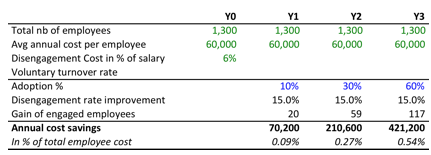
As you can see in the example below, you do not need to measure your precise engagement rate to estimate the financial benefits of boosting employee engagement. With our assumptions above, you would save 0.5% of your total employee costs by year three.
Financial benefits of employee engagement

4. How can you realize internal communication costs savings?

In addition to potentially boosting your employee engagement, a successful collaborative intranet also lowers the costs of your internal communications.

Think about the way in which you communicate top-down right now. If users shun your intranet, you probably rely heavily on email and physical supports for information flow. Try to list all the time and hard costs associated with this process. How many emails do you send per week/month/year? Assuming an interruption of at least one minute per email (time lost between reading the communication and coming back to the original task), how much does this cost your readers? What about the costs of paper, color printing, physical circulation, etc.? How would all this change if you acquired a strong reach platform through your collaborative intranet? How much would you save?

5. How can you measure employee engagement?

Let’s assume you introduced an employee engagement initiative, whether it’s a user-centered intranet or a communication campaign. How would you measure the improvement rate?
While annual engagement surveys would be the natural place to start, they tend to show an overly optimistic view of engagement. Therefore, other metrics can be used to complement the survey information, including work outside normal business hours, connexions and time spent with people outside the employee team, the number of cross-team collaboration initiatives, etc. That is where your collaboration platform can allow you to be creative and help you track some of those metrics.
FREE DATASHEET

eXo Platform  : The Open-Source

Digital Workplace Platform

Download the eXo Platform  Datasheet and discover all the features and benefits

book-datasheet-7
cta-rectangle-rose
FREE DATASHEET

Download the eXo Platform Datasheet and discover all the features and benefits

FAQs

You will find here Frequently Asked Questions about internal communication with all the answers in one place.

Internal communication (IC) is the process, strategy, and set of tools that organizations use to share information, align employees with business goals, and foster engagement and collaboration. It is much more than simply sending out company announcements or newsletters—it is a deliberate, strategic function that shapes how employees experience the organization every day.


Effective internal communication creates meaningful linkages: between leadership and teams, across departments, and between on-site and remote employees. It ensures that information doesn’t just travel—it lands, resonates, and prompts action.


In practice, internal communication involves:


  • Channels: Email, intranet, chat platforms, mobile apps.
  • Content: Strategic updates, culture stories, knowledge sharing, role-specific information.
  • Rituals: All-hands meetings, team check-ins, feedback loops.
  • Measurement: Engagement, clarity, alignment, and effectiveness of communication.


🤏In short, internal communication transforms information into understanding, alignment, engagement, and action.


Find out the full definition of internal communication

Effective internal communication is no longer optional—it is essential for organizational success. Studies consistently show that improving communication drives engagement, productivity, and business outcomes.


🕵Quick evidence

🕺The Modern Challenge


Find out Why Improving Internal Communication Matters

The way we communicate at work has evolved dramatically. In 2025, improving internal communication means combining strategic leadership, modern technology, and a human-centered culture. Below are 22 actionable and up-to-date strategies designed to help organizations strengthen engagement, boost productivity, and build trust across distributed teams.


  1. Build a Single Source of Truth (Central Intranet)
  2. Create a Digital-First, Human-Centric Communication Strategy
  3. Lead with Transparency and Authenticity
  4. Define and Share a Clear Purpose
  5. Establish Clear Communication Guidelines
  6. Foster Two-Way Dialogue
  7. Use Role- and Location-Based Targeting
  8. Keep Channels Organized and Purposeful
  9. Combine Real-Time Chat with Long-Term Knowledge Sharing
  10. Build Digital Communities and Recognition Spaces
  11. Measure Engagement with Meaningful Metrics
  12. Empower Managers as Communication Champions
  13. Optimize for Mobile and Frontline Workers
  14. Automate Routine Communications
  15. Enable Continuous Feedback Loops
  16. Localize and Personalize Messages
  17. Integrate Communication with Business Tools
  18. Leverage AI for Smarter Communication
  19. Use Storytelling and Multimedia to Engage
  20. Adopt a Clear Governance Model
  21. Balance Top-Down and Bottom-Up Communication
  22. Continuously Audit and Improve Communication Channels


Find out 22 Tips to Improve Internal Communication

In the modern workplace, Internal Communication (IC) goes far beyond simply sharing updates—it is the lifeline that connects employees, aligns teams, and drives organizational success.


Effective Internal Communication ensures that everyone understands the company’s goals, feels included in decision-making, and has the information they need to perform their roles confidently. Research consistently shows that organizations with strong internal communication enjoy higher employee satisfaction, better retention, and improved overall performance.


  1. Aligning Employees with Strategy
  2. Engaging a Diverse Workforce
  3. Saving Time and Reducing Confusion
  4. Supporting Culture and Values
  5. Breaking Down Silos and Encouraging Knowledge Sharing


Discover the advantages of internal communication

As workplaces continue to evolve at a rapid pace, internal communication (IC) has moved beyond simply sending messages—it has become a strategic pillar of organizational success. Building a strong Internal Communication strategy and using the right platform is no longer optional; it’s essential. Here’s why:


‍👨‍💻The Hybrid Work Imperative

🧲Employee Engagement and Retention

🔬Accelerating Innovation

🧠Knowledge Management and Operational Efficiency

👨‍👩‍👧‍👦Crisis and Change Management


Find out Why Internal Communications is important

Here are some Key differences between internal and external communications:

 
  • The audience
  • The goal
  • The frequency
  • The flow
  • The means
   

Find out the Key differences between internal and external communications

Selecting the right internal communications (IC) platform is a strategic decision. It’s about more than just picking a tool—it’s about enabling effective communication, engagement, and alignment across your organization.


Here’s a structured, step-by-step approach to guide your decision:


  1. Assess Your Current State
  2. Define Clear Goals
  3. Map Your Users
  4. Identify Must-Have Features
  5. Establish Budget and Total Cost of Ownership
  6. Create a Vendor Shortlist
  7. Test with a Proof of Concept (PoC)
  8. Plan for Adoption
  9. Define Governance and Metrics
  10. Go Live and Continuously Improve

Discover How to Choose the Right Internal Communications Platform

I am the Chief Executive Officer of eXo Platform (the open source digital workplace platform), a company that I co-founded while in college and that I came back to after several years in the banking and consulting industry. I blog about modern work, about open-source and sovereignty issues. Occasionally, I also blog about my personal areas of interest, such as personal development, work–life balance, sustainability and gender equality.
Related posts
  • All
  • eXo
  • Digital workplace
  • Employee engagement
  • Open source
  • Future of work
  • Internal communication
  • Collaboration
  • News
  • intranet
  • workplace
  • Knowledge management
  • Employee experience
  • Employee productivity
  • onboarding
  • Employee recognition
  • Change management
  • Cartoon
  • Digital transformation
  • Infographic
  • Remote work
  • Industry trends
  • Product News
  • Thought leadership
  • Tips & Tricks
  • Tutorial
  • Uncategorized
Leave a Reply

( Your e-mail address will not be published)

guest
1 Comment
Commentaires en ligne
Afficher tous les commentaires
Officekit hr
Officekit hr
16 March 2018 22 h 04 min

The best employee management software for your business

I am the Chief Executive Officer of eXo Platform (the open source digital workplace platform), a company that I co-founded while in college and that I came back to after several years in the banking and consulting industry. I blog about modern work, about open-source and sovereignty issues. Occasionally, I also blog about my personal areas of interest, such as personal development, work–life balance, sustainability and gender equality.