Discover our Employee Portal Solution for a Centralized access to Tools & information
- Brahim Jaouane
- May 14, 2025
Employee Productivity: Definition, Importance & Proven Ways to Improve It
Employee productivity is the bedrock of organizational success, directly translating effort into measurable results and driving a lasting competitive edge. In today’s dynamic and hybrid work environment, optimizing this output has become more critical—and more complex—than ever before.
For leaders, HR professionals, and digital workplace strategists, productivity is about far more than getting more work done in less time. It’s about empowering people to perform at their best, ensuring that every employee feels supported, engaged, and equipped to deliver meaningful contributions that move the organization forward.

Content
Yet, the path to productivity is increasingly challenging. The modern workplace is saturated with digital tools, notifications, and fragmented communication channels that often do more harm than good.
Employees are frequently forced to switch between dozens of applications, attend poorly structured meetings, and spend valuable hours searching for the right information. These issues are rarely due to a lack of motivation—instead, they stem from outdated systems, inefficient workflows, and poorly integrated technologies. Overcoming them requires more than managerial intervention; it demands a holistic strategy that combines cultural transformation with smart, integrated digital solutions.
This article provides a comprehensive look at employee productivity—what it truly means today, why it is vital to business success, and how organizations can strengthen it through the right tools and practices. It will explore key features of modern productivity-enhancing technologies, outline best practices for choosing the right platform, and share actionable tips for a seamless migration to a more efficient digital workplace.
Among the available options, comprehensive digital workplace platforms stand out as transformative solutions—and eXo Platform is a leading example. By uniting collaboration, communication, and workflow management into one cohesive environment, eXo Platform helps organizations eliminate friction, enhance engagement, and achieve measurable gains in productivity.
By the end of this article, you will gain a clear and actionable understanding of what drives employee productivity, the proven strategies to improve it, and the technologies that can empower your teams to reach their full potential in the modern workplace.
🧐What Is Employee Productivity?
Employee productivity refers to how efficiently and effectively an individual or a team converts their time, effort, and resources into meaningful outcomes that contribute to the organization’s overall goals. In simple terms, it measures the relationship between output (the work produced, goals achieved, or value delivered) and input (the time, energy, tools, and resources invested).
Traditionally, productivity was expressed through a straightforward formula:
Productivity = Output Input (Labor Hours and Resources)
While this classic employee productivity definition remains relevant in certain operational or manufacturing settings, it no longer captures the full picture of productivity in today’s knowledge-driven and hybrid workplaces.
In modern organizations, productivity goes beyond counting hours or output volume — it encompasses how effectively employees use their time, skills, and tools to produce valuable results that align with strategic objectives.
Modern employee productivity can therefore be defined as the effectiveness with which individuals or teams use available resources — including time, knowledge, digital tools, and collaboration — to create high-impact outcomes that support business goals.
This contemporary view blends both quantitative and qualitative dimensions. Quantitative measures might include completed projects, sales achieved, or tasks finalized, while qualitative factors focus on the quality of work, innovation, customer satisfaction, and the ability to collaborate effectively. True productivity, in this sense, balances doing more with doing better.
Importantly, employee productivity today is not just about speed or volume. It integrates several critical aspects that reflect the complexity of modern work:
- Efficiency, or completing tasks with minimal wasted time and effort.
- Effectiveness, meaning that employees focus on the right tasks — those that directly contribute to business value.
- Adaptability, the capacity to remain productive amid constant change, from digital transformation to hybrid and remote work arrangements.
- Well-being and engagement, since disengaged or burned-out employees inevitably produce less, regardless of skill or technology.
Academic research continues to affirm the connection between productivity and well-being. Studies, including those published in arXiv during the pandemic, have shown that employees who feel supported, equipped, and psychologically safe report significantly higher levels of productivity — proving that well-being is not a “nice-to-have,” but a direct driver of performance.
👉In essence: Employee productivity today represents the smart output of your workforce — not simply how busy employees are, but how effectively their time, energy, and creativity are directed toward outcomes that truly matter.
🧭 Why Is Employee Productivity Important?
Employee productivity isn’t just a performance metric — it’s the foundation of organizational growth, innovation, and long-term success. When employees work efficiently and purposefully, organizations can achieve more with the same resources, adapt faster to change, and maintain a competitive edge in an increasingly demanding business landscape.
At its core, productivity transforms individual effort into collective achievement. Every productive employee contributes to faster project completion, improved customer satisfaction, and higher profitability. But beyond these measurable outcomes, productivity nurtures a culture of purpose and engagement, where people feel that their work truly matters. In such environments, employees are more motivated, creative, and loyal — all essential ingredients for sustainable growth.
💼 The Strategic Importance of Productivity
In today’s global and hybrid workplaces, productivity has become more critical than ever. Distributed teams, digital tools, and shifting priorities can easily create inefficiencies if not managed properly. High productivity ensures that these complexities translate into agility rather than friction — enabling leaders to make smarter, data-driven decisions about processes, tools, and resource allocation.
From an organizational perspective, productive teams create a ripple effect across all business dimensions:
- Operational efficiency: Tasks are completed faster, with fewer errors, and less rework.
- Employee engagement: People feel accomplished and see tangible results from their efforts.
- Customer satisfaction: Efficient workflows lead to faster response times and better service quality.
- Innovation: Employees with time and mental space can think creatively and drive continuous improvement.
Ultimately, productivity isn’t about doing more work — it’s about doing better work with less friction. It means removing obstacles, reducing digital overload, and ensuring that employees have the right tools, clear goals, and supportive leadership.
📈 The Business Case for Employee Productivity
1. Increased Profitability and ROI
Productive employees deliver higher-quality output in less time, leading to lower operational costs and faster time-to-market. This directly boosts profitability.
According to PwC, highly productive companies can grow profits up to 50% faster than their less efficient counterparts. Similarly, OECD and McKinsey studies show that organizations with top-quartile productivity consistently outperform competitors by double-digit revenue margins.
Moreover, the global Productivity Management Software market is expected to reach $81.2 billion by 2025, and grow to $264.48 billion by 2034 (Source: Precedence Research, 2025) — highlighting the growing recognition of productivity as a key business driver.
2. Enhanced Competitive Advantage
In fast-moving markets, execution speed and efficiency are decisive. A productive organization can innovate faster, adapt quickly, and respond to opportunities before competitors do. Streamlined workflows and empowered teams enable organizations to turn strategy into action more effectively than those bogged down by bureaucracy or inefficiency.
3. Improved Employee Engagement and Retention
Contrary to popular belief, productivity and well-being go hand in hand. When employees have clear goals, efficient processes, and modern tools, they feel empowered and motivated. This reduces frustration, stress, and burnout.
According to Gallup, highly engaged teams show 21% greater profitability and significantly lower turnover. Productive environments build a sense of achievement and alignment with the organization’s mission — leading to long-term retention.
4. Greater Customer Satisfaction
Behind every great customer experience lies a productive workforce. When internal processes run smoothly, employees can dedicate more attention to customers — providing faster responses, resolving issues efficiently, and maintaining consistent service quality. The result: stronger customer loyalty and repeat business.
5. Cost-Efficiency and Smart Resource Use
High productivity enables businesses to do more without expanding their workforce or budgets. By identifying and eliminating redundant tasks, unnecessary meetings, or outdated processes, organizations achieve leaner operations and better ROI. Tools like Hubstaff and Teramind, for instance, provide visibility into work patterns, helping leaders spot inefficiencies and optimize team performance.
6. Adaptation to Hybrid and Digital Work Models
With remote and hybrid work becoming the norm, productivity measurement has evolved from tracking attendance to evaluating outcomes and impact. Digital collaboration platforms, project management tools, and knowledge-sharing systems have become essential for maintaining alignment and efficiency across distributed teams.
Organizations that invest in seamless digital workflows — like those powered by eXo Platform — can maintain visibility, foster collaboration, and drive consistent performance across locations and time zones.
7. Innovation and Knowledge Reuse
A productive workforce doesn’t just execute tasks; it learns, innovates, and improves. When knowledge is easily accessible and processes are streamlined, employees avoid reinventing the wheel and can focus on creating new value. Platforms that capture institutional knowledge and promote collaboration multiply this effect, turning productivity into a cycle of continuous improvement.
⚖️ Productivity as a Balance of Performance and Well-Being
Sustainable productivity is about balance. Overworking employees might bring short-term gains, but it leads to burnout and turnover in the long run. The real goal is empowered performance — where employees have autonomy, clarity, and the tools they need to thrive.
Forward-thinking organizations are shifting away from traditional micromanagement and time tracking. Instead, they focus on trust, empowerment, and digital enablement — creating workplaces where productivity is driven by purpose, not pressure.
🚀 In Summary
Employee productivity determines how effectively a company can turn potential into progress. When every individual operates at their best — equipped with the right tools, aligned with clear goals, and supported by a strong culture — the entire organization moves forward with speed, clarity, and resilience.
In this context, modern digital workplace platforms like eXo Platform play a pivotal role. They combine communication, collaboration, and knowledge management in one unified hub — helping organizations boost productivity, engagement, and innovation in an increasingly hybrid and digital world.
Discover our employee portal solution
for a Centralized access to
tools & information
for a Centralized access to
tools & information
🛠️ Key Features and Capabilities to Look For in a Employee Productivity Platform
Improving employee productivity goes beyond motivation or time management — it requires the right combination of people, processes, and technology. Modern organizations thrive when workflows are seamless, communication is unified, and employees have access to the tools and insights they need to focus on meaningful work.
A digital workplace platform can act as a productivity multiplier, consolidating communication, collaboration, knowledge management, and analytics into a single environment. When evaluating solutions, organizations should prioritize features that reduce friction, foster engagement, and enable data-driven decision-making. Below is a detailed breakdown of the key capabilities to look for.
1️⃣ Unified Communication and Collaboration
🌟Why it matters: Fragmented communication is one of the biggest productivity drains. Employees waste time switching between email, messaging apps, and meetings, losing focus and momentum. A unified platform centralizes all interactions — from instant messaging and video calls to activity feeds and project updates — in one place.
🧭Capabilities to prioritize:
- Real-time messaging (team & direct)
- Video conferencing integration
- Company-wide and team-specific activity streams
- @mentions and notifications hub
💥Impact: Streamlined communication reduces context switching, ensures everyone is aligned, and accelerates decision-making.
📘Example: eXo Platform provides integrated messaging, video, and activity feeds in a single workspace, keeping teams connected regardless of location.
2️⃣ Centralized Knowledge and Content Management
🌟Why it matters: Employees often spend hours searching for information across multiple systems. A centralized knowledge hub ensures that documents, FAQs, best practices, and project resources are easily accessible.
🧭Capabilities to prioritize:
- Centralized, structured wiki/intranet
- Powerful search across content, people, and apps
- AI-powered content recommendations
- Automated knowledge retention
💥Impact: Fast access to information saves time, prevents duplication of work, and preserves institutional knowledge.
📘Example: eXo Platform allows companies to build searchable knowledge bases and categorize information, making it easy to find and reuse content across teams.
3️⃣ Task and Project Management
🌟Why it matters: Productivity thrives on clarity and accountability. Teams need to see progress, track deadlines, and understand individual responsibilities.
🧭Capabilities to prioritize:
- Task assignment and progress tracking
- Project workspaces and milestones
- Automated reminders and notifications
💥Impact: Improved transparency, better collaboration across departments, and higher likelihood of meeting goals on time.
📘Example: eXo Platform offers robust task and project management features, enabling teams to stay organized and aligned with company objectives.
4️⃣ Employee Engagement and Well-Being Tools
🌟Why it matters: Engaged employees are more motivated, creative, and productive. Employee Productivity platforms should foster recognition, collaboration, and a sense of belonging.
🧭Capabilities to prioritize:
- Recognition systems (badges, kudos, leaderboards)
- Polls, surveys, and feedback loops
- Community spaces and social engagement
💥Impact: Engagement features create a culture of collaboration and appreciation, driving higher productivity and retention.
📘Example: eXo Platform integrates gamification and social features to celebrate achievements and encourage participation.
5️⃣ Personalization and Smart Insights
🌟Why it matters: Each employee works differently. Personalization and analytics help prioritize tasks, manage workload, and make informed decisions.
🧭Capabilities to prioritize:
- Personalized dashboards and notifications
- Analytics on engagement, performance, and collaboration patterns
- Insights for managers on bottlenecks and trends
💥Impact: Employees work smarter, not harder, while managers gain visibility into productivity and workflow efficiency.
📘Example: eXo Platform provides actionable insights and personalized workspaces that help employees focus on what matters most.
6️⃣ Process Automation and Workflow Management
🌟Why it matters: Routine tasks and repetitive approvals waste time. Automation frees employees to focus on higher-value work.
🧭Capabilities to prioritize:
- Low-code/no-code workflow automation
- Approval processes, expense claims, and routine requests
- Integration with core business apps (HR, CRM, ERP)
💥Impact: Reduces manual effort, increases accuracy, and speeds up business processes.
📘Example: eXo Platform allows organizations to automate internal processes like expense claims or room booking without heavy IT intervention.
7️⃣ Integration, Scalability, and Security
🌟Why it matters: Employee Productivity platforms must work seamlessly with existing enterprise systems and scale as the organization grows.
🧭Capabilities to prioritize:
- Open APIs for integration with Microsoft 365, Google Workspace, Salesforce, etc.
- Enterprise-grade security and permissions
- Support for hybrid/mobile work
💥Impact: Creates a connected, secure ecosystem while supporting organizational growth and flexibility.
📘Example: eXo Platform is built on open standards, allowing smooth integration and scalable adoption across teams and departments.
8️⃣ Mobile-First Experience
🌟Why it matters: With hybrid and remote work now standard, employees must remain productive regardless of location or device.
🧭Capabilities to prioritize:
- Fully-featured mobile apps
- Push notifications for updates and approvals
- Offline access and ergonomic design
💥Impact: Ensures continuity of work, faster communication, and better engagement for deskless or remote employees.
📘Example: eXo Platform 6.3 offers a redesigned mobile experience optimized for productivity on smartphones and tablets.
9️⃣ Recognition, Gamification, and Engagement
🌟Why it matters: Recognizing employee contributions reinforces positive behavior and motivates higher performance.
🧭Capabilities to prioritize:
- Badges, kudos, and reward systems
- Social recognition feeds
- Activity and performance leaderboards
💥Impact: Drives a culture of achievement and collaboration, turning productivity into a shared goal.
📘Example: eXo Platform integrates gamification to boost engagement and morale across teams.
✅ Summary
Modern employee productivity platforms must bring people, processes, and information together in a single, unified digital workplace. The ideal solution:
- Reduces digital friction and app switching
- Streamlines workflows and automates repetitive tasks
- Preserves institutional knowledge and promotes collaboration
- Provides analytics and insights for data-driven decision-making
- Supports hybrid and mobile work, ensuring everyone remains productive
Among these, eXo Platform stands out for its holistic approach, combining communication, collaboration, knowledge management, and engagement in one integrated environment. By doing so, it removes barriers, fosters employee engagement, and unlocks the full potential of the workforce — empowering teams to achieve better results with less friction.
| Feature Category | Key Capabilities | Description / Why It Matters | Trend / Impact (2025+) |
| Unified Communication & Collaboration | - Real-time messaging (team & direct) - Video conferencing integration - Company-wide and team-specific activity streams - @mentions & notifications hub | Centralizes discussions, reduces email overload, and eliminates the need to switch between Slack, Teams, or other apps. Enhances team alignment and decision-making. | Essential for hybrid teams, emphasizing multi-channel communication across desktop and mobile devices. High adoption for real-time collaboration. |
| Knowledge Management & Discovery | - Centralized knowledge hub / wiki - Powerful, AI-powered search & categorization - Intelligent content recommendations - Automated knowledge retention | Prevents knowledge silos, speeds up information retrieval, preserves institutional knowledge, and improves onboarding efficiency. | AI-driven search and categorization becoming standard; predictive suggestions increase employee efficiency. Critical for data-driven decision-making. |
| Process & Task Automation | - Low-code / no-code workflow automation - Custom workflows & approvals - Centralized task management - Integration with core apps (Google Workspace, Microsoft 365, Salesforce, ERP, HR systems) | Automates repetitive tasks (like IT tickets, leave requests) and creates a single, unified workspace for processes. Reduces context switching and operational delays. | Growth of citizen developers using low-code tools. Integration reduces SaaS sprawl and creates seamless digital experiences. |
| Content Collaboration | - Co-editing & version control - Secure document sharing - Advanced access controls | Enables simultaneous work on documents with robust versioning, maintaining compliance and governance while improving productivity. | Secure, compliant content management is critical; focus on remote and hybrid teamwork efficiency. |
| Social & Engagement Tools | - Employee profiles (skills & expertise) - Likes, comments, sharing - Recognition badges / gamification - Polls and surveys | Fosters a connected, motivated culture, especially in remote teams. Helps identify experts and boosts morale through recognition. | Social recognition and engagement gamification increasingly tied to retention and employee experience strategies. |
| Analytics & Insights | - Engagement analytics dashboards - Poll and survey analysis - Search trends & content consumption metrics | Provides actionable insights on team collaboration, content usage, and process bottlenecks. Helps leaders measure initiatives' impact and make data-driven decisions. | Shift toward AI-powered predictive analytics and sentiment analysis to anticipate issues and optimize productivity. |
| Mobile-First Experience | - Fully-featured native mobile apps - Push notifications for critical updates - Offline capabilities | Keeps deskless, hybrid, and remote employees connected and productive from anywhere. Supports real-time collaboration on-the-go. | Mobile adoption critical for frontline/field workers; offline capabilities ensure productivity even without connectivity. |
| Integration & Unification | - Open APIs & App Center - Seamless connection with CRM, ERP, HR systems | Reduces SaaS sprawl and creates a single interface for all business tools, minimizing disruption and maximizing efficiency. | Platforms that unify apps and workflows see higher employee engagement and adoption. |
🧭 How to Choose the Right Employee Productivity Solution
Selecting the right employee productivity platform is more than a technology decision — it’s a strategic choice that directly affects how your teams collaborate, innovate, and achieve business goals. With so many digital tools available today, organizations need a structured approach to ensure they invest in solutions that deliver measurable results.
1️⃣ Diagnose Your Productivity Pain Points
Start by understanding your organization’s unique challenges. Conduct surveys, interviews, or workflow audits to identify where productivity is being lost. Common pain points include:
- Fragmented communication across email, chat, and meetings
- Difficulty finding information or documents
- Inefficient task tracking or unclear project ownership
- Lack of employee engagement or recognition
- Bottlenecks in approval workflows or repetitive manual processes
Mapping these pain points forms the foundation for evaluating potential solutions.
2️⃣ Define Requirements, Goals & KPIs
Once pain points are clear, set measurable goals for your employee productivity platform:
- Reduce time spent searching for information by X%
- Decrease meeting hours or context switching
- Increase knowledge reuse or task completion rates
- Improve engagement scores or employee satisfaction
Also, create a prioritized list of features:
- Must-have: Non-negotiable capabilities critical to daily work
- Nice-to-have: Features that enhance productivity but aren’t essential
3️⃣ Map Features to Organizational Needs
Refer to the key capabilities of employee productivity platforms to ensure they align with your goals:
| Pain Point | Platform Capability to Look For |
| Difficulty finding information | Centralized knowledge hub, advanced search |
| Fragmented communication | Unified messaging, activity feeds, video calls |
| Lack of task clarity | Task and project management tools, progress tracking |
| Low engagement | Recognition, gamification, community spaces |
| Manual processes | Low-code/no-code workflow automation |
4️⃣ Evaluate Integration, Scalability & Architecture
A great emloyee productivity platform must fit seamlessly into your existing tech ecosystem:
- Integration with CRM, HRIS, ERP, and collaboration tools
- Scalability to support growth in users, teams, and global offices
- Deployment flexibility: SaaS, on-premises, or hybrid models
- Open standards and APIs for future customization
Choosing a platform that integrates well avoids creating new silos or friction.
5️⃣ Prioritize User Experience and Adoption
Even the most powerful platform is useless if employees don’t use it. Focus on:
- Intuitive interface and navigation
- Personalization options (dashboards, bookmarks, notifications)
- Mobile-first experience for hybrid or deskless teams
- Clear governance and guidance for adoption
High adoption drives ROI, reduces training time, and ensures long-term success.
6️⃣ Assess Security and Compliance
Productivity gains are meaningless if your platform compromises data security:
- Enterprise-grade access controls and encryption
- Compliance with GDPR, SOC 2, ISO 27001, or industry-specific standards
- Data sovereignty and clear ownership policies
7️⃣ Plan for Implementation, Change Management & Migration
A smooth rollout requires careful planning:
- Training & communication: Educate employees on benefits and usage
- Pilot groups: Test adoption and gather feedback
- Data migration: Move documents, knowledge bases, and social content without loss
- Governance: Define ownership of spaces, archive strategies, and workflows
8️⃣ Consider Total Cost of Ownership (TCO) & Long-Term Value
Look beyond the license fee to understand the full financial and operational impact:
- Implementation and customization costs
- Training and ongoing support
- Maintenance and updates
- Scalability for future growth
9️⃣ Measure Outcomes and Iterate
Productivity is not a one-off project. Continuously monitor KPIs, gather user feedback, and refine your approach to ensure the platform delivers ongoing value.

FREE WHITE PAPER
The Complete Guide to
Employee Engagement
Discover our in-depth analysis of the concept of employee engagement, its roots, and ways to improve it significantly



FREE WHITE PAPER
Discover our in-depth analysis of the concept of employee engagement, its roots, and ways to improve it significantly
🚀 A migration guide to an Employee productivity Platform
Migrating to a new employee productivity platform is more than a technical upgrade—it’s a strategic shift in how your organization collaborates, communicates, and manages work. Done well, migration ensures employees adopt the platform quickly, workflows are optimized, and productivity improvements are measurable from day one.
1️⃣ Assess Current Systems and Workflows
Before any migration, understand your existing environment:
- Which tools and platforms are employees currently using?
- How does information flow between teams?
- Where are bottlenecks, redundancies, or inefficiencies?
This audit helps you determine what to retain, consolidate, or redesign to maximize the benefits of the new platform. Cleaning up outdated documents, duplicate spaces, and unused apps before migration reduces clutter and confusion.
2️⃣ Define Goals and Metrics
Set clear, measurable objectives to track success:
- Reduce time spent searching for documents by 30%
- Cut unnecessary email volume by 20%
- Increase project completion rates or knowledge reuse
Identify which teams or business units will benefit most (HR, operations, remote workers) and use baseline metrics to measure improvement after migration.
3️⃣ Plan a Phased Migration
A phased rollout minimizes risk and ensures smoother adoption:
- Start with a pilot group or department to test workflows and gather feedback.
- Refine processes based on real-world use before company-wide deployment.
- Establish clear timelines, milestones, and responsibilities to keep the project on track.
4️⃣ Engage Employees Early
Employee engagement is critical for adoption:
- Communicate the benefits of the new platform clearly and repeatedly.
- Demonstrate how it simplifies work: reducing emails, streamlining document sharing, or centralizing collaboration.
- Offer hands-on workshops, live Q&A sessions, and role-based training tailored to different teams (e.g., “eXo for Sales” vs. “eXo for HR”).
- Identify power users or champions in each department to guide peers and advocate for the platform.
Gamification features like badges and points can reward early adoption and make the transition more engaging.
5️⃣ Migrate Data and Integrate Applications
Smooth migration requires careful handling of data and integrations:
- Clean, de-duplicate, and map content from legacy systems to the new platform. Prioritize the most-used documents and archive old or redundant content.
- Ensure seamless integration with existing business applications such as CRM, HRIS, ERP, and cloud storage.
- Leverage open APIs and built-in integration tools (like eXo Platform’s Application Center) to consolidate apps into a single digital workspace.
6️⃣ Optimize User Experience
A new platform should feel like a natural digital workplace, not just another tool:
- Define a clear taxonomy, navigation, branding, and governance.
- Ensure mobile and hybrid work capabilities are fully supported.
- Customize dashboards and workspaces for teams and roles to enhance productivity and adoption.
7️⃣ Monitor, Measure, and Iterate
Post-migration, track success and continuously improve:
- Use analytics to monitor adoption rates, content usage, and engagement patterns.
- Collect employee feedback to refine workflows and adjust platform configuration.
- Share wins internally—celebrate teams or individuals who effectively use the platform, fostering peer-to-peer recognition.
8️⃣ Foster a Culture of Continuous Improvement
Technology alone doesn’t drive productivity—culture matters:
- Provide leadership support and reinforce the platform’s value in achieving business goals.
- Recognize achievements and contributions using built-in engagement features.
- Encourage ongoing knowledge sharing, collaboration, and feedback loops to maintain momentum.
🔑 Why eXo Platform is the Best Solution for Employee Productivity
In the crowded market of digital workplace and employee productivity tools, eXo Platform stands out as a comprehensive, integrated solution that goes beyond basic collaboration or task management. It is designed to unlock real productivity gains, streamline workflows, and foster employee engagement across the organization.
1️⃣ A Fully Integrated Digital Workplace
Many organizations rely on multiple tools—Slack for messaging, Confluence for knowledge, Jira for tasks—creating fragmented workflows and wasted time. eXo Platform consolidates all core productivity functions in a single hub:
- Intranet & Knowledge Hub: Centralize company knowledge, FAQs, and project resources in searchable, AI-enhanced repositories.
- Collaboration Spaces: Team workspaces, discussion forums, and co-editing tools reduce context switching and keep everyone aligned.
- Applications Center: Access all business apps in one place, minimizing distractions and inefficiencies.
- Process Management: Digitize workflows such as approvals, expense claims, or room bookings with no-code/low-code tools.
This unified approach reduces cognitive load—research shows that it takes over 23 minutes to regain focus after a distraction—so employees can focus on meaningful work.
2️⃣ Superior Knowledge Management and Discovery
eXo Platform’s knowledge management goes beyond static wikis:
- Centralized & Intelligent: Indexes documents, discussions, tasks, and people in one searchable hub.
- AI-Powered Recommendations: Suggests relevant content, experts, and spaces based on user behavior.
- Preserves Institutional Knowledge: Keeps critical company knowledge accessible even when employees leave.
This ensures employees spend less time hunting for information and more time acting on it.
3️⃣ Designed for Employee Engagement and Connection
Productivity is closely linked to morale and engagement. eXo Platform integrates social and recognition features directly into daily workflows:
- Employee profiles, activity streams, and discussion forums foster collaboration.
- Kudos, badges, and gamification reward contributions and highlight achievements.
- Polls, surveys, and recognition tools help maintain engagement, especially for hybrid or remote teams.
These features not only boost motivation but also create a culture of transparency, belonging, and continuous learning.
4️⃣ Flexible, Extensible, and Open
Organizations often require customization and integration beyond what standard SaaS tools provide. eXo Platform is open source and highly extensible:
- Open APIs & Integrations: Works seamlessly with Google Workspace, Microsoft 365, HRIS, CRM, and other enterprise systems.
- Custom Workflows: No-code/low-code tools allow teams to automate processes without heavy IT involvement.
- On-Premise & SaaS Options: Suitable for enterprises with specific compliance, security, or scalability needs.
This flexibility ensures that eXo can adapt as the organization grows or changes.
5️⃣ Enterprise-Grade Security and Control
Security is crucial for employee productivity software handling sensitive business data:
- Granular permissions, SSO, and encryption protect information.
- Regulatory compliance support (GDPR, SOC 2, ISO 27001) provides peace of mind.
- Administrators maintain full control over content, workflows, and user access.
6️⃣ Proven Impact on Productivity
Unlike simple monitoring tools, eXo Platform enables productivity rather than just measuring it. Key differentiators include:
| Feature / Dimension | eXo Platform | Generic Monitoring/Tracking Tools |
| Scope of Tool | Unified digital workplace: collaboration, knowledge, apps center, recognition | Narrow: time tracking, monitoring, analytics |
| User Engagement | Strong focus on community, recognition, employee experience | Often utilitarian; less focus on engagement |
| Hybrid/Remote Support | Fully supported with mobile, bookmarks, unified search | Varies; limited collaboration depth |
| Open Source / Extensibility | Yes — customizable, integrates with existing systems | Often proprietary; limited flexibility |
| Productivity Enablement | Emphasizes workflows, automation, recognition | Mainly measures behavior; less workflow support |
| Adoption & Experience | Intuitive interface; gamification drives engagement | Can face adoption challenges; more managerial |
| Enterprise Readiness | Scalable, multilingual, on-premise or SaaS | Varies; may lack enterprise features |
7️⃣ Real-World Use Cases
eXo Platform supports productivity across multiple business scenarios:
- Modern Intranet: Strengthens internal culture and belonging.
- Collaboration Platform: Efficient project management and cross-functional teamwork.
- Social Employee Network: Engagement, recognition, and knowledge sharing.
- Knowledge Hub: Centralizes all critical information for easy access.
- Employee Portal: Unified access to tools and apps, reducing workflow friction.
8️⃣ Migration Made Easy
eXo Platform is also designed to simplify migration and adoption:
- Open APIs and integration tools consolidate existing applications.
- Intuitive UI and mobile-first design reduce training requirements.
- Analytics track adoption, engagement, and usage patterns.
- Gamification and recognition encourage sustained usage.
By combining strategic planning, phased rollout, robust integration, and continuous iteration, organizations can transform platform migration into a powerful lever for sustainable productivity and business growth.
🤏In short: eXo Platform is more than a tool—it’s a holistic productivity ecosystem that reduces friction, improves engagement, and unlocks employee potential, making it the top choice for organizations serious about boosting productivity in 2025 and beyond.
🏁 Conclusion
Employee productivity is the cornerstone of organizational success, but in today’s fast-paced, hybrid, and digitally driven workplace, it is far more than simply measuring hours worked or tasks completed. True productivity reflects how effectively employees convert their time, skills, and resources into meaningful outcomes that drive growth, innovation, and competitive advantage.
Achieving this requires a strategic combination of culture, processes, and technology. Organizations must foster clarity, purpose, and psychological safety while equipping teams with tools that remove friction, streamline workflows, and support engagement. Productivity is no longer about working harder—it’s about working smarter, with impact and focus.
Digital workplace platforms play a pivotal role in this transformation. By consolidating communication, collaboration, knowledge management, task tracking, and engagement into a single, unified environment, they enable employees to focus on high-value work and make decisions based on clear insights. Among these platforms, eXo Platform stands out as a best-in-class solution:
- Holistic Digital Workplace: Combines intranet, collaboration spaces, knowledge management, and productivity tools in one unified hub.
- Open and Extensible: Open-source architecture allows organizations to tailor the platform to their specific workflows, security requirements, and compliance needs.
- Enhanced Employee Engagement: Gamification, recognition, and community features motivate employees, encourage collaboration, and build a strong workplace culture.
- Seamless Integration: Open APIs and pre-built connectors enable smooth adoption, consolidating legacy tools and reducing friction.
- Analytics and Insights: Provides actionable metrics to track usage, measure impact, and continuously optimize productivity initiatives.
Investing in the right employee productivity platform is not just a technology decision—it is a strategic move that empowers employees, drives efficiency, and delivers measurable business results. When teams are supported by tools that simplify work, provide clarity, and foster engagement, productivity becomes sustainable, innovation thrives, and organizations are better prepared to adapt in a constantly evolving business landscape.
Ultimately, employee productivity is about doing better, not just doing more. By combining clear strategy, supportive culture, and a modern, integrated digital workplace like eXo Platform, organizations can transform potential into performance, enabling their workforce to deliver meaningful, high-impact results every day.
Would you like to explore a deeper dive into eXo Platform’s specific knowledge management features or a case study on its implementation?
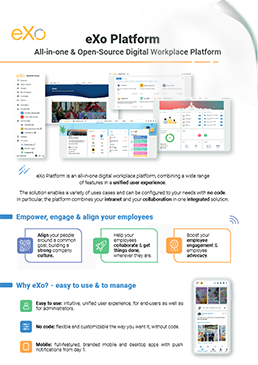

FREE DATASHEET
eXo Platform 7 : The Open-Source
Digital Workplace Platform
Download the eXo Platform 7 Datasheet and discover all the features and benefits

FREE DATASHEET
Download the eXo Platform Datasheet and discover all the features and benefits
FAQ
You will find here Frequently Asked Questions about employee productivity with all the answers in one place.
🧐What Is Employee Productivity?
Employee productivity refers to how efficiently and effectively an individual or a team converts their time, effort, and resources into meaningful outcomes that contribute to the organization’s overall goals. In simple terms, it measures the relationship between output (the work produced, goals achieved, or value delivered) and input (the time, energy, tools, and resources invested).
Traditionally, productivity was expressed through a straightforward formula:
Productivity = Output Input (Labor Hours and Resources)
Employee turnover refers to the number or percentage of employees who leave an organization (voluntarily or involuntarily) and are replaced by new hires. High turnover can impact productivity, morale, and costs.
🤷♂️Why Is Employee Productivity Important?
Employee productivity isn’t just a performance metric — it’s the foundation of organizational growth, innovation, and long-term success. When employees work efficiently and purposefully, organizations can achieve more with the same resources, adapt faster to change, and maintain a competitive edge in an increasingly demanding business landscape.
💼 The Strategic Importance of Productivity
📈 The Business Case for Employee Productivity
- Increased Profitability and ROI
- Enhanced Competitive Advantage
- Improved Employee Engagement and Retention
- Greater Customer Satisfaction
- Cost-Efficiency and Smart Resource Use
- Adaptation to Hybrid and Digital Work Models
- Innovation and Knowledge Reuse
⚖️ Productivity as a Balance of Performance and Well-Being
👉 How to Choose the Right Employee Productivity Solution
Selecting the right employee productivity platform is more than a technology decision — it’s a strategic choice that directly affects how your teams collaborate, innovate, and achieve business goals. With so many digital tools available today, organizations need a structured approach to ensure they invest in solutions that deliver measurable results.
1️⃣ Diagnose Your Productivity Pain Points
️2️⃣ Define Requirements, Goals & KPIs
3️⃣ Map Features to Organizational Needs
️4️⃣ Evaluate Integration, Scalability & Architecture
️5️⃣ Prioritize User Experience and Adoption
6️⃣ Assess Security and Compliance
7️⃣ Plan for Implementation, Change Management & Migration
8️⃣ Consider Total Cost of Ownership (TCO) & Long-Term Val
9️⃣ Measure Outcomes and Iterate
🔗 Find out How to Choose the Right Employee Productivity Solution.
🤝What is employee engagement?
Employee engagement is the emotional and intellectual commitment an employee has toward their job, their team, and their organization. It’s about how much an individual cares about the company’s success and how motivated they are to contribute to its goals. Engaged employees don’t just show up—they feel proud, passionate, and fully involved in their work.
This engagement can take many forms: feeling loyal and connected (emotional), being focused and eager to improve (cognitive), or showing high productivity and advocacy for the company (behavioral). Strong leadership, a positive culture, growth opportunities, and work-life balance are some of the key drivers that make it possible.
👌How to reduce employee turnover?
To reduce employee turnover, focus on creating a supportive and engaging work environment.
Here are 8 tips to reduce employee turnover:
- Foster a Positive Work Culture
- Recognize and Reward Employees
- Empower Employees
- Provide Growth Opportunities
- Encourage Work-Life Balance
- Enhance Leadership Skills
- Set Clear Expectations
- Offer Competitive Compensation
By implementing these strategies, organizations can boost job satisfaction, engagement, and long-term retention.
5/5 - (2 votes)

I am a Digital Marketing specialist specialized in SEO at eXo Platform.
Passionate about new technologies and Digital Marketing.
With 10 years' experience, I support companies in their digital communication strategies and implement the tools necessary for their success.
My approach combines the use of different traffic acquisition levers and an optimization of the user experience to convert visitors into customers.
After various digital experiences in communication agencies as well as in B2B company, I have a wide range of skills and I am able to manage the digital marketing strategy of small and medium-sized companies.
Related posts
- All
- eXo
- Digital workplace
- Employee engagement
- Open source
- Future of work
- Internal communication
- Collaboration
- News
- intranet
- workplace
- Knowledge management
- Employee experience
- Employee productivity
- onboarding
- Employee recognition
- Change management
- Cartoon
- Digital transformation
- Infographic
- Remote work
- Industry trends
- Product News
- Thought leadership
- Tips & Tricks
- Tutorial
- Uncategorized



Leave a Reply
( Your e-mail address will not be published)
Connexion
0 Comments
Commentaires en ligne
Afficher tous les commentaires