

FREE WHITE PAPER
Artificial intelligence has rapidly become part of everyday work. Employees experiment with AI tools, generate content, and explore new ways to be more productive.
Internal communication was once simple: a company-wide email, a team meeting, a memo pinned to a board. Today, it’s something else entirely, a dense web of messages, platforms, updates, and expectations that never quite stops moving.
Organizations now operate across time zones, roles, and hybrid environments, yet despite having more tools than ever, communication remains one of the most persistent weaknesses in business performance. Only a small fraction of employees feel truly informed, while the hidden cost of miscommunication continues to drain time, energy, and billions in productivity.
The instinctive response over the past decade has been to add more: more channels, more updates, more content. Another Slack thread. Another newsletter. Another meeting that could have been an email, or perhaps shouldn’t have existed at all. But instead of clarity, many organizations have created something closer to noise.
The modern knowledge worker isn’t lacking information; they’re overwhelmed by it. Hours are lost each week navigating fragmented conversations, duplicative updates, and unclear priorities.
By 2026, this problem has reached a turning point. The rise of generative AI has made content cre ation effortless, and that’s precisely the issue. When everyone can produce polished messages instantly, communication risks becoming diluted. Leaders broadcast more, employees tune out more, and organizations quietly slip into what some experts call an “attention crisis.” The challenge is no longer how to communicate, but how to communicate meaningfully, ensuring the right message reaches the right person at the right time.
This is where Artificial Intelligence begins to shift from a tool to an infrastructure.
AI is not just accelerating communication; it is redefining it. Instead of static, one-way broadcasts, communication becomes dynamic, adaptive, and context-aware. Messages can be personalized automatically, information can surface when it’s actually needed, and repetitive workflows can disappear into the background. In this new model, internal communication is no longer about volume, it’s about precision.
More importantly, AI introduces something that traditional systems have always struggled with: relevance at scale. It enables organizations to move beyond generic updates and toward targeted, role-specific communication that respects employees’ time and attention. In an era of digital fatigue, where most employees report feeling drained by constant notifications and meetings, this shift is not just beneficial, it’s necessary.
This article explores how organizations are making that shift. It goes beyond the hype to examine 10 practical ways AI is transforming internal communication today, from reducing noise and automating workflows to improving engagement and alignment. Along the way, it will highlight real-world applications, emerging patterns, and measurable outcomes that matter to both leaders and teams.
Because the future of internal communication isn’t about saying more, it’s about finally being understood.
Before exploring the how, it’s essential to understand the why. The case for AI in internal communication is not just about innovation, it’s about fixing a system that no longer works at scale.
Modern organizations face a growing internal communication gap driven by three core challenges: volume, relevance, and speed. Employees are overwhelmed with messages yet lack clarity on priorities. Leaders communicate more frequently, but their messages often fail to land. Critical information either arrives too late or gets lost in the noise.
Artificial Intelligence (AI) is transforming internal communication by addressing these challenges at their root, making communication smarter, faster, and more targeted.
One of the biggest barriers to effective internal communication is information overload. Employees juggle emails, chat platforms, intranet updates, and meetings, creating constant distraction and reduced productivity.
AI introduces intelligent content filtering, ensuring employees receive only what is relevant to their role, behavior, and context. Instead of mass communication, organizations can deliver targeted internal messaging that cuts through the noise.
This also solves the “search paradox”, where companies store massive amounts of knowledge, yet employees struggle to find what they need. AI-powered enterprise search connects data across silos, enabling fast, accurate information retrieval.
Speed is critical in modern workplaces. Delayed communication leads to confusion, misalignment, and missed opportunities.
AI-powered tools enhance real-time communication by automating message drafting, summarization, and responses. Organizations can reduce response times by up to 45%, improving both employee experience and operational efficiency.
Leaders can now respond to internal updates, crises, or milestones within minutes, ensuring communication is timely, clear, and actionable.
Traditional internal communication often relies on one-size-fits-all messaging, emails or announcements sent to everyone but relevant to few.
AI enables personalized communication at scale. Messages can be tailored based on employee role, location, behavior, and preferences. This ensures that each employee receives content that is meaningful and actionable.
The shift from generic broadcasts to context-aware communication significantly improves engagement, making employees more likely to read, understand, and act on messages.
Effective internal communication directly impacts employee engagement, productivity, and business performance. However, many organizations still rely on outdated metrics like open rates or infrequent surveys.
AI fills this “listening gap” through real-time sentiment analysis across emails, chats, and collaboration tools. This provides continuous insights into employee feedback, enabling organizations to respond proactively.
With AI, internal communication becomes data-driven and measurable, linking communication efforts to key outcomes such as employee retention, engagement, and organizational alignment.
Internal communication teams and HR departments spend a significant amount of time on repetitive tasks, answering FAQs, translating messages, and managing routine updates.
AI reduces this burden through workflow automation. It can handle repetitive communication tasks, provide instant multilingual translation, and assist in content creation.
This allows teams to shift their focus from administrative work to strategic communication initiatives, improving overall efficiency and impact.
👉In summary, AI in internal communication is not just an upgrade, it’s a fundamental shift. By reducing noise, increasing relevance, and enabling real-time insights, AI helps organizations close the gap between what is communicated and what is actually understood.
The next step is turning these capabilities into action, exploring the practical ways AI can transform communication across your organization.
AI-Augmented Digital Workplace
Artificial intelligence has rapidly become part of everyday work. Employees experiment with AI tools, generate content, and explore new ways to be more productive.
Artificial intelligence has rapidly become part of everyday work. Employees experiment with AI tools, generate content, and explore new ways to be more productive.
If AI once felt like an experimental add-on, that phase is over. In 2026, internal communication (IC) teams are among the most AI-augmented functions in the organization, not because they adopted more tools, but because AI is now embedded directly into how communication happens.
The role of IC teams is also evolving. They are no longer just message distributors; they are becoming strategic experience designers, responsible for shaping how employees receive, understand, and interact with information. AI is what makes this shift possible, turning communication into a system that is adaptive, intelligent, and scalable.
Here’s how leading organizations are putting AI into practice today.
One of the most immediate wins for organizations is the use of AI-powered chatbots and virtual assistants. These tools handle repetitive queries, HR policies, onboarding steps, benefits information, instantly and at scale. However, organizations should also evaluate the pros and cons of AI chatbots to ensure they balance automation with human support for more complex or sensitive employee interactions.
Instead of waiting for responses, employees get real-time answers, improving both efficiency and satisfaction. For HR and IC teams, this removes a significant operational burden and frees up time for more strategic work.
Creating internal content used to be time-consuming: drafting emails, newsletters, announcements, and updates across multiple platforms.
AI now enables instant content generation and editing, producing high-quality drafts in seconds. But it goes further, advanced systems can adjust tone, simplify complex information, and tailor messaging for different audiences.
More recently, teams are moving beyond simple prompts to AI agents, which can analyze context (like employee sentiment or business priorities) before generating communication, making outputs more relevant and aligned.
Traditional employee feedback methods, like quarterly surveys, are too slow for today’s pace of work.
AI changes this through real-time sentiment analysis, scanning communication channels such as emails, chats, and surveys to detect patterns in employee mood and engagement. This helps organizations identify issues early, from confusion around strategy to drops in morale.
Studies using natural language processing (NLP) show that AI can analyze thousands of feedback inputs simultaneously, turning raw data into actionable insights that improve decision-making and engagement.
Even the best message fails if it reaches the wrong audience, or arrives at the wrong time.
AI optimizes content distribution by selecting the most effective channels (email, Slack, intranet) and timing based on user behavior. This ensures that communication is not just sent, but actually seen and acted upon.
The result is a shift from mass broadcasting to precision delivery, significantly improving communication effectiveness.
For global organizations, language has always been a barrier to effective communication. Translating content manually is slow, expensive, and often inconsistent.
AI enables instant, high-quality translation and localization, allowing organizations to communicate seamlessly across regions. Beyond text, AI can now dub videos, adapt tone culturally, and ensure accessibility for diverse audiences.
What once required multiple workflows can now happen in seconds, making communication truly global.
Organizations generate enormous amounts of internal knowledge, but much of it remains underutilized because it’s hard to find.
AI-powered knowledge management systems solve this by enabling natural language search across platforms. Employees can ask a question and instantly surface the most relevant documents, policies, or past discussions.
This transforms knowledge from a static repository into a living, accessible resource.
A single piece of content, like a 45-minute town hall, can now be transformed into multiple formats automatically.
AI can generate a 2-minute video recap, a concise Slack summary, and a detailed FAQ, all from the same source. This approach ensures that employees can consume information in the format that suits them best.
It also dramatically increases the reach and impact of internal communication without increasing workload.
AI is enabling personalized intranet experiences, where each employee sees content tailored to their role, location, and interests.
A frontline worker might receive operational updates, while a corporate manager sees strategic insights. This level of personalization increases relevance and engagement, turning internal platforms into valuable daily tools rather than passive information hubs.
One of the most forward-looking applications is the rise of AI-powered executive communication.
Some organizations are experimenting with “digital twins” of leaders, AI systems trained to answer employee questions, share updates, and maintain a consistent leadership voice. For example, companies like Meta have explored AI-driven executive communication models to scale leadership presence.
While still evolving, this approach highlights how AI can standardize messaging while making leadership more accessible.
Perhaps the biggest shift is conceptual. AI is no longer just an assistant waiting for prompts, it is becoming an autonomous agent within communication workflows.
These systems can monitor engagement, detect gaps, recommend actions, and even generate content proactively. They help IC teams balance organizational priorities with employee needs, without manual intervention at every step.
✍In practice, these use cases show that AI in internal communication is not a single solution, but an ecosystem of capabilities. Together, they transform how information flows, making it faster, more relevant, and more human-centered.
📋The result is a communication function that doesn’t just inform employees, but actively supports alignment, engagement, and performance across the organization.
Internal communication is no longer just about sending messages, it’s about making sure those messages are understood, acted on, and relevant in real time. As organizations grow more distributed and digitally connected, traditional communication methods struggle to keep up with the volume, speed, and complexity of information flow.
This is where Artificial Intelligence (AI) is fundamentally reshaping internal communication. Instead of replacing communication teams, AI acts as a powerful layer that improves clarity, personalization, and responsiveness across the entire organization.
Here are 10 practical ways AI is improving internal communication in modern workplaces.
A large portion of internal communication is repetitive, HR FAQs, policy questions, onboarding instructions, and status updates.
AI chatbots and virtual assistants now handle these tasks instantly, answering employee questions in real time and reducing pressure on HR and communication teams. This allows teams to focus on strategic messaging instead of repetitive requests.
The result is a smoother, faster employee experience with fewer communication bottlenecks.
One-size-fits-all communication is no longer effective in diverse, hybrid workplaces.
AI enables hyper-personalized messaging based on role, location, behavior, and engagement history. A frontline employee, a manager, and an executive can receive the same core update, but tailored to their specific needs.
This increases relevance, improves engagement, and ensures employees actually pay attention to what matters most to them.
Traditional surveys are too slow to reflect what employees are actually feeling.
AI changes this by analyzing feedback across emails, chat platforms, and surveys to detect real-time sentiment trends. If frustration rises in a team or engagement drops in a department, leaders can respond immediately.
This creates a continuous feedback loop instead of waiting for quarterly insights.
Meetings and discussions generate valuable information, but much of it gets lost or repeated.
AI helps by summarizing meetings, extracting action items, and even suggesting responses during conversations. Employees who miss meetings can instantly catch up through concise AI-generated summaries.
This reduces “follow-up fatigue” and keeps collaboration focused and efficient.
Employees often struggle with overwhelming inboxes and constant notifications.
AI helps by filtering, prioritizing, and categorizing messages, ensuring that critical communication is never missed while low-priority updates are grouped or summarized.
This reduces cognitive overload and helps employees focus on what actually matters.
Creating internal communication content, emails, newsletters, announcements, can be time-consuming.
AI speeds up this process by generating first drafts in seconds, improving tone, and adapting messages for different audiences and channels. Communication teams can move from drafting to refining, significantly increasing productivity.
The focus shifts from writing everything manually to editing and shaping strategic narratives.
Global organizations face constant language and cultural barriers in communication.
AI solves this by providing instant translation, localization, and even multilingual video dubbing. This ensures that every employee, regardless of location, receives the same message in a format they understand.
Communication becomes truly global, inclusive, and consistent.
Internal communication is no longer just about sending messages, it’s about understanding impact.
AI analyzes communication patterns, engagement levels, and sentiment data to help leaders understand what is working and what isn’t. This turns communication into a measurable business function rather than a guesswork-driven activity.
Leaders can now make decisions based on real employee behavior and feedback data.
The first 90 days of an employee’s journey are critical, but often overwhelming.
AI-powered onboarding systems guide new hires step-by-step, delivering the right information at the right time. From login support on day one to culture insights and training on day 30, AI ensures a structured and personalized onboarding experience.
This reduces confusion and improves early engagement and retention.
The most advanced use of AI in internal communication is adaptability.
AI systems continuously learn from employee behavior, what gets read, ignored, or engaged with, and adjust communication strategies accordingly. Over time, messages become more precise, timing improves, and delivery channels become more effective.
This creates a self-optimizing communication ecosystem that evolves with the organization.
AI is not just improving internal communication, it is redefining it. By automating routine tasks, personalizing messages, and turning communication into a data-driven system, organizations can finally move from information overload to clarity, relevance, and alignment at scale.
The future of internal communication is not more messages, it’s smarter ones.
Internal communication is no longer just about sending messages, it’s about creating better conversations across the entire organization. In 2026, HR and communication leaders are no longer only managing channels; they are designing communication ecosystems powered by AI.
But the real shift is deeper than automation. The best AI tools are not replacing human communication, they are improving it, making it more contextual, more responsive, and ultimately more empathetic.
AI tools today fall into four major categories that reshape how organizations communicate internally:
Chatbots embedded in Slack, Microsoft Teams, or internal portals now handle HR FAQs, policy questions, and onboarding support instantly. Instead of waiting for human responses, employees get immediate answers, reducing friction and improving trust.
Modern platforms combine communication, feedback, and analytics into a single ecosystem. Tools like AI-enhanced HR suites don’t just deliver messages, they track how employees respond and adjust communication strategies accordingly.
These tools refine internal messaging by improving tone, clarity, and readability. A CEO update can be automatically adjusted to sound more human, less corporate, and more aligned with company culture.
AI-powered analytics scan engagement patterns, sentiment signals, and communication gaps. Instead of relying on quarterly surveys, leaders get continuous insight into employee sentiment and communication effectiveness.
However, there’s a critical point: poorly implemented AI doesn’t reduce confusion, it amplifies it. The success of these tools depends on alignment with company culture, governance, and clarity of purpose.
AI is fundamentally reshaping how communication flows inside organizations. Traditional workflows were linear and slow:
Draft → Review → Send → Wait for feedback
With AI, communication becomes a continuous optimization loop:
Generate → Personalize → Distribute → Analyze → Improve
This shift creates three major advantages:
But the real transformation happens when AI is used for team-wide coordination, not just individual productivity.
A powerful example comes from global organizations like Mercer International, which operates across multiple languages and regions.
With AI-powered tools in Google Workspace and Gemini, Mercer was able to:
What once required complex multilingual coordination is now handled in real time, turning communication into a scalable operational advantage.
One of the most urgent challenges in modern workplaces is information overload. Employees are not struggling to access information, they are struggling to filter it.
AI solves this by shifting from content creation to smart reduction of noise:
AI prioritizes messages based on urgency, relevance, and role-specific needs.
Long reports, meetings, and threads are condensed into clear, actionable insights.
Employees receive updates at optimal times, reducing distraction and burnout.
Information is delivered based on what employees actually need in their current workflow.
The result is a major shift: organizations don’t communicate more, they communicate better and more intentionally.
Some organizations are experimenting with advanced AI-driven communication systems to reduce overload at the executive level.
Instead of lengthy all-hands meetings, AI systems can deliver personalized summaries or direct answers based on approved company knowledge, reducing the need for repeated explanations and meetings.
Companies like Dropbox have also adopted AI systems that reduce “collaborative chaos” by summarizing threads, highlighting decisions, and resurfacing relevant context instantly.
This leads to fewer meetings, less repetition, and more focus on meaningful work.
The impact of AI in internal communication is no longer theoretical, it is measurable.
Organizations using AI knowledge assistants have reported up to 30% reduction in repetitive HR and support calls. Employees get instant answers, while HR teams focus on higher-value tasks.
In some organizations, AI tools have become so effective that employees actively rely on them for daily work support, saving hours of time and increasing satisfaction in ways traditional systems never achieved.
AI also compresses decision-making cycles. Leaders can move from idea to execution in hours instead of weeks because communication, summaries, and insights are instantly available.
The return on investment from AI is strongest when it goes beyond automation and improves organizational alignment.
Key ROI drivers include:
Research shows that organizations achieving the highest ROI are those that treat AI not as a tool, but as a communication strategy shift.
AI is redefining internal communication from a broadcast system into a living, adaptive conversation layer inside organizations.
The goal is no longer to send more messages, it is to ensure that every message:
When done well, AI doesn’t just improve communication. It creates organizations where people finally feel informed, aligned, and understood at scale.
AI is not simply another productivity tool for faster messaging, it represents a system-level transformation of internal communication. It is reshaping how organizations share information, align teams, and create meaningful employee engagement at scale.
But the real story is not about technology replacing people. It is about technology reducing noise so people can finally focus on what matters.
In many organizations today, communication has become overloaded, constant updates, endless notifications, and low-value “AI-generated content” that adds volume but not clarity. The risk is not just inefficiency; it is attention fragmentation. Employees are no longer struggling with lack of information, they are struggling with too much of the wrong information.
AI offers a way forward, but only if it is used with intention.
The companies seeing real impact from AI in internal communication are not simply adopting more tools, they are changing how communication itself is designed.
They consistently:
Instead of treating AI as a separate tool, they embed it into communication systems, HR platforms, messaging tools, and knowledge bases, so it becomes part of how work actually happens.
AI is used to reduce noise, not increase output. Messages are filtered, summarized, and personalized so employees receive what truly matters to them.
Even the best AI systems are guided by human judgment. Leaders ensure tone, ethics, and cultural alignment remain intact, preventing communication from becoming purely algorithmic. Many organizations also incorporate an AI detector into their editorial workflow to review AI-assisted content before it reaches employees, reinforcing trust and accountability.
The future of internal communication is not about replacing humans with machines. It is about using intelligence, both human and artificial, to protect attention and improve understanding.
As experts from organizations like Lattice emphasize, AI should ultimately help leaders do what only humans can do best: build culture, trust, and connection at scale.
When used well, AI doesn’t make communication more robotic, it makes it more human by removing unnecessary noise.
Instead of sending more messages, organizations can finally focus on creating better conversations, stronger alignment, and more meaningful employee experiences.
The shift is already happening. The tools exist. The workflows are evolving. The ROI is becoming measurable.
So the question is no longer whether AI can improve internal communication, it clearly can.
The real question is:
Are organizations ready to stop using AI just to write more messages and start using it to understand people better, reduce overload, and improve how work actually feels every day?
Because the future of internal communication is not about more output.
It is about better understanding, at scale, with less noise and more humanity.
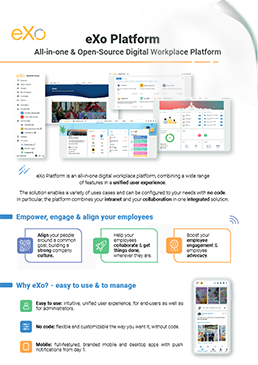

Download the eXo Platform Datasheet and discover all the features and benefits
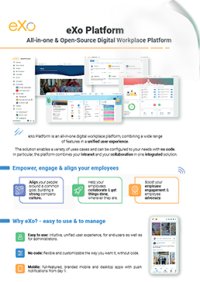

Download the eXo Platform Datasheet and discover all the features and benefits
Internal communication (IC) is the process, strategy, and set of tools that organizations use to share information, align employees with business goals, and foster engagement and collaboration. It is much more than simply sending out company announcements or newsletters—it is a deliberate, strategic function that shapes how employees experience the organization every day.
Effective internal communication creates meaningful linkages: between leadership and teams, across departments, and between on-site and remote employees. It ensures that information doesn’t just travel—it lands, resonates, and prompts action.
In practice, internal communication involves:
🤏In short, internal communication transforms information into understanding, alignment, engagement, and action.
Effective internal communication is no longer optional—it is essential for organizational success. Studies consistently show that improving communication drives engagement, productivity, and business outcomes.
🕵Quick evidence
🕺The Modern Challenge
The way we communicate at work has evolved dramatically. In 2025, improving internal communication means combining strategic leadership, modern technology, and a human-centered culture. Below are 22 actionable and up-to-date strategies designed to help organizations strengthen engagement, boost productivity, and build trust across distributed teams.
In the modern workplace, Internal Communication (IC) goes far beyond simply sharing updates—it is the lifeline that connects employees, aligns teams, and drives organizational success.
Effective Internal Communication ensures that everyone understands the company’s goals, feels included in decision-making, and has the information they need to perform their roles confidently. Research consistently shows that organizations with strong internal communication enjoy higher employee satisfaction, better retention, and improved overall performance.
As workplaces continue to evolve at a rapid pace, internal communication (IC) has moved beyond simply sending messages—it has become a strategic pillar of organizational success. Building a strong Internal Communication strategy and using the right platform is no longer optional; it’s essential. Here’s why:
👨💻The Hybrid Work Imperative
🧲Employee Engagement and Retention
🔬Accelerating Innovation
🧠Knowledge Management and Operational Efficiency
👨👩👧👦Crisis and Change Management
Here are some Key differences between internal and external communications:
➝ Find out the Key differences between internal and external communications
Selecting the right internal communications (IC) platform is a strategic decision. It’s about more than just picking a tool—it’s about enabling effective communication, engagement, and alignment across your organization.
Here’s a structured, step-by-step approach to guide your decision:
➝ Discover How to Choose the Right Internal Communications Platform
( Your e-mail address will not be published)

I am a Digital Marketing specialist specialized in SEO at eXo Platform. Passionate about new technologies and Digital Marketing. With 10 years' experience, I support companies in their digital communication strategies and implement the tools necessary for their success. My approach combines the use of different traffic acquisition levers and an optimization of the user experience to convert visitors into customers. After various digital experiences in communication agencies as well as in B2B company, I have a wide range of skills and I am able to manage the digital marketing strategy of small and medium-sized companies.