Discover the new generation
company intranet
company intranet
Poor internal communication is one of the most expensive, yet often overlooked, challenges in organizations today. According to McKinsey and Gallup, companies with strong communication practices see up to 25% higher productivity, lower turnover, and stronger employee engagement. Yet many organizations still struggle with fragmented information, siloed teams, outdated tools, and unclear communication strategies.
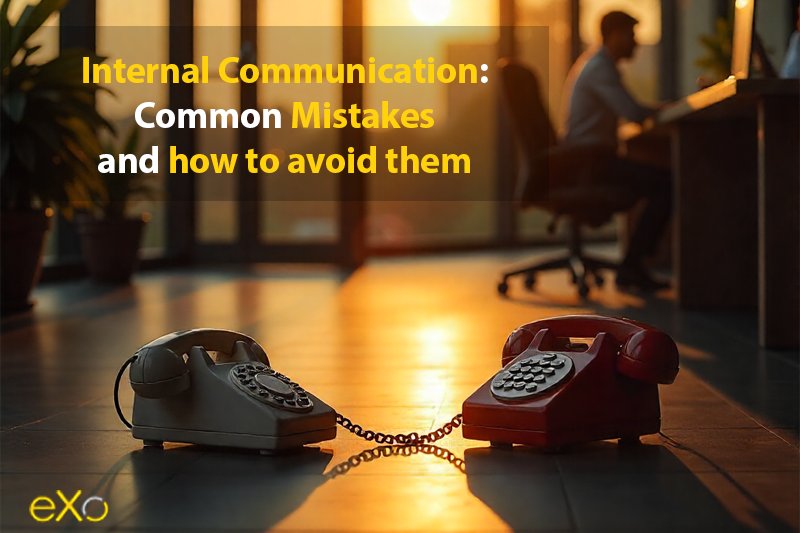
Today’s workplace is more complex than ever. Hybrid work models, continuous digital transformation, and the overwhelming flow of information across distributed teams have reshaped how employees connect and collaborate.
In this environment, poor communication is no longer a simple inconvenience. It has become a full-scale strategic risk. McKinsey estimates that communication inefficiencies cost companies as much as $15,000 per employee every year in lost productivity—losses that stem from delayed decisions, inconsistent messaging, avoidable mistakes, and steadily declining engagement.
Internal communication is essentially the backbone of organizational performance. When communication flows well, teams remain aligned, motivated, and able to execute with clarity. But when communication breaks down, the consequences spread quickly across the entire organization. Productivity stalls, confusion grows, morale weakens, and long-term performance suffers. Research from Towers Watson confirms that organizations that excel at internal communication are more than three times as likely to outperform those that don’t.
This article explores the full scope of poor internal communication: what it is, how it emerges, and why it remains one of the most persistent issues in modern workplaces. It examines the most common internal communication mistakes companies make and the subtle signals that reveal deeper communication problems. You will also discover the organizational, cultural, and financial consequences of these ongoing breakdowns.
Most importantly, this guide provides practical, actionable solutions to fix poor internal communication and build a stronger, clearer, and more connected workplace. By understanding how communication fails—and how to correct those failures—you can move from reactive problem-solving to a strategic, long-term approach that enhances transparency, alignment, and teamwork.
Whether you are a communication manager, HR leader, team supervisor, or executive, this guide will help you identify the 26 most common internal communication mistakes and learn how to avoid them, setting the foundation for a more efficient, engaged, and high-performing organization.

Poor internal communication is far more than the occasional misunderstanding or missed email—it is a systemic breakdown in how information flows within an organization. At its core, it occurs when employees do not receive the right information at the right time, when messages are unclear or inconsistent, or when communication channels create barriers instead of enabling dialogue. This breakdown affects not only operational efficiency but also employee engagement, trust, and overall organizational performance.
When internal communication is poor, employees often struggle to find the information they need, miss critical updates, or receive conflicting instructions. Teams may work in silos, unaware of what other departments are doing, while leadership may appear distant or unresponsive. In such environments, organizational silence can become the default, with employees hesitant to share ideas, raise concerns, or provide feedback.
The consequences extend beyond frustration and inefficiency. According to Gallup (2024), poor communication is the leading contributor to workplace stress, affecting more than 70% of employees across industries. Employees who feel disconnected or uninformed are more likely to disengage, make mistakes, and lose confidence in leadership. Over time, this erodes alignment, slows decision-making, and reduces the organization’s ability to respond effectively to challenges.
Ultimately, poor internal communication is the gap between the organization’s intentions and its employees’ understanding. It undermines collaboration, hinders productivity, and prevents teams from working toward shared goals. Recognizing and addressing these breakdowns is the first step toward building a connected, informed, and high-performing workplace.

Identifying poor internal communication early is essential for any organization aiming to maintain efficiency, engagement, and alignment. Communication issues rarely appear overnight—they develop gradually, often unnoticed, until their effects become disruptive. Recognizing the warning signs allows leaders to address the root causes before they escalate into serious operational or cultural problems.
Poor internal communication manifests in both quantitative and qualitative ways. On the quantitative side, organizations may notice increased email volume paired with lower response rates, or project delays caused by employees waiting for critical information. Surveys and engagement metrics often reveal low scores on communication-related questions, sometimes below 65%, while specific departments may experience higher turnover, particularly among support staff and middle management. These measurable indicators signal that the flow of information is inconsistent, slow, or ineffective.
Poor internal communication often leaves measurable traces in organizational data. Common quantitative signs include:
Equally important are the qualitative signs of poor internal communication. These observable behaviors often reveal deeper systemic issues:
Ultimately, poor internal communication is not just an abstract problem—it shows up in missed deadlines, duplicated work, disengaged teams, and constant misunderstandings. By identifying both quantitative and qualitative indicators, organizations can pinpoint where communication is failing and take proactive steps to create a more aligned, informed, and high-performing workplace.
| Type | Indicator | Impact / Observation |
| 🧮Quantitative | High email volume with low response rates | Critical information is missed or delayed |
| Project delays exceeding 30% of timelines | Slow decision-making and inefficiency | |
| Low engagement survey scores (<65%) | Employees feel uninformed and disconnected | |
| High employee turnover | Frustration leads to attrition | |
| 💎Qualitative | Siloed teams | Departments rarely collaborate or share knowledge |
| Frequent misunderstandings or “surprises” | Employees are confused or unprepared for changes | |
| Repeated basic questions | Policies and processes are unclear | |
| Rumor mills or informal channels | Unofficial information spreads faster than official updates | |
| Meeting overload / “cc culture” | Information overload reduces productivity and clarity |
By combining these quantitative and qualitative indicators, organizations gain a complete picture of where communication is breaking down. Recognizing these patterns early is the first step toward addressing poor internal communication and building a workplace that is more connected, transparent, and high-performing.

Poor internal communication is rarely a single misstep; it is a combination of systemic flaws that undermine efficiency, alignment, and employee engagement. Understanding these characteristics is key to identifying where communication breaks down and why it hampers organizational performance.
One of the most obvious traits is asymmetrical or one-way communication. Information often flows from leadership downward without opportunities for feedback, dialogue, or peer-to-peer exchange. Frontline employees may learn about strategic decisions months after they are made, leaving them feeling disconnected and excluded from the decision-making process. This top-down approach also contributes to a feedback vacuum, where employees have little or no structured mechanism to ask questions, provide input, or share insights.
Another hallmark is disorganized communication channels. Important messages may arrive through multiple platforms—email, chat apps, SMS, or internal portals—with no clear protocol for which channel to use. This channel confusion results in missed updates, duplicated messages, and frustration as employees struggle to track critical information. Coupled with temporal disconnect, where information arrives too late to be actionable or too early to be remembered, the organization experiences inefficiencies and repeated mistakes.
Poor internal communication is also characterized by lack of transparency and clarity. Messages are often stripped of context, forcing employees to reconstruct meaning through follow-ups or guesswork. Instructions may be overly complex, inconsistent, or unclear, creating operational errors and wasted effort. In some cases, communication is reactive rather than proactive, surfacing only during crises or major announcements rather than through a continuous, strategic approach to keep employees informed and aligned.
Other common indicators include irregular updates, where critical information has no predictable schedule or standardized format, and outdated tools, such as relying primarily on email for complex or sensitive communication. When combined with little or no measurement of effectiveness, such as missing KPIs or feedback loops, these flaws create fragmented, siloed information that prevents teams from working collaboratively and efficiently.
👉In essence, poor internal communication is a systemic problem where information flow is inconsistent, uncoordinated, and insufficiently engaging. Recognizing these characteristics helps organizations identify weaknesses early, take corrective action, and move toward a more transparent, responsive, and high-performing communication culture.

Traditional communication tools such as emails, basic chat applications, meetings, and outdated intranets are no longer sufficient for today’s fast-paced, hybrid workplaces. Relying solely on these methods often creates more problems than it solves: emails generate information silos and overload, chat apps constantly interrupt workflow without maintaining a record of decisions, video calls contribute to meeting fatigue with little meaningful engagement, and intranets frequently become stagnant repositories of outdated content. While these tools may have been adequate in the past, they fail to address the underlying challenges of modern organizational communication.
Many organizations attempt to fix communication issues by simply sending more emails, holding additional meetings, or posting updates on legacy platforms. This approach treats the symptoms—employees feeling uninformed or disconnected—without addressing the root causes, such as the lack of a central, structured communication hub or the absence of leadership engagement in dialogue. As a result, confusion persists, decisions are delayed, and employees experience frustration and disengagement.
Modern internal communication requires a more strategic approach. It is no longer enough to push information out; organizations need systems that enable real-time collaboration, multi-channel communication across mobile and web platforms, targeted messaging to specific teams, roles, or locations, and a centralized knowledge base where information is organized and easily accessible. Additionally, analytics and feedback mechanisms are essential to measure the impact of communication and continuously refine the strategy.
Looking beyond traditional tools means shifting communication from a purely administrative function to a strategic driver of business success and organizational culture. When done effectively, it not only ensures that employees are informed but also fosters alignment, engagement, and productivity, creating a workplace where information flows efficiently, collaboration thrives, and everyone can contribute to shared goals.
Internal communication is essential for alignment, productivity, and engagement. However, organizations often fall into common pitfalls that disrupt information flow, frustrate employees, and reduce overall performance.
Below is a structured list of 26 unique internal communication mistakes, grouped into strategic, channel, content, structural, feedback, engagement, measurement, and cultural categories, each with significant consequences if left unaddressed.
Strategic and measurement mistakes are among the most critical internal communication errors organizations make. When these foundational elements are missing or poorly implemented, communication becomes reactive, inconsistent, and ineffective, resulting in confusion, disengagement, and operational inefficiencies.
This results in confusion, disengagement, and operational inefficiencies. This section explores the most common strategic and measurement mistakes, their consequences, and practical insights to avoid them.
A clear communication strategy defines the objectives, audiences, key messages, and channels that ensure information flows efficiently and effectively across the organization. Without it, communication is ad-hoc and inconsistent. Employees may not know what is expected of them, when updates will arrive, or which sources to trust for accurate information.
📊Insight: Organizations lacking a communication strategy often respond to events rather than plan proactively, resulting in firefighting approaches that never address the root issues. Strategic planning ensures that every message supports business objectives and reinforces organizational alignment.
Measurement is essential for understanding whether communication efforts achieve their intended outcomes. Without tracking engagement, reach, or effectiveness, leaders operate blindly, wasting resources on channels or messages that fail to inform employees.
📊Insight: Measuring communication enables continuous improvement. Metrics such as email open rates, survey feedback, engagement with internal portals, and meeting attendance provide insight into employee understanding and help refine strategies.
Organizations that fail to anticipate potential risks—such as crises, operational disruptions, or sensitive company announcements—expose themselves to misinformation, rumors, and escalating confusion. Without a risk-aware communication plan, minor issues can quickly grow into major organizational challenges.
📊Insight: Proactive risk management involves identifying possible internal communication breakdowns and creating clear guidelines and protocols to handle sensitive information or crises effectively.
Organizations that communicate only in response to events often send inconsistent messages and miss opportunities to align teams. Reactive communication leads to firefighting rather than strategic alignment.
📊Insight: Proactive planning ensures communication supports organizational goals, reinforces alignment, and reduces operational friction.
| Mistake | Immediate Consequence | Long-Term Impact |
| No clear communication strategy | Chaos, inefficiency; employees unsure of priorities | Redundant or missing information, misaligned teams, delayed decision-making, decreased performance |
| Not measuring communication effectiveness | Leaders cannot determine which messages reach employees or resonate | Ineffective channels persist, resources wasted, ROI unknown |
| Ignoring communication risks | Employees rely on rumors and informal channels | Trust erosion, credibility damage, escalating crises |
| Reactive vs. proactive planning | Confusion, inconsistent messaging, operational inefficiency | Reduced alignment across departments, delayed decisions, disengaged employees |
👉By addressing these strategic and measurement mistakes, organizations can build a proactive, structured, and data-driven internal communication system. Clear objectives, effective measurement, risk anticipation, and audience segmentation not only reduce confusion and inefficiencies but also foster trust, alignment, and long-term organizational success.
The channels and technologies used for internal communication play a critical role in ensuring information flows effectively across an organization. Missteps in this area can fragment information, confuse employees, and reduce engagement. Common channel and technology mistakes may seem minor but can have significant long-term consequences if left unaddressed.
This section explores the most frequent channel and technology mistakes, their immediate and long-term consequences, and practical solutions using tools like eXo Platform.
Using the wrong channels—or scattering messages across email, chat apps, intranets, or shared drives—makes it difficult for employees to locate and act upon critical information. Without a clear channel strategy, employees may miss updates, rely on informal sources, or duplicate work.
📊Insight: Defining a channel protocol clarifies where each type of information belongs and ensures employees can reliably access the right updates.
Excessive emails, chat notifications, and alerts overwhelm employees, leading to disengagement and missed critical updates. When communication floods inboxes, attention is divided, and important messages may go unnoticed.
📊Insight: Limiting unnecessary emails, consolidating updates in central platforms, and providing subscription options mitigates notification fatigue.
Outdated or poorly integrated tools create information silos, reduce accessibility, and frustrate employees. When platforms are hard to use or don’t integrate with existing systems, important messages may be ignored or overlooked.
📊Insight: Conducting a technology audit ensures chosen tools align with actual workflows, user needs, and organizational goals rather than simply features.
Generic, one-size-fits-all messaging fails to engage diverse teams, departments, or roles. Employees are more likely to ignore content that doesn’t feel relevant to them.
📊Insight: Personalization ensures that each employee receives messages that matter to them, enhancing comprehension and participation.
Relying solely on emails, PDFs, or intranet posts can exclude certain employee groups, such as frontline staff or those who prefer visual or interactive formats. Written-only communication risks misinterpretation and low engagement.
📊Insight: Mixed-media communication allows organizations to reach all employees effectively, regardless of location, role, or work environment.
| Mistake | Immediate Consequence | Long-Term Impact | eXo Platform Solution |
| Inappropriate communication channels | Critical messages scattered; employees struggle to find information | Loss of trust, inefficiency, slower decision-making | Consolidated channels, structured content spaces, channel protocols |
| Email overload / notification fatigue | Fatigue, disengagement, missed updates | Reduced productivity, slower responses, decreased morale | Centralized workspace, digest notifications, subscription-based updates |
| Using Unsuitable Technology | Messages ignored or inaccessible | Accumulated inefficiencies, mistrust in channels, reduced performance | Integrated digital workplace, app integrations, user-friendly interface |
| Lack of personalization | Irrelevant updates ignored | Reduced engagement, fragmented culture | Personalized feeds, AI-driven content recommendations, targeted messaging |
| Overreliance on written communication | Misinterpretation, ignored updates | Low engagement, poor comprehension, inconsistent execution | Mixed media: video, dashboards, webinars, interactive tools |
👉By addressing channel and technology mistakes, organizations can ensure employees receive the right information, at the right time, through the right platform. Clear protocols, streamlined channels, appropriate technology, and personalized, multimedia communication improve clarity, engagement, trust, and overall organizational efficiency.
Clear and consistent communication is the backbone of a high-performing organization. When messages are ambiguous, irregular, or fragmented, employees struggle to understand their responsibilities, deadlines, and objectives. This leads to mistakes, delays, and missed opportunities for collaboration. Mistakes related to clarity, consistency, and knowledge management often overlap, making them some of the most impactful internal communication errors.
This section explores common clarity and consistency mistakes, their consequences, and practical solutions using tools like eXo Platform.
Inconsistent communication occurs when updates, announcements, or policies are shared irregularly, through unpredictable channels, or without standardized formats. Employees are left uncertain about when to expect information and may question the reliability of messages.
📊Insight: Establishing templates, approval processes, and scheduled cadences ensures messages are professional, timely, and reliable.
Unclear or ambiguous instructions lead to mistakes, rework, and dependency on supervisors for clarification. Employees who do not fully understand expectations waste time and may become frustrated or disengaged.
📊Insight: Using frameworks like SBIR (Situation, Background, Instruction, Rationale) ensures messages are actionable and easily understood.
Information silos form when teams hoard knowledge instead of sharing it across the organization. Silos prevent collaboration, reduce efficiency, and hinder the adoption of best practices.
📊Insight: Breaking silos requires deliberate knowledge-sharing initiatives, shared platforms, and regular collaborative sessions.
Poor knowledge management—disorganized, outdated, or inaccessible content—forces employees to rely on memory, informal channels, or duplicated work.
📊Insight: Effective knowledge management ensures that valuable organizational expertise is preserved, accessible, and actionable for all employees.
| Mistake | Immediate Consequence | Long-Term Impact | eXo Platform Solution |
| Communication inconsistency | Distrust, uncertainty; employees unsure when updates arrive | Misalignment, delayed decisions, fragmented culture | Scheduled updates, standard templates, approval workflows |
| Lack of clarity / vague instructions | Errors, repeated tasks, dependency on supervisors | Missed deadlines, reduced productivity, employee frustration | Structured guides, workflow instructions, centralized documentation |
| Information silos | Duplication of work, missed opportunities | Stagnation, limited collaboration, lost innovation potential | Centralized knowledge repositories, cross-team collaboration, social tools |
| Poor Knowledge Management | Time wasted searching for information, duplicated work | Loss of institutional knowledge, slower onboarding, decreased productivity | Searchable knowledge bases, version control, integrated documentation |
👉By addressing clarity and consistency mistakes, organizations can create communication that is predictable, actionable, and collaborative. Standardized messaging, structured instructions, and knowledge-sharing practices reduce errors, improve efficiency, and foster a culture of trust, alignment, and high performance.
Feedback and engagement are critical to maintaining a motivated, informed, and productive workforce. When employees feel their voices are unheard, communication becomes one-sided, trust erodes, and overall performance suffers. Mistakes in this area can be subtle but have long-term consequences for organizational culture, collaboration, and operational efficiency.
This section explores common feedback and engagement mistakes, their consequences, and practical solutions using tools like eXo Platform.
Without structured channels for employee input, organizations miss valuable insights and reduce participation. Continuous feedback mechanisms such as surveys, polls, idea boxes, or forums are essential for engagement and trust.
📊Insight: Visible follow-ups and transparent responses ensure employees know their feedback is valued and acted upon.
Even when feedback channels exist, failing to act on employee concerns undermines trust. Employees who see no follow-up perceive communication as a monologue rather than a dialogue.
📊Insight: Consistently acknowledging and acting on concerns strengthens credibility and engagement.
Minimal or inconsistent communication leaves employees disconnected, especially in remote or hybrid environments. Without regular updates, employees feel isolated and uninformed about priorities or changes.
📊Insight: Regular, structured communication prevents disconnect and keeps employees aligned with organizational objectives.
Engagement mistakes occur when communication is one-way or fails to involve employees in meaningful ways. Lack of participation reduces collaboration, innovation, and employee satisfaction.
📊Insight: Active engagement requires two-way communication, recognition, and opportunities for employees to contribute ideas.
Failure to acknowledge effort or achievement diminishes motivation and reduces discretionary effort. Employees need recognition to feel valued and committed.
📊Insight: Recognition shifts communication from task-focused to people-centered, enhancing morale and performance.
When communication flows almost exclusively from leadership, employees feel passive and unheard. Valuable insights from frontline staff remain invisible, reducing innovation.
📊Insight: Balanced communication empowers all employees, fostering innovation and stronger engagement.
Unclear protocols or slow communication during emergencies create confusion, panic, and operational risk. Effective crisis communication ensures clarity, coordination, and trust during critical situations.
📊Insight: Proactive crisis planning ensures calm, clarity, and coordinated action during emergencies.
| Mistake | Immediate Consequence | Long-Term Impact | eXo Platform Solution |
| Poor feedback mechanisms | Low morale, disengagement | Stifled innovation, higher attrition, reduced collaboration | Surveys, polls, idea boxes, discussion forums |
| Ignored employee concerns | Frustration, loss of trust | Weakened culture, higher turnover, decreased participation | Transparent tracking, status indicators, public updates |
| Lack of communication altogether | Isolation, confusion | Misalignment, reduced collaboration, loss of institutional knowledge | Recurring updates, team spaces, activity streams |
| Low employee engagement | Ignored messages, minimal participation | Weak culture, lower productivity, missed organizational goals | Dialogic communication, recognition programs, interactive communities |
| Lack of recognition | Reduced motivation | High attrition, weak culture | Badges, kudos, public recognition feeds |
| Overemphasis on top-down communication | Employees feel unheard | Reduced innovation, blind spots | Forums, AMA sessions, horizontal/bottom-up communication |
| Poor crisis communication planning | Panic, misinformation | Reputational damage, operational risk | Crisis workflows, alerts, templates, centralized knowledge bases |
👉By addressing feedback and engagement mistakes, organizations create a two-way communication environment where employees feel heard, valued, and motivated. Structured feedback systems, responsive leadership, inclusive communication practices, and recognition programs foster trust, collaboration, and higher organizational performance.
Effective internal communication is not just about sharing information; it’s about ensuring the right messages reach the right people at the right time.
Mistakes in addressing audiences, transparency, or culture can erode trust, reduce engagement, and create a disconnect between employees and leadership. This section examines common mistakes in audience management, transparency, onboarding, and cultural alignment, with practical solutions.
Failing to identify and address all relevant audiences is a frequent error. Different teams, roles, or locations have unique information needs. Communication that does not consider these differences leaves employees uninformed, excluded, and frustrated.
📊Insight: Mapping stakeholder groups and tailoring communication ensures all employees receive relevant, actionable information.
Selective communication or withholding information fosters mistrust. Employees may speculate about decisions, creating anxiety and disengagement. Transparent leadership communication is essential for credibility and culture building.
📊Insight: Openly sharing rationale, progress, and outcomes strengthens credibility while maintaining clear boundaries for confidential information.
Remote and hybrid employees often miss informal communication available to on-site staff. Without inclusive strategies, organizations create a “two-tier workforce,” leaving distributed teams disengaged.
📊Insight: Inclusive communication strategies for distributed teams prevent isolation and ensure alignment across all locations.
New hires are particularly vulnerable to communication gaps. Disorganized or fragmented onboarding leads to confusion, mistakes, and slow integration into the organization.
📊Insight: A structured, digital onboarding process accelerates integration and builds confidence among new employees.
Unwritten rules and hidden norms—like fear of asking questions or relying on private channels—can limit open communication. Culture shapes how employees interact and share information, impacting innovation and collaboration.
📊Insight: Making culture visible strengthens alignment and encourages open communication across all levels.
During crises, restructuring, or major policy changes, unclear communication leads to panic, misinformation, and operational risk. Timely, transparent updates are essential to maintain trust and organizational stability.
📊Insight: Preparedness and clear protocols ensure calm, clarity, and coordination during high-pressure situations.
| Mistake | Immediate Consequence | Long-Term Impact | How eXo Platform Helps |
| Overlooked audiences | Employees miss critical updates; confusion | Misalignment, reduced collaboration, slower decisions | Segmentation, personalized feeds, targeted notifications |
| Lack of transparency | Suspicion, anxiety, disengagement | Loss of trust, low morale, weakened culture | Executive spaces, AMA sessions, transparent updates |
| Remote/hybrid exclusion | Remote staff feel excluded | Uneven awareness, reduced engagement, inconsistent performance | Mobile-first communication, virtual communities |
| Broken onboarding communication | Confusion, mistakes | High early turnover, slower productivity, weak culture | Onboarding hubs, automation, mentor programs |
| Cultural misalignment | Hesitation, silence, lack of participation | Rigid culture, reduced innovation, weak collaboration | Social intranet, peer recognition, culture hubs |
| Poor crisis/change transparency | Panic, rumors, misinformation | Broken trust, reputational risk, operational disruption | Crisis workflows, alerts, central knowledge base, multi-channel updates |
👉Addressing audience, transparency, and culture mistakes ensures inclusive, open, and timely communication. Segmenting messages, maintaining leadership transparency, integrating new hires effectively, and fostering a visible, open culture strengthens trust, engagement, and organizational cohesion.
The Complete Guide to
Employee Engagement
Discover our in-depth analysis of the concept of employee engagement, its roots, and ways to improve it significantly



Discover our in-depth analysis of the concept of employee engagement, its roots, and ways to improve it significantly
Internal communication failures are multifaceted, affecting strategy, channels, clarity, feedback, audience management, and organizational culture. Addressing these mistakes is essential for improving alignment, engagement, and productivity.
Below is a detailed overview of all 26 mistakes, their immediate consequences, long-term impact, and solutions with eXo Platform.
Strategic mistakes occur when organizations fail to define a communication plan, measure its effectiveness, or anticipate risks. Without clear objectives, KPIs, and audience mapping, communication becomes ad-hoc, reactive, and inefficient.
🙏eXo Platform Helps: Centralized plans, audience-targeted messages, analytics dashboards, crisis workflows, strategic calendars, and automated reminders.
Inefficient use of channels and technology fragments information and frustrates employees. Misaligned tools or overload reduces engagement and slows decision-making.
🙏eXo Platform Helps: Consolidated channels, structured workspaces, digest notifications, personalized feeds, mixed media formats (videos, dashboards, polls), and integrated apps.
Lack of clarity and inconsistent messaging lead to operational errors, misunderstandings, and siloed work environments. Teams fail to collaborate effectively when communication is unpredictable or vague.
🙏eXo Platform Helps: Scheduled updates, templates, step-by-step guides, knowledge repositories, centralized documentation, and structured workflows.
When employees feel unheard or excluded, engagement, collaboration, and innovation suffer. Feedback loops and active participation are essential for a motivated workforce.
🙏eXo Platform Helps: Surveys, polls, idea boxes, discussion forums, recognition tools, horizontal and bottom-up communication, recurring updates, activity streams, crisis workflows, and alerts.
Effective internal communication goes beyond sharing information—it ensures the right messages reach the right people at the right time. Mistakes in audience management, leadership transparency, onboarding, and cultural alignment can erode trust, reduce engagement, and create barriers to collaboration and innovation.
| Category | Mistake | Immediate Consequence | Long-Term Impact |
| Strategic & Measurement | No clear communication strategy | Chaos, inefficiency; employees unsure of priorities | Information gaps, misaligned teams, delayed decisions, redundancy |
| Strategic & Measurement | Not measuring communication effectiveness | Leaders cannot tell which messages reach or resonate | Ineffective channels persist, wasted resources, unknown ROI |
| Strategic & Measurement | Ignoring communication risks | Employees rely on rumors and informal channels | Trust erosion, credibility damage, crises escalate |
| Strategic & Measurement | Reactive vs. proactive planning | Confusion, inconsistent messaging, firefighting | Reduced alignment, delayed decisions, operational inefficiency |
| Channel & Technology | Inappropriate communication channels | Employees struggle to find critical messages | Loss of clarity, slower decisions, inefficiency |
| Channel & Technology | Email overload / notification fatigue | Missed updates, disengagement | Reduced productivity, slower responses, morale decline |
| Channel & Technology | Using unsuitable technology | Employees cannot access important messages | Accumulated inefficiencies, mistrust, lower performance |
| Channel & Technology | Lack of personalization | Irrelevant updates ignored | Fragmented culture, low engagement |
| Channel & Technology | Overreliance on written communication | Misinterpretation, ignored updates | Poor comprehension, inconsistent execution, low engagement |
| Clarity & Consistency | Communication inconsistency | Distrust, uncertainty | Misalignment, fragmented culture, slower decision-making |
| Clarity & Consistency | Vague instructions | Mistakes, dependency on supervisors | Missed deadlines, reduced productivity, frustration |
| Clarity & Consistency | Information silos | Duplicated work | Missed opportunities, stagnation, reduced collaboration |
| Clarity & Consistency | Poor knowledge management | Searching, duplicated work | Loss of institutional knowledge, slower onboarding, inefficiency |
| Feedback & Engagement | Poor feedback mechanisms | Low morale, disengagement | Stifled innovation, higher attrition, reduced collaboration |
| Feedback & Engagement | Ignored employee concerns | Frustration, disengagement | Weakened culture, turnover, decreased participation |
| Feedback & Engagement | Lack of communication altogether | Isolation, confusion | Misalignment, reduced collaboration, lost knowledge |
| Feedback & Engagement | Low employee engagement | Ignored messages, minimal participation | Weak culture, lower productivity, missed goals |
| Feedback & Engagement | Lack of recognition / appreciation | Reduced motivation | High attrition, weak culture |
| Feedback & Engagement | Overemphasis on top-down communication | Employees feel unheard | Reduced innovation, disengagement, blind spots |
| Feedback & Engagement | Poor crisis communication planning | Panic, misinformation | Reputational damage, operational risk |
| Audience & Transparency | Overlooked audiences | Exclusion, confusion | Misalignment, slower decisions, reduced collaboration |
| Audience & Transparency | Lack of transparency | Suspicion, anxiety | Low morale, weakened culture |
| Audience & Transparency | Overlooking remote/hybrid challenges | Remote staff feel excluded | Uneven awareness, reduced performance |
| Audience & Transparency | Broken/inconsistent onboarding communication | Confusion, errors | Early turnover, slow integration, weaker cultural alignment |
| Cultural & Behavioral | Cultural misalignment & hidden norms | Hesitation, silence, lack of participation | Rigid culture, slower innovation, reduced collaboration |
| Cultural & Behavioral | Poor crisis or change transparency | Panic, rumors, misinformation | Broken trust, reputational damage, operational chaos |
By identifying and addressing these 26 internal communication mistakes, organizations can create a proactive, structured, and inclusive communication strategy. Clear objectives, effective channels, structured feedback, transparency, and a supportive culture not only prevent errors but also foster engagement, alignment, and long-term organizational success.
Addressing internal communication mistakes requires a strategic, technological, and cultural approach. Each mistake has a practical solution to improve alignment, engagement, and operational efficiency. Below, we outline actionable solutions for all 26 mistakes, grouped by category.
Mistakes in strategy and measurement create confusion, inefficiency, and blind management.
👋Solution: Define a structured communication plan with clear objectives, key messages, audiences, ownership, channels, and timelines. Assign responsible parties for each message type and ensure alignment with organizational goals. A consistent plan reduces ad-hoc updates and improves clarity.
👋Solution: Track engagement using analytics dashboards, click-through metrics, read receipts, and pulse surveys. Regularly measure feedback, reach, and comprehension to identify gaps and optimize messaging. This turns internal communication into a measurable, accountable process.
👋Solution: Develop crisis communication protocols for sensitive announcements, operational disruptions, or PR challenges. Prepare templates, FAQs, and pre-approved responses to avoid misinformation. Conduct scenario simulations to train teams on rapid and consistent response.
👋Solution: Implement a strategic communication calendar covering daily, weekly, and monthly updates. Plan announcements, campaigns, and key events in advance, including cross-channel coordination. Automate reminders and approvals to ensure timely delivery and consistency.
🙋♂️eXo Platform Integration: Centralized communication plans, analytics dashboards, automated reminders, and crisis workflows support proactive, measurable, and audience-targeted communication.
Mistakes in channels and content fragment communication, reduce clarity, and increase employee fatigue.
👋Solution: Map each communication type to the most effective channel (e.g., urgent alerts via mobile notifications, project updates via team spaces, knowledge sharing via intranet). Consolidate platforms to reduce scattering across email, chat, and drives.
👋Solution: Limit emails to critical updates. Shift routine messages to collaboration tools, centralized dashboards, or internal social feeds. Introduce digest notifications and allow employees to subscribe to relevant channels.
🙋♂️eXo Platform Integration: Consolidated workspace, personalized feeds, multimedia communication, and integrated apps provide one platform for all internal communications.
Poor clarity and inconsistent messaging lead to errors, misunderstandings, and operational silos.
👋Solution: Standardize updates using templates, approval workflows, and regular schedules. Establish predictable rhythms (weekly, monthly) for recurring messages to build trust and reduce confusion.
👋Solution: Provide structured frameworks such as SBIR (Situation, Background, Instruction, Rationale), detailed checklists, and visual guides. Clarify responsibilities, deadlines, and escalation paths.
👋Solution: Create cross-team collaboration spaces, shared knowledge repositories, and community-of-practice programs. Encourage knowledge sharing and recognize contributors to break departmental barriers.
👋Solution: Centralize documentation in a searchable knowledge base with version control and tagging. Include onboarding guides, FAQs, and lesson-learned repositories to preserve institutional knowledge.
🙋♂️eXo Platform Integration: Structured workflows, templates, collaborative knowledge bases, and social collaboration spaces ensure clarity and consistency across the organization.
Mistakes in feedback and engagement reduce participation, trust, and morale.
👋Solution: Implement structured feedback channels like surveys, polls, discussion forums, and idea boards. Encourage open dialogue and ensure employees see outcomes of their input.
👋Solution: Assign ownership for all feedback, communicate follow-ups transparently, and publicly update the status of ideas or issues. Leadership must acknowledge concerns consistently.
👋Solution: Establish recurring updates, team meetings, and digital activity streams. Ensure distributed teams receive timely information through asynchronous and mobile-friendly tools.
👋Solution: Build community spaces, gamification, recognition programs, and interactive social channels. Encourage participation in discussions, polls, and collaborative initiatives.
👋Solution: Implement peer-to-peer recognition, badges, public kudos feeds, and reward programs. Celebrate achievements to boost motivation and retention.
👋Solution: Encourage horizontal and bottom-up communication, AMAs, co-creation spaces, and collaborative decision-making platforms. Employees must feel their voice matters.
👋Solution: Prepare crisis workflows, alerts, templates, and FAQs in advance. Ensure rapid, multi-channel dissemination of critical information.
🙋♂️eXo Platform Integration: Surveys, discussion forums, recognition tools, interactive communities, and crisis workflows increase engagement, transparency, and trust.
Mistakes in addressing audiences, transparency, and cultural alignment create confusion, mistrust, and disengagement.
👋Solution: Segment messages by team, role, location, and language. Use targeted notifications, personalized feeds, and multilingual support to ensure inclusivity.
👋Solution: Maintain consistent, open communication from leadership. Explain rationale for decisions, share updates regularly, and provide opportunities for Q&A or AMA sessions.
👋Solution: Adopt mobile-first and asynchronous tools, virtual communities, recorded town halls, and inclusive schedules. Ensure remote staff have equal access to updates and discussions.
👋Solution: Centralize onboarding in hubs containing all relevant documentation, step-by-step guides, training modules, and mentor assignments. Automate reminders and progress tracking for smooth integration.
👋Solution: Make culture visible through culture hubs, recognition programs, communities of practice, and collaboration spaces. Encourage psychological safety, open feedback, and shared norms.
👋Solution: Communicate major changes, restructures, or crises with pre-defined protocols. Use multi-channel broadcasts, FAQs, and templates to reduce rumors and maintain trust. Ensure leadership provides context and guidance promptly.
🙋♂️eXo Platform Integration: Audience segmentation, executive spaces, onboarding hubs, social collaboration, and culture-driven features ensure clarity, inclusivity, and alignment.
👉By implementing these strategic, technological, and cultural solutions, organizations can prevent the 26 common internal communication mistakes. Using structured planning, effective channels, clear messaging, active feedback, transparency, and cultural reinforcement—supported by platforms like eXo Platform—organizations improve engagement, alignment, efficiency, and overall performance.
| Mistake | Solution | Immediate Benefit | Long-Term Impact |
| No clear communication strategy | Define a structured communication plan with clear objectives, key messages, audiences, ownership, channels, and timelines | Clear priorities and direction | Consistent, aligned communication across teams |
| Not measuring internal communication | Track engagement using analytics dashboards, click-through metrics, read receipts, and pulse surveys | Identify gaps and weak areas | Optimized communication ROI and evidence-based improvements |
| Ignoring communication risks | Develop crisis communication protocols, templates, FAQs, and simulation drills | Preparedness for unexpected events | Reduced misinformation, preserved trust, and credibility |
| Reactive vs. proactive planning | Implement strategic communication calendars, automated reminders, and multi-channel scheduling | Messages delivered on time | Operational efficiency, alignment, and controlled messaging |
| Overlooked audiences | Segment messages by team, role, location, and language | Inclusive updates reach all stakeholders | Higher engagement, better alignment, reduced exclusions |
| Inappropriate communication channels | Map communication types to effective channels; consolidate platforms | Improved message delivery | Reduced confusion, faster decision-making, better adoption of channels |
| Email overload / notification fatigue | Limit emails to critical updates; shift routine messages to collaboration tools, digests, or hubs | Reduced employee fatigue | Improved attention to critical messages, better retention of information |
| Using unsuitable technology | Audit communication tools, ensure integration, accessibility, and usability; adopt unified digital workplace | Easier access to information | Higher adoption, fewer missed messages, efficient workflows |
| Lack of personalization | Use role-based targeting, personalized feeds, and AI-driven recommendations | Relevant messages are noticed | Stronger engagement, reduced fragmentation of culture |
| Overreliance on written communication | Incorporate mixed media: videos, dashboards, webinars, interactive tools | Clearer understanding of messages | Consistent execution, improved comprehension across all employee levels |
| Communication inconsistency | Standardize templates, approval workflows, and predictable schedules | Predictable updates | Trust, clarity, and alignment across the organization |
| Vague instructions | Provide structured frameworks, checklists, step-by-step guides | Fewer errors and confusion | Higher productivity, efficiency, reduced dependency on supervisors |
| Information silos | Create cross-team spaces, shared knowledge bases, and communities of practice | Shared information and reduced duplication | Collaboration, innovation, cultural cohesion |
| Poor knowledge management | Centralize documentation in searchable knowledge bases with version control | Quick access to required information | Preservation of institutional knowledge, faster onboarding |
| Poor feedback mechanisms | Implement surveys, polls, discussion forums, and idea boards | Employees feel heard | Continuous improvement, higher engagement, and innovation |
| Ignored employee concerns | Assign ownership, track follow-ups, provide transparent updates | Increased trust and satisfaction | Higher retention, morale, and culture of accountability |
| Lack of communication altogether | Establish recurring updates, team spaces, and digital activity streams | Employees are informed | Alignment, cohesion, and reduced operational gaps |
| Low employee engagement | Build community spaces, gamification, recognition programs, and interactive channels | Participation in discussions and initiatives | Motivation, collaboration, and stronger culture |
| Lack of recognition & appreciation | Use badges, kudos, public recognition feeds, and reward programs | Boosted motivation | Higher retention, strong culture, and increased performance |
| Overemphasis on top-down communication | Encourage horizontal and bottom-up communication, AMAs, co-creation spaces | Employees feel valued and heard | Reduced disengagement, increased innovation, better feedback loops |
| Poor crisis communication planning | Prepare crisis workflows, alerts, templates, and FAQs | Rapid response, reduced confusion | Reputation protection, operational stability, preserved trust |
| Lack of transparency from leadership | Communicate openly, regularly, provide rationale, enable Q&A | Builds immediate trust | Strong organizational culture, morale, and credibility |
| Remote / hybrid challenges | Adopt mobile-first and asynchronous tools, virtual communities, recorded town halls | Inclusive access for all employees | Fairness, engagement, and consistent awareness across distributed teams |
| Broken/inconsistent onboarding communication | Centralize onboarding hubs, automate reminders, assign mentors, provide structured training | Faster understanding for new hires | Reduced early turnover, faster integration, cultural alignment |
| Cultural misalignment & hidden norms | Implement culture hubs, social collaboration, recognition programs, communities of practice | Employees feel safe to contribute | Stronger alignment, open communication, increased innovation |
| Poor crisis or change transparency | Communicate major changes or crises with pre-defined protocols, multi-channel broadcasts, FAQs, and templates | Reduced confusion and rumors | Maintained trust, organizational stability, clear leadership guidance |
👉By implementing these solutions, organizations can transform internal communication from a source of frustration into a strategic advantage. Structured channels, clear messaging, measurable outcomes, inclusive practices, and cultural alignment ensure employees are informed, engaged, and empowered to contribute effectively.
Once the foundational communication mistakes are addressed, the next step is to elevate internal communication into a strategic advantage. High-performing organizations recognize that internal communication is not just an operational necessity—it is a driver of engagement, productivity, and culture. Moving beyond reactive fixes requires a combination of modern technology, structured strategy, and cultural transformation.
A modern internal communication environment is more than email chains and outdated intranets. Organizations must create a centralized, integrated digital workplace that acts as the “digital front door” for employees. This hub should combine essential functions such as news, collaboration spaces, knowledge management, workflows, and employee directories. When all information flows through a single, accessible platform, employees spend less time searching for updates, and decision-making becomes faster and more informed.
One of the biggest challenges in internal communication is information overload. Employees are often overwhelmed by irrelevant emails, messages, and updates. The solution is personalized communication:
Personalization not only reduces fatigue but also ensures that employees receive the right message at the right time, increasing engagement and comprehension.
High-performing organizations do not treat communication as a one-way broadcast. Instead, they create transparent feedback cultures, where employees feel heard and empowered to contribute ideas. Key approaches include:
A strong feedback loop builds trust, promotes accountability, and encourages employees to actively participate in the organization’s success.
Transforming internal communication requires a phased, structured approach:
Next-level communication also involves employee-driven sharing and collaboration:
☝By integrating these practices, communication becomes engaging, interactive, and culturally embedded, rather than a series of passive announcements.
| Practice | Purpose | Outcome |
| Centralized Digital Workplace | Single source of truth | Faster access, reduced silos |
| Mobile-First & Real-Time Collaboration | Connect distributed teams | Higher responsiveness, inclusivity |
| Personalization & AI Summaries | Targeted messaging | Reduced information overload, increased relevance |
| Social Features & Community Spaces | Engagement & recognition | Stronger culture, employee motivation |
| Integrated Knowledge Management | Organized content | Less duplication, better decisions |
| Analytics & Feedback Loops | Measure & optimize | Continuous improvement, higher ROI |
| Strategic Rollout Phases | Structured change | Smooth adoption, minimized disruption |
| Employee Advocacy | Peer sharing | Enhanced brand, internal alignment |
👉By adopting these modern approaches, organizations can move beyond basic fixes, transforming internal communication into a strategic engine that drives alignment, engagement, and performance. High-performing companies treat communication as a deliberate, structured, and data-informed function, ensuring employees feel informed, connected, and empowered to act.
Poor internal communication is far more than a workplace nuisance — it is a significant business risk that directly affects productivity, employee engagement, operational efficiency, and revenue. Organizations that fail to address communication breakdowns face cascading challenges: repeated mistakes, siloed teams, disengaged employees, and slower decision-making. Studies consistently show that poor internal communication costs companies thousands of dollars per employee each year, underscoring its impact on both the bottom line and organizational culture.
Addressing poor communication requires a holistic approach, not a single quick fix. It is not solely a technological problem, nor is it merely about sending more emails or scheduling additional meetings. True improvement demands attention to strategy, structure, skills, and culture simultaneously. High-performing organizations recognize internal communication as the operating system of their business, the foundational layer upon which alignment, collaboration, and innovation depend.
To transform internal communication into a strategic advantage, organizations must first acknowledge the root causes. This includes identifying gaps in strategy, measurement, clarity, channels, and feedback, and addressing the 26 common mistakes that most organizations make. Only by confronting these underlying issues can communication move from reactive and fragmented to proactive, transparent, and inclusive.
Centralizing the communication experience is a critical next step. A modern, unified digital workplace or employee experience platform serves as a single source of truth, consolidating information, collaboration tools, and knowledge management into one accessible hub. When employees know exactly where to find the information they need, confusion diminishes, and alignment improves across all levels of the organization.
Equally important is the establishment of two-way dialogue and feedback loops. Employees must feel heard, and leaders must actively respond, providing context and transparency. Whether through pulse surveys, suggestion channels, or interactive Q&A sessions, creating mechanisms for dialogue fosters trust, engagement, and accountability.
Finally, measurement and continuous improvement are essential. By tracking engagement, adoption, sentiment, and message reach, organizations can refine their internal communication strategy over time, ensuring that it remains effective, relevant, and responsive to the evolving needs of the workforce.
Organizations that embrace these practices not only eliminate the inefficiencies of poor internal communication but also turn their workforce into a strategic asset. Clear, consistent, and transparent communication strengthens alignment, boosts morale, accelerates decision-making, and enhances overall organizational resilience. In an era of distributed work, information overload, and constant change, the ability to communicate effectively is no longer optional—it is a critical determinant of long-term success.
By recognizing the warning signs, correcting the most common mistakes, and implementing a structured, data-driven, and culturally embedded approach, organizations can transform internal communication from a persistent challenge into a measurable competitive advantage, fostering a collaborative, engaged, and high-performing workplace.
Ready to transform your internal communication? Start with a free trial or contact us now!
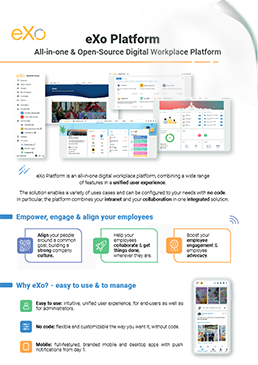

eXo Platform : The Open-Source
Digital Workplace Platform
Download the eXo Platform Datasheet and discover all the features and benefits

Download the eXo Platform Datasheet and discover all the features and benefits
Internal communication (IC) is the process, strategy, and set of tools that organizations use to share information, align employees with business goals, and foster engagement and collaboration. It is much more than simply sending out company announcements or newsletters—it is a deliberate, strategic function that shapes how employees experience the organization every day.
Effective internal communication creates meaningful linkages: between leadership and teams, across departments, and between on-site and remote employees. It ensures that information doesn’t just travel—it lands, resonates, and prompts action.
In practice, internal communication involves:
🤏In short, internal communication transforms information into understanding, alignment, engagement, and action.
The way we communicate at work has evolved dramatically. In 2025, improving internal communication means combining strategic leadership, modern technology, and a human-centered culture. Below are 22 actionable and up-to-date strategies designed to help organizations strengthen engagement, boost productivity, and build trust across distributed teams.
In the modern workplace, Internal Communication (IC) goes far beyond simply sharing updates—it is the lifeline that connects employees, aligns teams, and drives organizational success.
Effective Internal Communication ensures that everyone understands the company’s goals, feels included in decision-making, and has the information they need to perform their roles confidently. Research consistently shows that organizations with strong internal communication enjoy higher employee satisfaction, better retention, and improved overall performance.
As workplaces continue to evolve at a rapid pace, internal communication (IC) has moved beyond simply sending messages—it has become a strategic pillar of organizational success. Building a strong Internal Communication strategy and using the right platform is no longer optional; it’s essential. Here’s why:
👨💻The Hybrid Work Imperative
🧲Employee Engagement and Retention
🔬Accelerating Innovation
🧠Knowledge Management and Operational Efficiency
👨👩👧👦Crisis and Change Management
Here are some Key differences between internal and external communications:
➝ Find out the Key differences between internal and external communications
Selecting the right internal communications (IC) platform is a strategic decision. It’s about more than just picking a tool—it’s about enabling effective communication, engagement, and alignment across your organization.
Here’s a structured, step-by-step approach to guide your decision:
➝ Discover How to Choose the Right Internal Communications Platform
( Your e-mail address will not be published)

I am a Digital Marketing specialist specialized in SEO at eXo Platform. Passionate about new technologies and Digital Marketing. With 10 years' experience, I support companies in their digital communication strategies and implement the tools necessary for their success. My approach combines the use of different traffic acquisition levers and an optimization of the user experience to convert visitors into customers. After various digital experiences in communication agencies as well as in B2B company, I have a wide range of skills and I am able to manage the digital marketing strategy of small and medium-sized companies.