Discover the new generation
company intranet
company intranet
Effective internal communication is the backbone of a healthy, high-performing organization. Without clarity, transparency, and engagement, teams can feel siloed, disconnected, or misaligned with the company’s mission. In modern workplaces — especially with remote or hybrid models — boosting internal communications is more critical than ever.

In this guide, you’ll discover 5 practical, actionable steps to improve internal communication—covering everything from clarifying communication channels and encouraging employee feedback to centralizing documents and strengthening company culture. Whether you lead HR, internal communications, IT, or general management, these steps offer a clear and comprehensive roadmap to transform how your teams connect and collaborate.
Beyond the steps themselves, this guide also explores updated features, emerging practices, and the rise of open-source communication platforms. As more organizations seek flexible, secure alternatives to traditional proprietary systems, we take a closer look at why eXo Platform has become a top contender for modern, scalable, and employee-centric internal communication.
Whether you’re aiming to streamline daily communication, boost alignment, or future-proof your digital workplace, the insights ahead will equip you with the clarity and tools needed to succeed.
Let’s dive into the 5 steps that can reshape your internal communication strategy today.
Before diving into the steps, it’s essential to understand the obstacles that often derail internal communication efforts. Modern organizations—especially hybrid and fast-growing ones—face a combination of structural, cultural, and technological challenges. Addressing these barriers early on lays the foundation for a more aligned, engaged, and informed workforce.
Departments frequently operate in isolation, leading to fragmented communication. Employees often find critical updates scattered across email threads, chat apps, and outdated document systems. According to Harvard Business Review, 83% of professionals say silos harm productivity.
Employees receive an overwhelming amount of information each day—often 120+ emails, countless chat pings, and a constant flow of notifications. With so much noise, only a small percentage of messages stand out, making it hard for teams to prioritize what truly matters.
As remote and hybrid work models expand, gaps in access to information become more visible. Studies show remote employees are 2.5 times more likely to feel excluded from important updates than their in-office peers. Without intentional communication practices, distributed teams can easily feel left out.
Most organizations rely on an average of 9+ communication tools, from chat apps to email, project management systems, and legacy intranets. This patchwork approach leads to context switching, inconsistent messaging, and lost information—ultimately slowing down collaboration.
When communication is strictly top-down, employees feel disconnected. Many workers report that their voices don’t matter or that there’s no structured way to participate, contribute, or recognize peers. This results in lower morale, trust, and retention.
Collecting employee feedback is only half the battle—organizations often struggle to act on it and close the loop. Without transparent mechanisms or follow-up actions, employees may feel ignored, reducing future participation and overall engagement.
Only 28% of organizations regularly measure the effectiveness of their internal communication. Without insights such as open rates, reach, or engagement trends, IC teams operate without clarity on what’s working—or what needs to change.
Not every message is relevant to every employee. Blanket communications increase noise and decrease relevance. Segmented, targeted communication based on role, location, or team delivers far better engagement but is often overlooked.
As organizations grow, informal channels and ad hoc processes quickly become unmanageable. Content gets duplicated, outdated documentation circulates, and governance becomes inconsistent, weakening the overall communication ecosystem.
These barriers highlight a deeper truth: internal communication isn’t just about choosing the right tools—it’s about building a strategy rooted in clarity, consistency, inclusion, and alignment. Once these challenges are recognized and addressed, organizations can move toward more effective communication practices that truly support their teams.

Internal communication is a critical driver of organizational alignment, employee engagement, and productivity. To ensure your messages are not only heard but also understood and acted upon, you need clear communication channels and well-defined communication goals.
Here are 5 actionable steps to dramatically improve how your organization communicates internally:
Internal communication succeeds only when it starts with a clear purpose. Most communication issues inside organizations have nothing to do with tools, formats, or channels—they come from unclear or undefined goals.
Without direction, messages become noise. With direction, they become a strategic engine that strengthens alignment, culture, and performance.
When employees understand why a message matters, they pay attention, engage, and act. When you define a communication goal, you also define how you will measure success, refine your strategy, and ensure your messages contribute to real business outcomes—whether it’s productivity, compliance, engagement, or alignment.
Clear goals allow communication teams to:
Before crafting a single message, ask yourself:
This simple diagnostic ensures every message has purpose and relevance.
A strong communication goal should be:
Using S.M.A.R.T. goals keeps communication intentional and impact-driven.
Every communication should connect employees’ daily work to the organization’s mission, vision, and priorities. Include a quick “Why it matters” statement in every message to reinforce meaning and alignment.
Examples:
Visuals help too—strategy maps, infographics, or diagrams make the message more memorable.
When preparing a large communication initiative—such as launching a new tool, changing workflows, or rolling out major updates—consult employees early.
Use:
This ensures buy-in, reduces resistance, and helps you tailor your message to real needs.
A global technology company struggled with low awareness of new product guidelines.
The issue wasn’t the tools—they were sending updates—but the absence of a clear communication goal.
Compliance improved by 30%, and employees reported a clearer understanding of expectations.
Once your communication goals are clear, the next step is to build a strategy that ensures your messages land effectively. A solid strategy answers the questions: What to communicate? To whom? How often? And in which format? Without a strategy, even the most important messages can get lost or ignored.
A strong internal communication strategy is built around 5 key dimensions: content, cadence, audience segmentation, governance, and overload prevention.
Not all messages are created equal. Different content formats suit different purposes, and combining them improves comprehension, engagement, and retention.
😎Pro Tip: Rotate formats to avoid content fatigue and keep employees engaged.
Consistency helps employees know when to expect information, which reduces anxiety and prevents them from feeling overwhelmed.
A predictable cadence builds trust, reinforces transparency, and ensures important messages are noticed.
Employees engage most when messages are directly relevant to their role, location, or function. Segmenting your audience prevents information overload and ensures the right people get the right updates.
A retail chain implemented role-based dashboards. Store teams received operational updates, while corporate teams received strategic insights. The result? Engagement increased by 50%.
😎Pro Tip: Regularly refresh segments as teams grow or organizational structures change.
Governance ensures that communication is consistent, approved, and organized. It sets expectations for when and how messages are shared.
Proper governance prevents duplication, reduces confusion, and increases clarity across the organization.
Too many messages lead to disengagement. Combat overload by prioritizing content, batching updates, and giving employees control over notifications.
One company reduced daily notifications from 30+ to 10 strategic messages. Employee satisfaction rose by 25%.
Even the best communication strategy can fail without the right tools. Employees waste time switching between apps, hunting for information, or missing critical updates when tools are scattered or uncoordinated.
This step is about creating a centralized, integrated, and accessible communication ecosystem that supports your strategy and makes information easy to find and act on.
Tools are the backbone of modern internal communication. They:
A global consulting firm reduced redundant emails by 60% simply by defining clear channels and encouraging intranet adoption. Engagement with the intranet increased by 45%.
Your intranet is the core of internal communication. Use it for:
😎Pro Tip: A modern intranet reduces email clutter and keeps employees informed in one place.
Chat apps like Slack, Teams, or Mattermost are ideal for:
📋Guideline: Chats should complement, not replace, structured communication on the intranet or in newsletters.
Tools like Asana, Trello, or Jira help teams manage:
🎁Benefit: Operational communication stays organized and traceable, reducing confusion.
Centralize all important documents in a searchable, well-organized repository:
😎Pro Tip: Use tagging, version control, and clear ownership to make content findable and reliable.
Tools like surveys, polls, AMAs, suggestion boxes, and employee forums turn communication into a dialogue:
😎Pro Tip: Collect both qualitative and quantitative feedback to continuously improve communication.
To maximize impact:
😎Pro Tip: Appoint “platform champions” in each department to train colleagues, encourage adoption, and audit tool usage regularly.
Even the most carefully crafted messages and perfectly chosen tools can fall flat without active support and promotion.
This step ensures that communication is visible, engaging, meaningful, and two-way. It’s about turning messages into habits, reinforcing culture, and fostering dialogue across the organization.
Employees engage more when they understand why a message matters. Every communication should clearly explain:
A healthcare organization introduced weekly “Impact Stories” showcasing how employee actions improved patient care. Result: employees reported a stronger sense of purpose and alignment with organizational goals.
Internal communication is not just broadcasting—it’s a conversation. Enable employees to share input and feel heard:
😎Pro Tip: Always close the feedback loop. Show how employee input leads to changes—this builds trust and reinforces a listening culture.
Leaders and managers are your most powerful communication amplifiers. Their involvement adds credibility and motivates employees to engage. Support them with:
😎Pro Tip: Encourage leaders to ask questions, participate in discussions, and publicly acknowledge contributions from employees.
Celebrating employees fosters morale, motivation, and engagement. Recognition can be:
One company implemented a Kudos Wall, increasing participation in recognition programs by 60%.
People remember what they interact with. Combine formats to increase retention and participation:
A tech company gamified compliance training, resulting in an 80% increase in completion rates.
Communication only works if everyone can access it. Ensure all content is:
Internal communication is never “set and forget.” Even the best strategy needs continuous measurement, refinement, and experimentation to stay effective. This final step ensures your communication evolves with your organization, resonates with employees, and drives real business outcomes.
You cannot improve what you don’t measure. Collect both quantitative and qualitative metrics to understand how employees interact with your communications.
😎Pro Tip: Use dashboards for real-time insights, making it easy for communication teams to spot trends and adjust quickly.
Internal communication is not just broadcasting—it’s a conversation. Enable employees to share input and feel heard:
😎Pro Tip: Always close the feedback loop. Show how employee input leads to changes—this builds trust and reinforces a listening culture.
A healthcare organization introduced weekly “Impact Stories” showcasing how employee actions improved patient care. Result: employees reported a stronger sense of purpose and alignment with organizational goals.
Quarterly or biannual audits help identify gaps, redundancies, and areas for improvement:
A retail company redesigned onboarding communications after an audit and employee feedback, increasing participation in internal programs by 65%.
Collecting feedback is only half the battle. Listen to employees and close the feedback loop by acting on their suggestions:
😎Pro Tip: Sharing the changes you made based on feedback reinforces a culture of listening and trust.
Internal communication should be dynamic. Test different approaches to find what resonates best:
A software company doubled internal engagement within a year by iterating newsletter formats, adding short videos, refining audience segmentation, and analyzing behavior patterns.
The true value of internal communication shows in organizational results. Link your KPIs to outcomes such as:
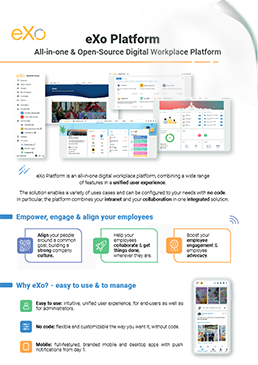

eXo Platform : The Open-Source
Digital Workplace Platform
Download the eXo Platform Datasheet and discover all the features and benefits

Download the eXo Platform Datasheet and discover all the features and benefits
Choosing the right platform is crucial to successfully implementing your internal communication strategy.
Modern internal communication platforms—or digital workplaces—go far beyond simple document repositories. They need to empower collaboration, engagement, knowledge sharing, and analytics while providing security, personalization, and flexibility. Here’s a comprehensive guide to the key features and capabilities you should prioritize:
A modern platform should centralize all communication and collaboration tools in a single environment, eliminating the chaos of scattered apps:
😎Pro Tip: Look for platforms that combine communication, collaboration, and task management in a single interface to reduce app fatigue and increase adoption.
Not every message should reach every employee. The best platforms allow segmentation based on role, department, location, or seniority:
📚Use Case: HR can target onboarding content only to new hires, while team leads can push project updates to relevant team members.
Engagement thrives when employees can interact and recognize each other’s contributions:
😎Pro Tip: Encourage cross-team recognition to break down silos and boost morale.
Modern workplaces require seamless teamwork regardless of location:
📚Use Case: Marketing teams can simultaneously work on campaign content, track deadlines, and approve assets without switching tools.
Employees should be able to quickly find HR, IT, or administrative resources without bottlenecks:
Measure impact and continuously improve internal communication:
😎Pro Tip: Use dashboards to identify under-engaged teams and adjust communication strategies accordingly.
Your platform should seamlessly connect with other business-critical systems:
Employees expect seamless experiences on any device:
Protect sensitive data while maintaining compliance:
Every organization is unique, and your platform should reflect that:
When evaluating internal communication platforms, focus on those that offer AI-driven personalization, real-time collaboration, social engagement, analytics, and robust security. A platform that integrates these features will not only streamline communication but also increase adoption, boost engagement, and create a connected, informed workforce.
| Feature Category | Key Capabilities (Must-Haves) | Advanced Capabilities / Differentiators |
| Unified Digital Workplace | Newsfeeds, announcements, chat, document & task management, team workspaces | AI-powered content ranking, semantic search, multi-format content support (text, images, video) |
| Audience Targeting & Personalization | Role-based or team-based content segmentation, personalized dashboards | Predictive analytics, AI content recommendations, contextual notifications |
| Social Engagement & Gamification | Likes, comments, @mentions, recognition (kudos) | Badges, leaderboards, rewards, gamification of tasks and knowledge sharing |
| Real-Time Collaboration | Document co-editing, versioning, shared calendars, tasks | Workflow automation, integrated project boards, automated approvals |
| Self-Service Portals | Onboarding checklists, FAQs, HR/IT forms | AI-powered knowledge bases, contextual guidance, automated support suggestions |
| Analytics & Feedback | Engagement metrics, adoption dashboards | Pulse surveys, sentiment analysis, predictive communication insights |
| Integration & Extensibility | SSO, integration with Microsoft 365, Google Workspace, HRIS | Open APIs, custom application connectors, real-time data synchronization |
| Mobile Accessibility & UX | Native iOS/Android apps, responsive design | Offline access, unified cross-system search, accessibility-first interfaces |
| Security & Compliance | Role-based permissions, audit trails, data protection | Zero-trust security, GDPR/CCPA/HIPAA compliance tools, digital sovereignty options |
| Customization & Extensibility | No-code/low-code configuration, modular architecture | Personalized dashboards, configurable workflows, custom community modules |
Boosting internal communication is far more than adopting the “right tool”—it requires a holistic strategy that connects people, processes, and technology. The 5 steps outlined in this guide provide a roadmap for creating sustainable, inclusive, and effective communication practices that engage employees, foster collaboration, and ensure that critical information reaches the right audience at the right time.
However, even the most thoughtful strategy can falter without the right technological foundation. This is where a modern, integrated platform becomes a strategic asset. eXo Platform stands out as a compelling solution, combining open-source flexibility with enterprise-ready capabilities. Its unified digital workplace supports newsfeeds, real-time collaboration, communities, task management, and self-service portals—all in one environment—while offering audience targeting, personalization, analytics, and AI-driven insights.
By leveraging such a platform, organizations can:
Ultimately, the integration of these 5 steps with a robust platform like eXo Platform transforms internal communication from a routine operational task into a strategic advantage. It fosters transparency, strengthens engagement, and drives organizational agility—turning communication infrastructure into a core driver of sustainable growth and competitive success.
In today’s fast-evolving workplace, companies that embrace strategic integration, modern tools, and continuous innovation will not only avoid communication chaos—they will thrive.
The Complete Guide to
Employee Engagement
Discover our in-depth analysis of the concept of employee engagement, its roots, and ways to improve it significantly


Discover our in-depth analysis of the concept of employee engagement, its roots, and ways to improve it significantly
Internal communication (IC) is the process, strategy, and set of tools that organizations use to share information, align employees with business goals, and foster engagement and collaboration. It is much more than simply sending out company announcements or newsletters—it is a deliberate, strategic function that shapes how employees experience the organization every day.
Effective internal communication creates meaningful linkages: between leadership and teams, across departments, and between on-site and remote employees. It ensures that information doesn’t just travel—it lands, resonates, and prompts action.
In practice, internal communication involves:
🤏In short, internal communication transforms information into understanding, alignment, engagement, and action.
Effective internal communication is no longer optional—it is essential for organizational success. Studies consistently show that improving communication drives engagement, productivity, and business outcomes.
🕵Quick evidence
🕺The Modern Challenge
The way we communicate at work has evolved dramatically. In 2025, improving internal communication means combining strategic leadership, modern technology, and a human-centered culture. Below are 22 actionable and up-to-date strategies designed to help organizations strengthen engagement, boost productivity, and build trust across distributed teams.
In the modern workplace, Internal Communication (IC) goes far beyond simply sharing updates—it is the lifeline that connects employees, aligns teams, and drives organizational success.
Effective Internal Communication ensures that everyone understands the company’s goals, feels included in decision-making, and has the information they need to perform their roles confidently. Research consistently shows that organizations with strong internal communication enjoy higher employee satisfaction, better retention, and improved overall performance.
As workplaces continue to evolve at a rapid pace, internal communication (IC) has moved beyond simply sending messages—it has become a strategic pillar of organizational success. Building a strong Internal Communication strategy and using the right platform is no longer optional; it’s essential. Here’s why:
👨💻The Hybrid Work Imperative
🧲Employee Engagement and Retention
🔬Accelerating Innovation
🧠Knowledge Management and Operational Efficiency
👨👩👧👦Crisis and Change Management
Here are some Key differences between internal and external communications:
➝ Find out the Key differences between internal and external communications
Selecting the right internal communications (IC) platform is a strategic decision. It’s about more than just picking a tool—it’s about enabling effective communication, engagement, and alignment across your organization.
Here’s a structured, step-by-step approach to guide your decision:
➝ Discover How to Choose the Right Internal Communications Platform
( Your e-mail address will not be published)

I am a Digital Marketing specialist specialized in SEO at eXo Platform. Passionate about new technologies and Digital Marketing. With 10 years' experience, I support companies in their digital communication strategies and implement the tools necessary for their success. My approach combines the use of different traffic acquisition levers and an optimization of the user experience to convert visitors into customers. After various digital experiences in communication agencies as well as in B2B company, I have a wide range of skills and I am able to manage the digital marketing strategy of small and medium-sized companies.