
FREE WHITE PAPER
Discover our in-depth analysis of the concept of employee engagement, its roots, and ways to improve it significantly
We define digital collaboration as the digital systems people use to collaborate internally (within the enterprise network) or externally (with enterprise communities or partners) to get things done.
Digital collaboration tools connect people, information, business applications and company communications, transforming your company into a unified, successful business force.
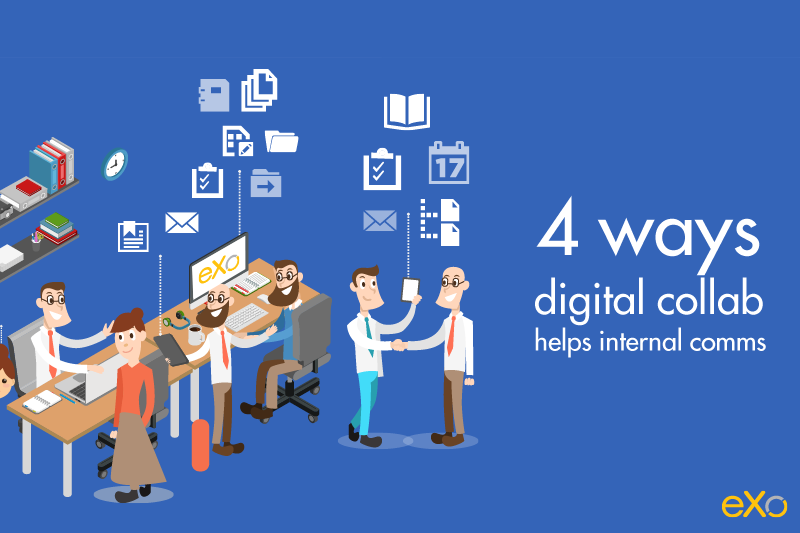
What can digital collaboration platforms bring to internal communications that traditional intranets cannot? We highlight four key points.

Employee engagement is one of the top five areas of focus for most internal communication departments, and it is used widely to attach a solid business value to communications. As many as 70% of all business leaders believe employee engagement is critical to their organisation’s success, according to a study by CLC.
A number of studies have shown a correlation between employee engagement and financial performance indicators, such as revenue growth, operating margin and shareholder return. Indeed, companies with high employee engagement :
Digital collaboration makes people more engaged. Our clients report up to 30% improvement in their employee engagement rates, which matches statistics shared by other digital collaboration solution providers.
How does it do this? Successful digital collaboration helps people cope with today’s demanding workplaces by allowing them to get help from colleagues when needed and find relevant information faster. As a result, it brings back the feeling of personal control and involvement with the company. It helps employees interact with a wider range of colleagues and form connections throughout the organization. It helps information flows outside the departmental silos and promotes transparency, creating a sense of larger purpose for employees.
Traditional top-down communication is easy to ignore—it just sleeps in one’s archived emails, in the corner for one’s screen or in the company intranet that nobody uses.
With digital collaboration tools, on the other hand, managers can use multiple channels to relay messages. A message can be posted, reshared and discussed through social activity streams, sparking two-way conversations. Content can be placed in a contextualized environment, targeting precise subgroups and communities of interest. This not only helps get messages and information across better but also helps build trust and make employees feel more aware of what is generally happening in the organization.
A corporate culture consists of (often) unspoken rules for how things are done in the company. Together with official processes and systems, it forms the “software” that guides how people in the company work.
A company culture is best built and reinforced whenever people interact. To actively build an organizational culture, you need key people to model the right kinds of behaviour. Digital collaboration tools in turn can play an important role in amplifying these behaviors, making them more visible and allowing management to visibly encourage them.
Digital collaboration tools allow people to establish social and work connexions while collaborating on projects and exchanging ideas within communities of interests. Gradually, an active employee community can emerge in which mutual help, knowledge sharing and innovation can thrive.
Communicators often find it difficult to prove to management that internal communications have business value because they lack the quantitative and qualitative KPIs to do so. In fact, measuring the efficiency of internal communications is a struggle in most communication departments; over 60% of internal communicators do not measure internal communications at all, and only 16% appear satisfied with their measurement protocols.
If users shun your intranet, you probably rely heavily on email and physical supports for information flow. Think of all the time and hard costs associated with this process. How many emails do you send per week/month/year? What about the costs of paper, color printing and physical circulation?
Through a digital collaboration intranet, you acquire a strong reach platform for your communications. Your content production will gain in efficiency through collaboration tools and workflows for your team, and digital collaboration tools will improve your communications reach by adding new channels to your usual communications flow.
Furthermore, quantitative KPIs, such as reach and engagement, and a direct means to survey your population will become available via likes, shares, comments, followers, total number of connexions between people, content consumption metrics and more.
Besides improving your internal communications efficiency, digital collaboration tools can transform your business from the inside out. Want to learn more about the business impact of digital collaboration?
The Complete Guide to
Employee Engagement
Discover our in-depth analysis of the concept of employee engagement, its roots, and ways to improve it significantly
Discover our in-depth analysis of the concept of employee engagement, its roots, and ways to improve it significantly
Internal communication (IC) is the process, strategy, and set of tools that organizations use to share information, align employees with business goals, and foster engagement and collaboration. It is much more than simply sending out company announcements or newsletters—it is a deliberate, strategic function that shapes how employees experience the organization every day.
Effective internal communication creates meaningful linkages: between leadership and teams, across departments, and between on-site and remote employees. It ensures that information doesn’t just travel—it lands, resonates, and prompts action.
In practice, internal communication involves:
🤏In short, internal communication transforms information into understanding, alignment, engagement, and action.
Effective internal communication is no longer optional—it is essential for organizational success. Studies consistently show that improving communication drives engagement, productivity, and business outcomes.
🕵Quick evidence
🕺The Modern Challenge
The way we communicate at work has evolved dramatically. In 2025, improving internal communication means combining strategic leadership, modern technology, and a human-centered culture. Below are 22 actionable and up-to-date strategies designed to help organizations strengthen engagement, boost productivity, and build trust across distributed teams.
In the modern workplace, Internal Communication (IC) goes far beyond simply sharing updates—it is the lifeline that connects employees, aligns teams, and drives organizational success.
Effective Internal Communication ensures that everyone understands the company’s goals, feels included in decision-making, and has the information they need to perform their roles confidently. Research consistently shows that organizations with strong internal communication enjoy higher employee satisfaction, better retention, and improved overall performance.
As workplaces continue to evolve at a rapid pace, internal communication (IC) has moved beyond simply sending messages—it has become a strategic pillar of organizational success. Building a strong Internal Communication strategy and using the right platform is no longer optional; it’s essential. Here’s why:
👨💻The Hybrid Work Imperative
🧲Employee Engagement and Retention
🔬Accelerating Innovation
🧠Knowledge Management and Operational Efficiency
👨👩👧👦Crisis and Change Management
Here are some Key differences between internal and external communications:
➝ Find out the Key differences between internal and external communications
Selecting the right internal communications (IC) platform is a strategic decision. It’s about more than just picking a tool—it’s about enabling effective communication, engagement, and alignment across your organization.
Here’s a structured, step-by-step approach to guide your decision:
➝ Discover How to Choose the Right Internal Communications Platform
( Your e-mail address will not be published)

I am the Chief Executive Officer of eXo Platform (the open source digital workplace platform), a company that I co-founded while in college and that I came back to after several years in the banking and consulting industry. I blog about modern work, about open-source and sovereignty issues. Occasionally, I also blog about my personal areas of interest, such as personal development, work–life balance, sustainability and gender equality.