
FREE WHITE PAPER
Artificial intelligence has rapidly become part of everyday work. Employees experiment with AI tools, generate content, and explore new ways to be more productive.
Artificial Intelligence (AI) is no longer a distant promise or a niche experiment, it has become the operating system of the modern workplace.
Today, organizations are not debating whether to adopt AI, but how deeply it should be woven into everyday work. Insights from the World Economic Forum highlight a clear shift: AI is now embedded across industries, quietly transforming workflows, redefining job roles, and raising expectations for what work should feel like.
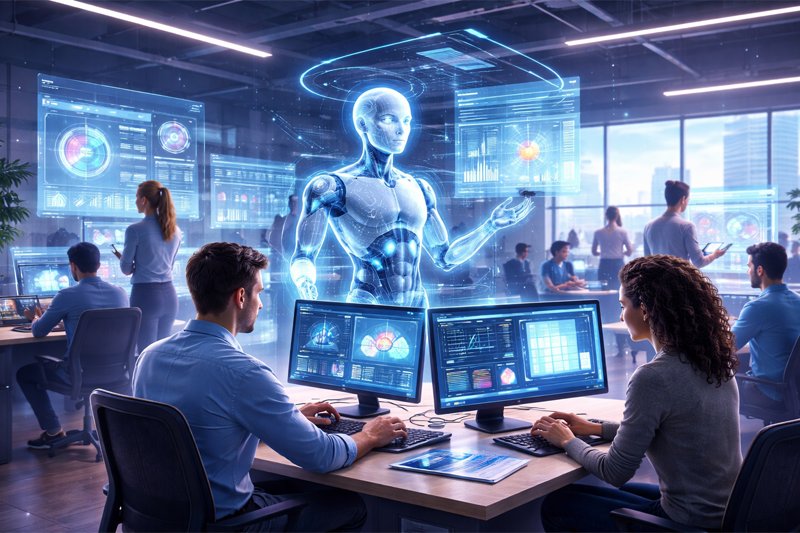
This transformation is not theoretical. Recent findings from Gallup suggest that nearly half of employees already use AI tools in their daily tasks, a number driven largely by leadership initiatives and digital transformation strategies. What was once optional is quickly becoming essential.
To understand the significance of this shift, it helps to look back. For years, the “digital workplace” was often synonymous with friction, fragmented tools, overwhelming email chains, and disconnected systems that slowed people down rather than empowering them. Employee experience (EX) was reactive at best, measured through delayed surveys instead of real-time insight.
That era has ended.
Today, we are entering what can best be described as the agentic workplace, an environment where AI acts not as a passive tool, but as an active participant in work. Intelligent systems now assist with decision-making, automate repetitive cognitive tasks, and provide context-aware support across the employee lifecycle. From onboarding new hires to streamlining collaboration and even identifying communication bottlenecks, AI is evolving into a kind of digital coworker, one that learns, adapts, and anticipates needs.
At its core, this shift is redefining employee experience. AI reduces the “mental overhead” of modern work, searching for information, summarizing meetings, organizing schedules, freeing employees to focus on higher-value, creative, and strategic tasks. At the same time, it enables a level of personalization that was previously impossible: tailored learning paths, adaptive workflows, and real-time feedback loops that respond to individual needs.
Yet, this evolution is not without complexity. As AI becomes more embedded in daily operations, organizations must confront new challenges around trust, transparency, governance, and workforce readiness. The question is no longer just what AI can do, but how it should be implemented responsibly and effectively.
This article explores AI in the digital workplace as it stands in today, examining the tools, trends, and real-world applications shaping this new reality. It also outlines the risks, governance considerations, and practical strategies organizations can use to design AI-powered environments that are not only efficient, but genuinely human-centered.
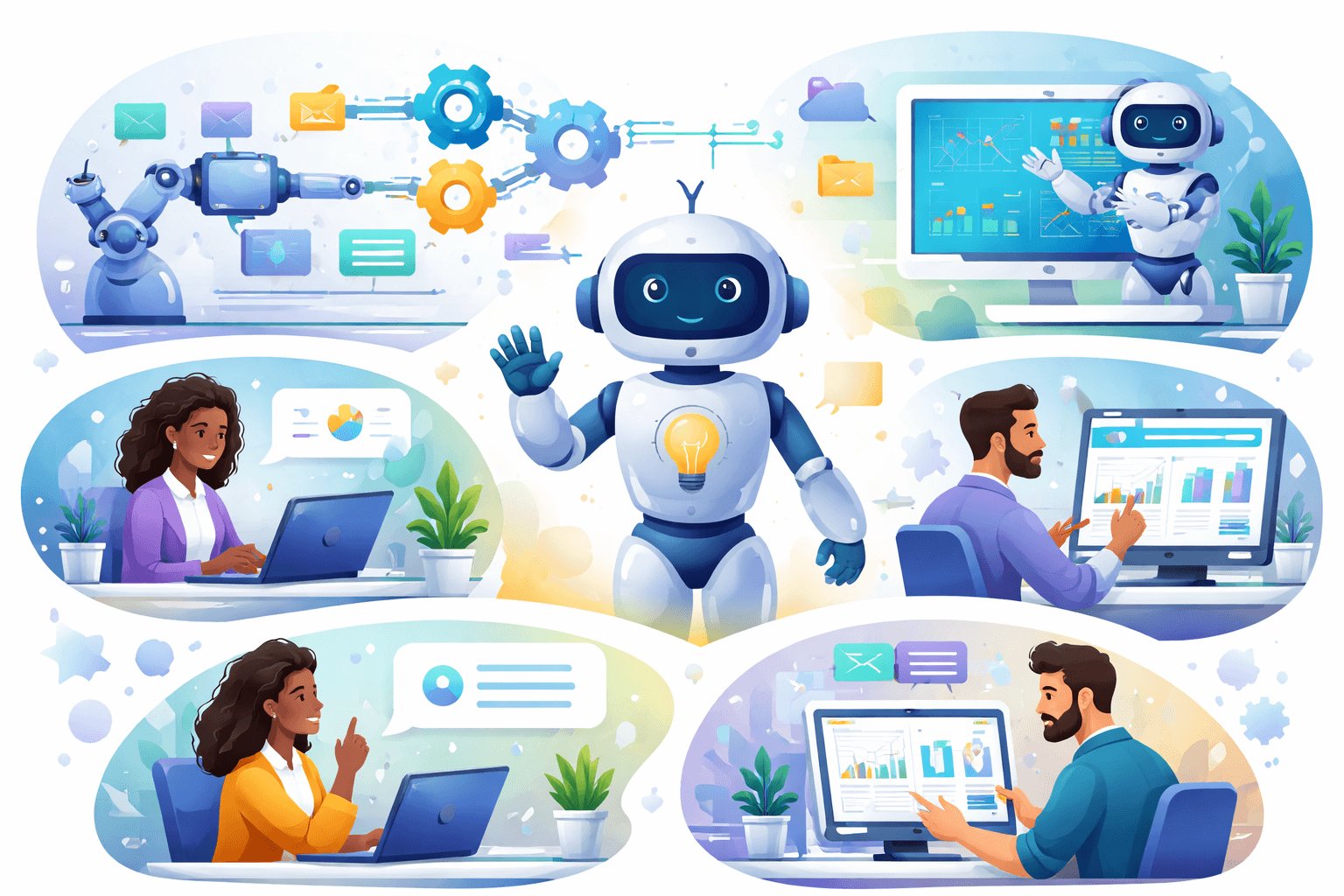
Instead of relying on traditional workplace software made up of separate, disconnected apps, the digital workplace now operates as a unified intelligence ecosystem. It brings together tools, data, communication, and workflows into one seamless environment powered by generative AI (GenAI), predictive analytics, and automation technologies such as robotic process automation (RPA).
This integration removes the friction of switching between platforms and allows work to flow naturally across systems that understand context and user intent.
In this new model, artificial intelligence is no longer a passive support feature, it becomes an active layer of work execution. Key capabilities include:
These capabilities work together to create a workplace that actively supports employees throughout their day, anticipating needs, reducing manual effort, and improving overall efficiency.
In earlier digital workplaces, employees were responsible for managing multiple tools and manually coordinating work between systems. In contrast, the AI-powered workplace shifts this responsibility to the system itself.
AI becomes a collaborative layer embedded within daily work, helping employees:
As a result, employees experience a significant reduction in cognitive load, allowing them to focus more on strategic thinking, creativity, and decision-making.
At a practical level, the workplace feels like having a smart, always-on digital team working alongside every employee. This digital team of AI systems helps with planning tasks, prioritizing workloads, coordinating across teams, and providing real-time guidance based on evolving business needs.
👉 In simple terms:
An AI-powered digital workplace today is like working with an invisible but highly capable digital workforce that supports employees at every step, helping them work faster, smarter, and with less effort. It represents a fundamental shift from simply using digital tools to collaborating with intelligent systems that actively help get work done.
AI-Augmented Digital Workplace
Artificial intelligence has rapidly become part of everyday work. Employees experiment with AI tools, generate content, and explore new ways to be more productive.
Artificial intelligence has rapidly become part of everyday work. Employees experiment with AI tools, generate content, and explore new ways to be more productive.
One of the core features of an AI-powered digital workplace is unified context intelligence. Instead of switching between Slack, email, SharePoint, Jira, or cloud drives, employees interact with a single AI layer that connects all enterprise data.
Employees can ask natural language questions such as:
“What was the final decision on the Q3 remote work policy?”
The system then delivers a real-time, cited, and permission-aware answer, eliminating fragmented searches and reducing time spent locating information.
Modern workplaces now use agentic AI systems that can execute multi-step tasks autonomously. These AI agents go beyond suggestions, they take action.
For example:
This shift transforms workflows from manual execution to AI-orchestrated processes with human oversight.
Unlike earlier AI tools that required prompts, today’s systems are proactive. They analyze patterns in work activity and anticipate needs before users ask.
For instance, if a deadline is approaching, AI may:
This reduces friction and improves productivity by ensuring employees always have what they need, when they need it.
A growing feature of AI-powered workplaces is emotion-aware analytics. Advanced models can detect early signs of stress or burnout by analyzing communication patterns such as tone changes, workload intensity, or after-hours messaging.
When risks are identified, the system may:
This helps organizations build a more supportive and balanced employee experience (EX).
AI is becoming more natural and less visible through voice and ambient intelligence. Employees can interact with workplace systems using speech or passive automation.
Examples include:
This reduces manual effort and makes collaboration more fluid.
AI-powered workplaces are highly adaptive. Instead of one universal interface, employees receive role-specific AI experiences.
This “UX of one” ensures AI is relevant to each employee’s daily work.
The AI-powered digital workplace extends beyond software into physical environments. Smart office systems use AI to optimize:
This creates a seamless link between digital systems and real-world workplace environments.
The AI-powered digital workplace today represents a major shift from fragmented tools to fully connected, intelligent work ecosystems. Employees no longer spend time searching for information or manually coordinating tasks, AI systems now handle much of the cognitive load.
By combining unified search, autonomous agents, predictive assistance, and personalized experiences, organizations are creating workplaces that are faster, smarter, and more human-centered, following many of the best practices adopted by customer experience companies. Ultimately, AI is not replacing employees, it is redefining how they work, collaborate, and experience the modern workplace.
The AI-powered digital workplace is evolving into a fully intelligent, connected ecosystem where humans and AI systems work side by side in real time. Today, organizations are no longer simply digitizing tasks, they are redesigning how work is structured, executed, and experienced through automation, agentic AI systems, and human-AI collaboration, often enabled through unified digital workplace platforms that bring communication, knowledge, and workflows together in one place.
This shift is fundamentally transforming employee experience (EX) by reducing manual effort, improving decision-making, and creating more meaningful, strategic work environments.
AI has moved beyond the role of a basic assistant. In today’s AI-powered digital workplace, it functions as a fully embedded digital co-worker operating directly inside daily workflows and collaboration environments.
Employees now use AI to:
Instead of interrupting work, AI becomes a continuous layer of support, especially when integrated into unified digital workplace platforms where communication, content, and tasks coexist in one experience.
A defining feature of the modern AI workplace transformation is deep workflow integration. Rather than introducing separate AI tools, intelligence is embedded directly into platforms employees already use, often within a single digital workplace environment that connects messaging, documents, and business applications.
Across HR, finance, operations, and customer service, AI now:
This creates a low-friction digital workplace experience, where processes run smoothly in the background while employees focus on higher-value work, supported by a centralized collaboration hub.
One of the most significant shifts today is the rise of agentic AI systems, AI that can reason, plan, and execute multi-step tasks autonomously.
These systems are capable of managing entire workflows such as:
In modern digital workplaces, these agents are increasingly embedded directly into employee environments, reducing friction between tools and enabling employees to focus on oversight rather than execution.
Organizations are increasingly redesigning workflows around human-AI collaboration models, where both humans and AI play complementary roles within a connected workplace ecosystem.
In this model:
This collaboration leads to:
Rather than replacing humans, AI is amplifying human capability, especially in environments where collaboration, knowledge sharing, and workflow orchestration are unified.
Assist employees with writing, coding, analytics, and content generation directly inside workflows.
AI systems that:
End-to-end automation tools that connect business systems across departments and eliminate manual handoffs.
Natural language assistants that help employees retrieve information, complete tasks, and navigate enterprise systems instantly, often embedded within unified workplace environments.
AI tools that forecast trends, detect risks, and support proactive business decisions.
In a modern AI-powered digital workplace, IDP systems can:
This significantly reduces manual workload while improving accuracy and operational speed, especially when integrated into centralized digital workplace ecosystems.
This creates a low-friction digital workplace experience, where processes run smoothly in the background while employees focus on higher-value work, supported by a centralized collaboration hub.
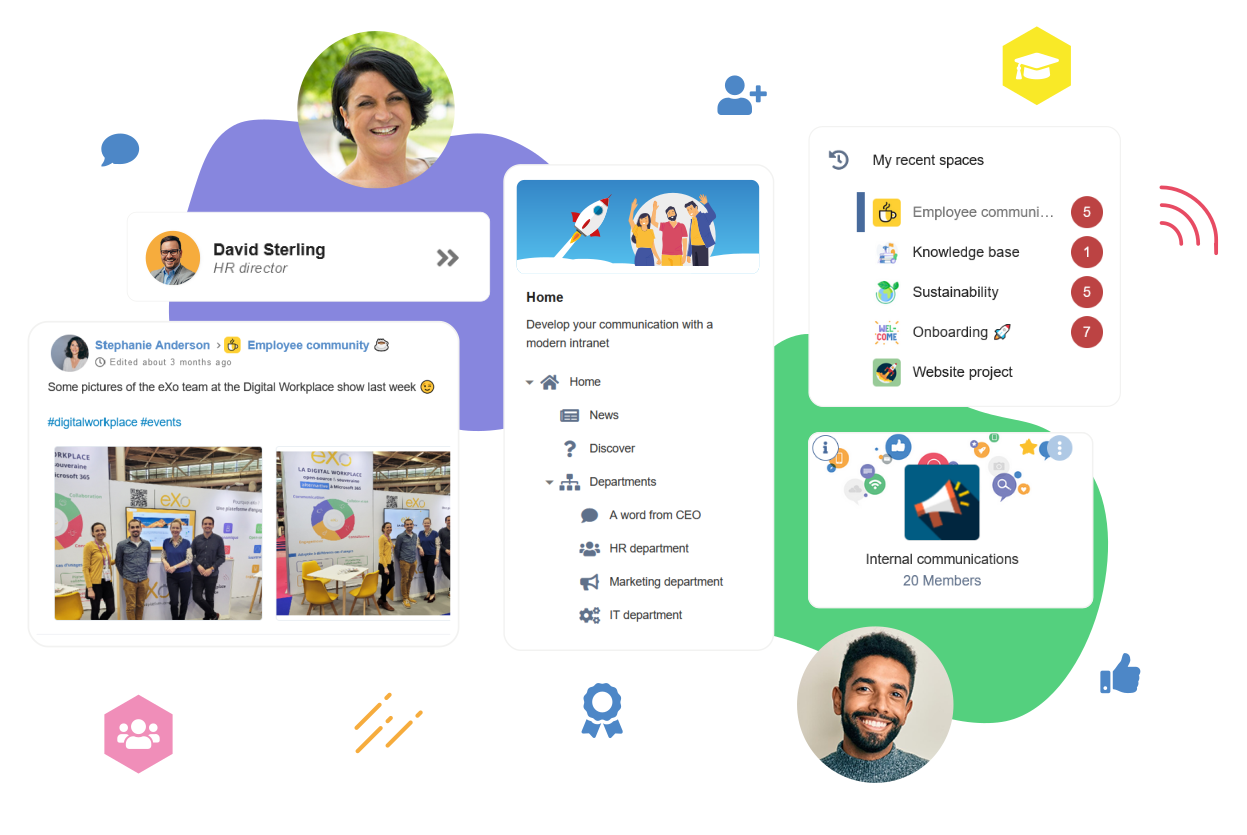
eXo Platform Digital Workplace
To successfully implement and scale the AI-powered digital workplace, organizations rely on four foundational pillars:
A unified, secure, and well-governed data environment that enables AI systems to function effectively across the organization.
AI embedded directly into daily tools and business processes, ideally within a unified digital workplace environment that connects communication, knowledge, and operations.
Continuous upskilling programs that teach employees how to use, supervise, and validate AI systems effectively.
Clear frameworks ensuring responsible AI usage, data privacy, transparency, and regulatory compliance.
AI systems increasingly manage complete end-to-end business processes instead of isolated tasks, enabling true operational automation.
AI processing is moving closer to users, on local devices and enterprise edge servers, to improve speed, privacy, and reliability.
Organizations are adopting sovereign AI frameworks to ensure data remains within controlled geographic or corporate boundaries, aligning with regulations such as NIS2 and DORA.
| Category | Leading Tools | Value in the AI-Powered Digital Workplace |
| 🎨 Collaborative Design | Figma, Galileo AI | Converts text into UI/UX designs |
| 📊 Productivity Platforms | Microsoft 365 Copilot, Read AI | Automates meetings, notes, and actions |
| 🏢 Operations & HR Systems | ServiceNow, Dynamics 365 | Handles routine employee requests at scale |
| 💻 Development Tools | GitHub Copilot X, Replit | Automates coding, debugging, and software creation |
The AI-powered digital workplace today represents a major shift from manual execution to intelligent orchestration. Work is no longer defined by repetitive tasks but by how effectively humans and AI systems collaborate to achieve outcomes, often within unified, experience-driven platforms that centralize communication, knowledge, and workflows.
By embedding AI into workflows, tools, and enterprise systems, organizations are building workplaces that are faster, smarter, and more adaptive, ultimately transforming employee experience (EX) into a more productive, personalized, and human-centered model.
Work is no longer just digitized, it is becoming intelligent, adaptive, and continuously optimized. AI now acts as a permanent layer of workplace intelligence, reshaping how decisions are made, how tasks are executed, and how employees interact with technology.
This marks a clear transition toward a workplace where humans and AI operate as a unified system, enabled by connected digital environments that bring collaboration, content, and intelligence together in one seamless experience.
The AI-powered digital workplace is transforming how organizations operate by embedding intelligent tools directly into daily workflows. Today, AI is no longer just an efficiency booster, it is a core driver of employee experience (EX), productivity, and workplace design. However, while the benefits are significant, organizations must also manage new risks and establish strong governance frameworks to ensure responsible adoption.
One of the most immediate impacts of the AI-powered digital workplace is a dramatic increase in productivity. Employees complete tasks faster, with fewer errors, and less manual effort.
Recent industry insights show:
By removing repetitive work, AI allows employees to focus on higher-value tasks such as strategy, creativity, and problem-solving.
AI significantly enhances employee experience by reducing stress, burnout, and administrative overload. Instead of spending time on “work about work,” employees engage in more meaningful tasks.
Key improvements include:
Organizations that use AI to support employees, not monitor them, also report up to 15–20% higher retention rates.
A major shift in the AI-powered workplace is the move toward personalized employee experiences. AI systems adapt workflows, tools, and interfaces based on individual roles and preferences.
Examples include:
This creates a “UX of one” workplace, where every employee experiences a tailored digital environment.
AI enables organizations to make faster, data-driven decisions by analyzing large and complex datasets in real time.
Benefits include:
Instead of relying on fragmented reports, leaders now access continuous, AI-generated intelligence.
One of the most common concerns is that automation may replace certain roles or reduce demand for repetitive tasks. While AI creates new roles, it also reshapes existing ones, requiring continuous upskilling.
The real shift is not replacement, but role transformation into AI-supervised work.
A growing risk is deskilling, where employees rely too heavily on AI for writing, analysis, or decision-making.
Some organizations are already responding by introducing practices such as:
The goal is to preserve critical thinking while still leveraging automation.
AI systems that constantly suggest actions or insights can overwhelm employees, leading to notification fatigue and reduced attention.
Best practices now include:
Without proper design, even helpful AI can become disruptive.
Employees may hesitate to trust AI if outputs are unclear or inconsistent. Additionally, concerns around surveillance, such as tracking keystrokes or productivity behavior, have led to regulatory restrictions in several regions.
Key issues include:
Trust remains a foundational requirement for adoption.
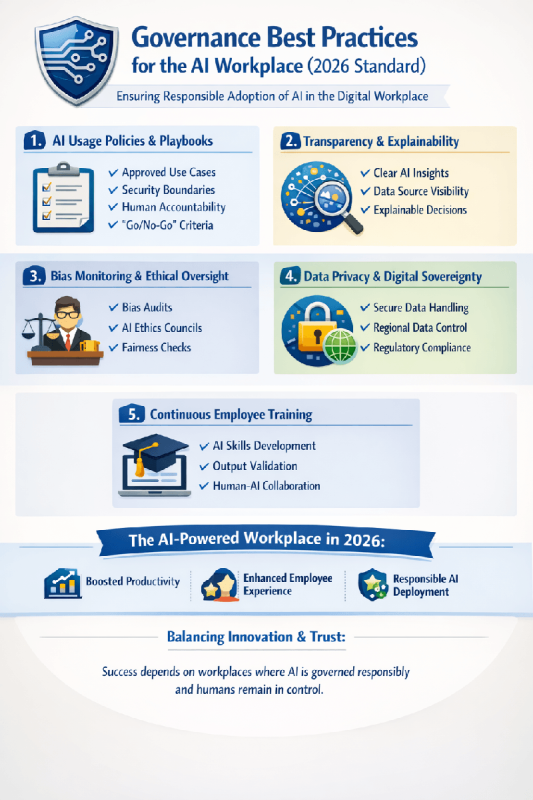
To ensure responsible adoption of the AI-powered digital workplace, organizations are adopting stronger governance frameworks:
Organizations define clear rules for how AI can be used, including:
Employees must understand how AI systems generate outputs. This includes:
AI systems must be continuously monitored for fairness and bias, especially in:
Many organizations now establish dedicated AI ethics councils with employee representation.
Strong data governance ensures that sensitive information is protected and compliant with regulations such as the EU AI Act and other global frameworks.
This includes:
AI literacy is now a core workplace skill. Employees must learn how to:
The AI-powered digital workplace today delivers measurable improvements in productivity, employee experience, and decision-making. By reducing repetitive work and enabling personalized workflows, AI helps organizations unlock new levels of efficiency and engagement.
However, these benefits come with real challenges, especially around trust, skill evolution, and responsible deployment. Success depends not just on adopting AI, but on designing workplaces where humans remain in control of intelligent systems.
The future of the AI-powered digital workplace is not defined by automation alone, but by balance. Organizations that succeed will be those that combine innovation with governance, ensuring AI enhances human capability without replacing human judgment.
In this model, AI becomes not just a productivity engine, but a trusted partner in creating a smarter, safer, and more human-centered workplace.
Successfully implementing an AI-powered digital workplace requires more than adopting tools, it demands a structured strategy that aligns technology, people, and governance. Today, organizations are shifting from experimental AI adoption to intentional workplace design, where AI is embedded into workflows to improve productivity, decision-making, and employee experience (EX).
A strong strategy ensures AI reduces complexity instead of adding it, and that it enhances, not disrupts, the way people work.
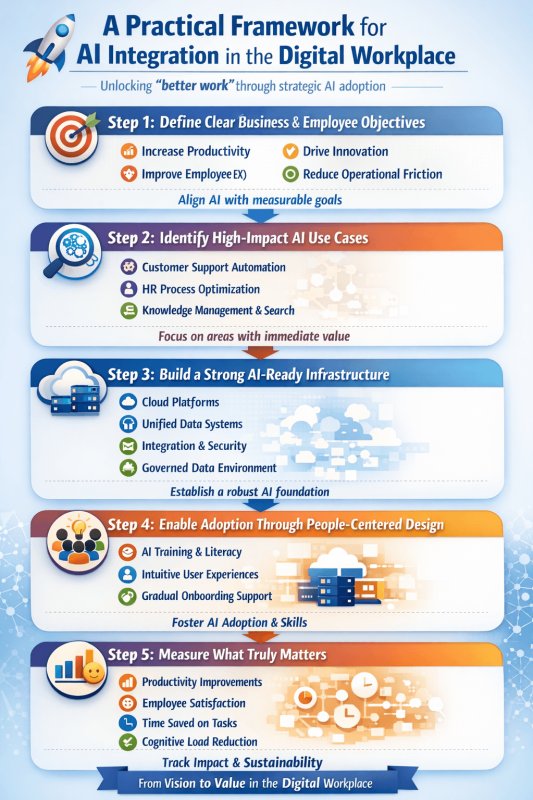
Every AI initiative must start with purpose, not technology.
Organizations should align AI adoption with measurable goals such as:
A successful AI-powered digital workplace strategy begins by clearly defining what “better work” means for both the organization and employees.
Instead of spreading AI across every function, organizations should focus on areas where it delivers immediate and visible value.
High-impact domains include:
A focused approach ensures faster adoption and stronger ROI in the digital workplace.
AI cannot function effectively without the right foundation.
Key infrastructure components include:
Modern digital workplace platforms increasingly act as a central layer connecting communication, knowledge, and workflows, enabling AI to operate seamlessly across systems.
Even the most advanced AI system fails without user adoption.
Organizations must:
The goal is to ensure AI feels like a natural extension of work, not an additional burden.
Success in the AI-powered digital workplace is not just about efficiency, it is about experience and sustainability.
Key KPIs include:
Organizations that measure only output often miss the real value of AI: better ways of working, not just faster work.
Before implementing any AI system, organizations must critically evaluate readiness across strategy, technology, people, and governance.
These questions help prevent fragmented adoption and ensure long-term success of the digital workplace transformation.
As AI becomes more embedded in workplace systems, deeper governance checks are required:
These safeguards ensure that AI enhances fairness, transparency, and trust within the workplace.
A successful AI-powered digital workplace strategy follows a clear operational sequence:
Identify tasks employees find repetitive, draining, or time-consuming, such as scheduling, reporting, or searching for information.
Before deployment, establish:
Test AI systems with a small group of voluntary employees for 60 days to evaluate:
AI should simplify the workplace, not expand it.
Best practice:
Beyond productivity, track:
A successful digital workplace improves how employees feel about work, not just how fast they complete it.
A well-designed AI-powered digital workplace strategy ensures that technology serves people, not the other way around. When AI is introduced with clear objectives, strong infrastructure, and responsible governance, it becomes a powerful enabler of productivity and employee experience.
However, success depends on balance: combining innovation with trust, automation with accountability, and efficiency with human-centered design.
The future of the digital workplace is not defined by how much AI an organization deploys, but by how thoughtfully it is integrated into everyday work.
Organizations that succeed will be those that design AI systems around human needs, creating workplaces that are not only smarter and faster, but also more transparent, inclusive, and sustainable.
The AI-powered digital workplace today is no longer a future vision, it is an operational reality across a growing majority of global enterprises, including a large share of Fortune 1000 organizations. What defines this new era is not the presence of artificial intelligence itself, but how it is being used to reshape the very meaning of work.
The true divide between successful and unsuccessful digital workplace transformations does not come from technology alone. It comes from philosophy, design choices, and leadership intent.
At its core, the evolution of the AI-powered digital workplace marks a clear transition: from automation to augmentation. AI is no longer positioned simply as a tool for efficiency or cost reduction, it is becoming a force that enhances human capability, reduces friction, and improves employee experience (EX) in measurable and meaningful ways.
The most effective organizations are not asking, “How much can we automate?” Instead, they are asking a deeper question:
“How can we make work better for humans?”
In these leading organizations, AI is treated as an employee experience enabler, not just a productivity engine. Success is no longer defined only by output metrics, but also by human outcomes, such as reduced burnout, improved confidence, and healthier work-life balance.
It is reflected in simple but powerful indicators:
These outcomes signal a workplace where technology is genuinely serving people, not overwhelming them.
However, achieving this balance requires more than deploying advanced tools. The most mature AI-powered digital workplaces are those that move beyond fragmented experimentation or “AI theater” and instead integrate intelligence across the entire organization, workflows, culture, governance, and employee skills.
Three elements consistently define success:
Without these foundations, even the most advanced systems fail to deliver sustainable value.
The path forward is therefore not about maximizing automation, it is about achieving meaningful augmentation. AI should take over the mechanical layers of work, so humans can focus on what truly matters: creativity, judgment, collaboration, and innovation.
When implemented with intention, the AI-powered digital workplace becomes more than a system of tools. It becomes a living environment where people are empowered, not replaced, where productivity and well-being reinforce each other instead of competing.
Ultimately, the future of work is not defined by humans versus machines, but by humans working with machines in harmony. Organizations that embrace this balance will not only operate more efficiently, they will build workplaces where employees do not simply work, but genuinely thrive.

Download the eXo Platform Datasheet and discover all the features and benefits

Download the eXo Platform Datasheet and discover all the features and benefits
You will find here Frequently Asked Questions about AI in the Digital Workplace with all the answers in one place.
An AI-powered digital workplace today is a fully connected and intelligent work environment where artificial intelligence is deeply embedded into nearly every tool, system, and workflow. Work is no longer just digital, it becomes intelligent, automated, and adaptive, designed to continuously support how employees think, decide, and execute tasks in real time.
A Modern Digital Workplace is a connected ecosystem of people, processes, and cloud-native tools that enable employees to work effectively from anywhere. It integrates communication, collaboration, knowledge sharing, automation, and security into a single, seamless experience — empowering teams to focus on meaningful outcomes rather than juggling multiple apps.
A digital workplace is a next generation of intranet solutions or intranet 2.0 that is based on three pillars: communication, collaboration and information. In a way this definition is true but it doesn’t cover the whole spectrum of the term.
Here are some definitions of digital workplace:
The Digital Workplace Experience (DWX) is the holistic sum of how people in an organization engage with its digital tools, platforms, and services throughout their journey—from onboarding, through learning, through day-to-day work, through collaboration, up to career growth. It’s not merely about having technology; it’s about how that technology is designed, how the systems connect, how people feel, how easy it is to get work done, and how the organization supports employees in that flow.
➝ See the full definition of digital workplace experience (DWX)
The Modern Digital Workplace (MDW) is no longer a “nice-to-have”—it has become a strategic imperative for organizations that want to thrive in today’s fast-evolving business landscape. Its impact goes far beyond technology: it directly influences employee experience, business outcomes, productivity, resilience, and cost efficiency.
👥Driving Employee Experience and Business Outcomes
🤖Productivity, Efficiency, and AI Integration
🤝Inclusion Across Hybrid and Frontline Teams
💰Agility, Resilience, and Cost Optimization
The Modern Digital Workplace is evolving rapidly. Today, it’s no longer just about basic collaboration or document sharing—it’s an intelligent, integrated, employee-centric ecosystem that connects people, processes, and technology. The following features distinguish a truly modern digital workplace from legacy intranet and collaboration stacks, reflecting the latest trends and vendor innovations.
💬Unified Communication and Collaboration
🧑💻Integrated Employee Experience Platforms (EXP)
⚡AI and Automation
🔍Intelligent Search and Knowledge Management
🧩Contextual Integrations and Composable Architecture
👀Data-Driven Employee Experience and Observability
🛡️Advanced Security and Zero Trust
📱Mobile-First and Hybrid Enablement
🛠️Hyperautomation, Low-Code, and No-Code Platforms
♻️ESG and Sustainability Support
🤏In short: A modern digital workplace integrates communication, collaboration, knowledge, AI, automation, and security into a seamless, employee-centric ecosystem. It enables smarter, faster, and more resilient work while empowering employees to focus on high-value outcomes rather than mundane tasks.
Organizations that implement a Modern Digital Workplace typically experience:
A digital workplace strategy is a deliberate plan that aligns people, processes, and technology so employees can do their best work anywhere. It’s not just a collection of apps — it’s a human-centered ecosystem that defines workflows, governance, culture, and employee experience.
Key points:
( Your e-mail address will not be published)

I am a Digital Marketing specialist specialized in SEO at eXo Platform. Passionate about new technologies and Digital Marketing. With 10 years' experience, I support companies in their digital communication strategies and implement the tools necessary for their success. My approach combines the use of different traffic acquisition levers and an optimization of the user experience to convert visitors into customers. After various digital experiences in communication agencies as well as in B2B company, I have a wide range of skills and I am able to manage the digital marketing strategy of small and medium-sized companies.