AI for Employee Engagement: Transforming Retention and Workforce Engagement

The workplace is experiencing a seismic shift that is redefining how organizations connect with their people. Artificial intelligence (AI) isn’t just another technology trend, it is fundamentally reshaping the employee experience from first touchpoint to final farewell.

While 42% of employees now use AI frequently at work, the real story isn’t about adoption rates. It’s about how this technology is solving one of business’s most persistent challenges: keeping talented people engaged, productive, and committed.

AI for Employee Engagement

Content

This article explores how AI is transforming employee engagement and retention in modern organizations. It first examines the limitations of traditional engagement methods and the challenges driving the current workforce crisis. It then explores how AI-powered tools, such as predictive analytics and sentiment analysis, can provide real-time insights into the employee experience

Finally, the article discusses practical strategies for implementing AI-driven engagement solutions to build a more responsive, supportive, and resilient workplace.

🧪Engagement Reinvented: How AI is Shaping the Employee Experience

Traditional employee engagement strategies have stalled. Annual surveys feel dated by the time results arrive. One-size-fits-all recognition programs miss the mark. Career development conversations happen too infrequently to matter. Meanwhile, turnover costs companies billions annually, and quiet quitting persists across industries.

AI changes this equation entirely. By analyzing patterns in communication, productivity, and sentiment, intelligent systems can identify disengagement before it becomes resignation. They personalize learning paths based on individual skills and aspirations. They surface insights from thousands of employee interactions that no HR team could manually process. The result? Organizations that understand their workforce at a granular level and respond with precision.

This transformation goes beyond efficiency gains. It’s about creating workplaces where employees feel genuinely understood and supported, ironically, by leveraging technology that learns what humans struggle to track at scale.

♻️The Changing Landscape of Employee Engagement

Over the past few years, the relationship between employers and employees has undergone a profound transformation. The global workforce has experienced major shifts, highlighted by phenomena such as “The Great Resignation” and the rise of “quiet quitting.” These trends have revealed a deeper problem within many organizations: employees increasingly feel disconnected, undervalued, or overwhelmed in their workplaces. As a result, companies are struggling to retain talent, maintain morale, and sustain productivity.

At the heart of this issue lies employee engagement, the emotional commitment employees feel toward their work, their team, and their organization. Highly engaged employees are more motivated, productive, and innovative. 

They collaborate more effectively, contribute to a positive work culture, and are far more likely to stay with their employer long-term. In contrast, disengaged employees often experience burnout, reduced motivation, and a weaker connection to organizational goals. This disengagement can lead to higher turnover rates, lower productivity, and significant financial costs for organizations.

🚧 Limitations of Traditional Engagement Strategies

Despite the growing importance of employee engagement, many organizations continue to rely on traditional and outdated methods to measure and manage it. Tools such as annual engagement surveys, occasional feedback meetings, and exit interviews have long been considered standard practices. While these approaches provide some insights, they are often too slow, reactive, and fragmented to address today’s fast-moving workplace challenges.

In many cases, traditional engagement methods function more like organizational autopsies, analyzing why employees left only after the damage has been done. By the time companies collect feedback, analyze survey data, and identify engagement issues, valuable employees may have already disengaged or even resigned.

Modern employees expect to be heard, supported, and valued in real time, not just once a year through a survey. This creates a growing mismatch between employee expectations and traditional management practices. Annual surveys and occasional feedback sessions cannot capture the dynamic fluctuations in morale, stress levels, and overall satisfaction that employees experience daily.

This misalignment raises a critical question for organizations: How can companies better understand and respond to workforce needs in a timely and meaningful way? Addressing this gap is essential, as failing to do so can lead to disengagement, higher turnover rates, and significant productivity losses.

In short, while traditional engagement approaches provide historical insights, they are insufficient for proactive employee management in today’s rapidly evolving workplaces. Organizations need more agile, data-driven, and continuous feedback mechanisms to keep their workforce motivated, supported, and committed.

book-employee-engagement-recognition-in-the-workplace-white-paper
FREE WHITE PAPER
Employee Engagement & Recognition in the Workplace
Employee engagement has become a central concern for organizations of all sizes. It is widely recognized as a key driver of performance, retention, and alignment — especially in increasingly distributed and fast-moving work environments.
cta-rectangle-orange
FREE WHITE PAPER
Employee engagement has become a central concern for organizations of all sizes. It is widely recognized as a key driver of performance, retention, and alignment — especially in increasingly distributed and fast-moving work environments.

😎 AI as a Transformative Solution

Artificial Intelligence (AI) is increasingly emerging as a powerful solution for the challenges of modern employee engagement. Rather than replacing human leadership, AI enhances managerial decision-making by analyzing large volumes of workforce data, identifying patterns in employee behavior, and detecting early warning signs of disengagement or burnout.

Through advanced analytics, AI transforms fragmented feedback into actionable insights, enabling organizations to move from reactive management to proactive employee experience improvement. In this sense, AI represents more than automation, it offers the possibility of “empathy at scale.” By continuously monitoring engagement indicators, AI-powered systems help leaders:

  • Understand employee sentiment in real time.
     
  • Personalize development opportunities based on individual skills, strengths, and aspirations.
     
  • Recommend timely interventions that prevent disengagement before it escalates.

Instead of relying on guesswork, managers can now make informed decisions that genuinely support their teams, creating workplaces where employees feel understood, valued, and empowered, ironically, through technology that tracks what humans struggle to measure at scale.

🔑 Key Capabilities of AI in Engagement

AI changes the engagement equation entirely by delivering insights and interventions that traditional methods cannot achieve:

  1. Predictive Insights – AI identifies patterns that indicate disengagement or potential turnover before it escalates to resignation.

  2. Personalized Career Development – AI aligns learning paths and growth opportunities with individual skills, aspirations, and performance data.

  3. Real-Time Analysis – AI surfaces insights from thousands of employee interactions that no HR team could manually track.

The outcome is a workforce that is more engaged, productive, and committed, supported by data-driven insights and proactive management. By augmenting human empathy with intelligence, AI transforms engagement from a reactive, annual process into a continuous, responsive, and meaningful experience.

🧠 Why AI Doesn’t Replace Humans

The capabilities of AI naturally raise an important question: Can an algorithm understand employee morale better than a busy manager? The answer is no, AI cannot replace human empathy. What it can do is enhance human judgment by providing leaders with deeper, timely, and actionable insights.

The most effective organizations combine AI intelligence with human interpretation, ensuring that managers can contextualize data, apply care, and use emotional intelligence to make decisions that truly support their teams. AI provides the information; humans provide the understanding, connection, and judgment that technology alone cannot replicate.

💡 What This Means for the Workforce

By leveraging AI alongside human leadership, organizations can:

  • Detect early signs of burnout and disengagement before issues escalate.
     
  • Personalize career development and learning paths, aligning opportunities with individual skills and aspirations.
     
  • Optimize workload and collaboration, ensuring teams are productive without becoming overextended.
     
  • Strengthen recognition and feedback mechanisms, ensuring praise and guidance are timely and fair.
     
  • Respond proactively rather than reactively, moving from post-mortem solutions to real-time support.

In short, AI transforms engagement from a reactive, survey-driven process into a continuous, data-driven strategy that empowers managers to support employees effectively, retain talent, and foster a thriving workplace culture.

🤖How AI is Rehumanizing Employee Engagement?

The irony isn’t lost on workplace leaders: artificial intelligence is making work more human, not less. AI is fundamentally rehumanizing employee engagement by removing the administrative barriers that prevented meaningful human connection in the first place. When managers spend three hours analyzing spreadsheets instead of having one-on-one conversations, technology hasn’t failed, it simply hasn’t arrived yet.

Since AI employee engagement initiatives gained momentum in 2021, organizations have discovered something unexpected. AI adoption isn’t replacing human judgment, it’s amplifying it. The mundane tasks that consumed 60% of a manager’s day are increasingly automated, creating space for the coaching conversations, recognition moments, and strategic thinking that actually drive retention.

A common pattern is emerging: companies using AI for engagement aren’t becoming more robotic, they’re becoming more responsive. When sentiment analysis identifies a team struggling with burnout, leaders can intervene immediately rather than waiting for quarterly survey results. The technology handles the listening at scale; humans handle the caring at depth. This shift represents a fundamental reimagining of how organizations understand and respond to their people, setting the foundation for engagement strategies that are both data-informed and deeply personal.

The workplace is undergoing a seismic shift, redefining how organizations connect with their people. Artificial Intelligence (AI) isn’t just another technology trend, it’s fundamentally reshaping the employee experience from the first touchpoint to the final farewell. While 42% of employees now use AI frequently at work, the real story isn’t adoption rates, it’s how this technology is solving one of business’s most persistent challenges: keeping talented people engaged, productive, and committed.

Over the past few years, the relationship between employers and employees has changed dramatically. Phenomena like The Great Resignation and the rise of quiet quitting have exposed a deeper problem: employees increasingly feel disconnected, undervalued, or overwhelmed. The result is clear, companies are struggling to retain talent, maintain morale, and sustain productivity.

At the heart of this challenge lies employee engagement: the emotional commitment employees feel toward their work, their team, and their organization. Highly engaged employees are more motivated, productive, and innovative. They collaborate effectively, contribute to a positive work culture, and are far more likely to stay long-term. Conversely, disengaged employees often experience burnout, reduced motivation, and a weaker connection to organizational goals. This disengagement can lead to higher turnover, lower productivity, and substantial financial costs for organizations.

🤔 AI for Employee Engagement: Smart Ways to Increase Retention

Organizations are discovering that retention isn’t just about competitive salaries, it’s about understanding what makes employees stay before they start looking elsewhere. An AI-powered employee engagement framework transforms this understanding from reactive exit interviews into proactive relationship management.

The approach works through three interconnected layers:

  1. Behavioral Analysis – AI monitors communication patterns, meeting frequency, and collaboration networks to detect isolation or disengagement before it escalates.

  2. Predictive Modeling – Machine learning identifies flight risk by detecting subtle behavioral changes such as decreased messaging activity, reduced contributions in meetings, or shifts in work patterns.

  3. Personalized Retention Strategies – AI matches interventions to individual preferences rather than applying blanket policies.

The power of AI lies in its speed and scale. Where HR teams might conduct quarterly pulse surveys covering 40% of employees, AI continuously monitors engagement across 100% of the workforce. Organizations adopting these always-on listening systems can catch disengagement at the concern stage rather than the resignation stage, enabling meaningful retention conversations.

💡 Why Employee Engagement Matters?

Employee engagement refers to the emotional and intellectual connection employees feel toward their work, colleagues, and organizational mission. Highly engaged employees are:

  • More motivated, productive, and innovative
     
  • Better collaborators
     
  • Contributors to a positive workplace culture
     
  • More likely to remain loyal

Conversely, disengagement leads to:

  • Reduced motivation and productivity
     
  • Increased absenteeism
     
  • Voluntary turnover, with financial and knowledge loss

Traditional methods, annual surveys, performance reviews, and exit interviews, are often too slow and reactive. By the time insights are gathered, the employee may already have disengaged or left. AI addresses this gap by providing continuous, real-time understanding of employee experiences.

🚨 The Digital Early Warning System

AI functions as an early warning system for potential retention risks. Using machine learning and advanced analytics, it detects subtle behavioral signals long before employees formally express dissatisfaction:

  • Absenteeism trends – Frequent or irregular absences may indicate stress or burnout.
     
  • Productivity fluctuations – Sudden declines in performance or responsiveness can signal reduced motivation.
     
  • Communication sentiment – Natural language processing analyzes messages and feedback for disengaged or negative tones.
     
  • Collaboration patterns – Reduced participation in meetings or projects may suggest withdrawal from the team.

By detecting these signals early, AI allows managers to intervene with supportive actions such as workload adjustments, career discussions, or well-being initiatives, before disengagement turns into resignation.

🚀 Key AI Features That Improve Retention

AI-driven retention systems combine multiple capabilities into integrated, adaptive solutions:


  1. Predictive Analytics – Identifies disengagement or turnover risk based on hundreds of variables, from communication patterns to project participation.

  2. Sentiment Analysis – Monitors employee communication in real time, detecting shifts in tone and engagement.

  3. Hyper-Personalized Career Development – Tailors learning paths, mentorship, and advancement opportunities based on skills, aspirations, and performance.

  4. AI-Driven Recognition & Feedback – Provides continuous, contextual acknowledgment of achievements, aligned with individual preferences.

  5. Task Optimization & Cognitive Load Reduction – Automates routine administrative tasks, freeing employees to focus on creative and strategic work.

  6. Work-Life Balance Guardrails – Monitors overwork and schedules breaks to prevent burnout.

  7. Instant HR Support via Chatbots – Provides real-time answers to benefits, policy, and procedural questions, improving accessibility and consistency.

  8. Bias Mitigation & Objective Recognition – Ensures fair recognition and performance evaluation, reducing human bias.

  9. Scalable Managerial Support – Offers actionable “nudges” for managers, augmenting human empathy with data-driven insights.

🏢 Real-World Impact

Organizations implementing AI-powered engagement systems are already seeing measurable benefits:

  • Early detection of burnout and disengagement
     
  • Increased employee satisfaction and retention
     
  • Personalized career growth opportunities
     
  • Efficient and proactive management interventions

For example, a financial services firm increased retention by 34% after implementing AI-driven career mapping, allowing employees to visualize clear paths forward rather than vague promises. Similarly, AI-driven recognition platforms ensure contributions are acknowledged in real time, strengthening motivation and loyalty.

🔑 The Bottom Line

AI transforms employee engagement from a reactive, survey-driven process into a continuous, data-driven strategy that empowers managers and supports employees. It doesn’t replace human leadership, but amplifies it, combining analytics, foresight, and empathy to create workplaces where employees feel valued, supported, and motivated to stay.

By leveraging AI, organizations can finally move from managing retention reactively to enhancing engagement proactively, positioning themselves for long-term workforce stability and success.

book-AI-Augmented-Digital-Workplace
FREE WHITE PAPER

AI-Augmented Digital Workplace

Artificial intelligence has rapidly become part of everyday work. Employees experiment with AI tools, generate content, and explore new ways to be more productive.

cta-rectangle-orange
FREE WHITE PAPER

Artificial intelligence has rapidly become part of everyday work. Employees experiment with AI tools, generate content, and explore new ways to be more productive.

🧲The Retention Engine: Using AI for Employee Engagement and Talent Management

Traditionally, organizations treated employee engagement and talent management as separate areas of HR strategy. Engagement initiatives focused on how employees felt, through surveys, feedback, or well-being programs, while talent management tracked what employees did, such as performance evaluations, promotions, and training. This separation created a critical gap: companies could measure morale or track performance, but rarely connect the two.

Today, organizations recognize that daily engagement and long-term career development are deeply interconnected. Employees stay where they feel valued, challenged, and supported in their growth. Free perks like snacks or casual dress codes may boost morale temporarily, but they rarely address the deeper reasons employees remain committed. True retention comes from career progression and the sense that contributions matter.

AI is transforming this approach by integrating engagement insights with talent management systems, creating a “Retention Engine”, a data-driven infrastructure that continuously monitors the employee experience and aligns it with organizational goals.

🧩 Breaking Down HR Data Silos

One of AI’s most powerful capabilities is eliminating data silos. Traditionally, engagement surveys, performance reviews, learning platforms, and attendance records exist in separate systems, making it difficult to fully understand what drives satisfaction and retention.

AI consolidates data from multiple sources, including:

  • Engagement surveys and employee feedback
     
  • Productivity and performance metrics
     
  • Attendance and absenteeism records
     
  • Learning and development participation
     
  • Internal mobility and promotion data
     
  • Collaboration and communication patterns

By analyzing these streams together, AI uncovers hidden relationships. For instance, declining engagement scores may correlate with increased workloads or a lack of development opportunities. This integrated perspective transforms fragmented data into a cohesive “stay strategy”, helping organizations proactively manage engagement.

⚠️ Identifying Disengagement Risks

AI also functions as an early warning system for potential turnover. Machine learning models detect patterns that signal disengagement or dissatisfaction, such as:

  • Declining productivity or performance levels
     
  • Increased absenteeism or irregular attendance
     
  • Reduced participation in meetings or collaborative projects
     
  • Lower engagement in training or professional development programs

For example, an AI system might flag a previously high-performing employee who has recently missed several meetings and reduced participation in team discussions. While a manager may see this as a temporary slump, AI can recognize it as a flight risk based on historical patterns.

Instead of reacting after an employee resigns, managers can intervene early with supportive conversations, workload adjustments, or career development discussions.

🚀 Proactive Talent Management: Identifying Opportunities

The same data used to detect risks can also reveal hidden growth opportunities. AI identifies high-potential employees, those performing well but under-challenged, and recommends actions such as:

  • Stretch assignments on high-impact projects
     
  • Leadership development programs
     
  • Cross-department collaborations
     
  • Internal job mobility opportunities

Proactively offering new challenges signals commitment to employee growth, increasing retention among top performers.

🎯 Hyper-Personalized Career Development

AI enables personalized career growth at scale. Instead of generic career paths, AI analyzes each employee’s:

  • Skills and experience
     
  • Performance patterns
     
  • Career interests

And recommends:

  • Tailored training programs
     
  • Relevant mentorship opportunities
     
  • Internal job openings aligned with skills
     
  • Skill-building projects for future roles

This approach helps employees see the connection between their current work and long-term goals, making them more likely to stay and grow internally rather than seek external opportunities.

📚 Optimizing Training and Skill Development

AI revolutionizes learning and development by identifying skill gaps and delivering targeted learning experiences, including:

  • Adaptive learning modules based on performance
     
  • Micro-learning sessions for specific skills
     
  • Leadership training for emerging managers
     
  • Industry-relevant skill development aligned with business objectives

By continuously analyzing workforce capabilities, AI ensures training remains relevant and strategically aligned with future needs.

📈 Aligning Engagement with Business Objectives

For AI to act as a true Retention Engine, engagement strategies must connect to broader business outcomes. AI analytics reveal how engagement impacts productivity, innovation, customer satisfaction, and financial performance.

For example, AI may show that highly engaged teams deliver projects faster or achieve higher client satisfaction. Organizations can then invest in initiatives, leadership development, recognition programs, or skill-building opportunities, that directly support business success, transforming engagement from an HR initiative into a strategic driver of organizational performance.

🔗 From Data to a Strategic Retention Ecosystem

Ultimately, AI turns talent management from a reactive HR function into a proactive, integrated retention ecosystem. By connecting engagement insights with performance data, career development, and workforce planning, AI enables organizations to create workplaces where employees feel valued, challenged, and invested in their future.

Rather than relying on superficial perks or reactive interventions, companies can build sustainable retention strategies rooted in data, personalization, and continuous development. AI becomes more than a technological tool, it becomes the foundation of a smarter, human-centered approach to employee engagement and workforce retention.

book-employee-engagement-cta-2
FREE WHITE PAPER

The Complete Guide to

Employee Engagement

Discover our in-depth analysis of the concept of employee engagement, its roots, and ways to improve it significantly

cta-rectangle-orange
FREE WHITE PAPER

Discover our in-depth analysis of the concept of employee engagement, its roots, and ways to improve it significantly

📊 AI for Employee Engagement: Using Predictive Analytics to Prevent Turnover

What if organizations could identify employees at risk of leaving months before they update their LinkedIn profiles or submit a resignation letter? This is the promise of predictive analytics, one of the most transformative applications of Artificial Intelligence (AI) in employee engagement and retention.

Instead of looking backward to understand why employees left, predictive analytics allows organizations to look forward, anticipating which employees may disengage or depart, and taking proactive action to retain them.

⏱ Traditional vs. Predictive Approaches

Historically, HR relied on reactive methods like exit interviews, post-departure surveys, and retrospective reports to understand turnover. While informative, these methods often come too late to prevent the loss of valuable talent.

Predictive analytics changes this dynamic by:

  • Shifting from reactive to proactive retention strategies
     
  • Detecting subtle warning signs of dissatisfaction, burnout, or stagnation early
     
  • Giving managers the ability to intervene strategically before disengagement escalates

⚙️ The Technical Core: How Predictive Analytics Works

Predictive analytics relies on machine learning algorithms trained on historical workforce data. These algorithms detect patterns that historically precede employee turnover and use them to forecast future risks.

Key variables analyzed include:

  • Employment history: time since last promotion, role changes, career progression
     
  • Compensation factors: salary adjustments, market benchmarks, pay equity
     
  • Behavioral signals: reduced meeting participation, slower email response, missed milestones
     
  • Engagement metrics: survey results, peer feedback, recognition frequency
     
  • Workload indicators: overtime patterns, after-hours work, digital exhaustion signals
     
  • External factors: commute, remote work preferences, market demand for skills

From these inputs, AI generates a “flight risk score”, estimating the likelihood that an employee may leave within a specific timeframe. Dashboards categorize employees by risk level, but the real value lies in understanding the “why” behind the risk.

🔍 From Alarm Signal to Insight: Understanding the “Why”

Modern AI systems do more than flag potential turnover, they provide diagnostic insights into disengagement drivers. For example, an AI platform may detect that an employee:

  • Has not received a promotion or salary increase in over 18 months
     
  • Shows reduced collaboration or communication activity
     
  • Participates less in team initiatives or projects
     
  • Receives fewer recognition signals from management

The system may report something like:

” Employee engagement score has declined 20% over the last quarter, compensation is below market benchmarks, and participation in internal projects has dropped significantly. “

These actionable insights allow managers to address root causes rather than reacting to symptoms.

🚨 The Flight Risk Model: Early Warning Signs

The flight risk model identifies behavioral patterns that typically precede resignation:

  • Declining productivity or missed project milestones
     
  • Reduced participation in meetings, collaboration tools, or team initiatives
     
  • Increased absenteeism or irregular attendance
     
  • Lower engagement in training or professional development programs
     
  • Decreased communication with colleagues or managers

These indicators often emerge weeks or months in advance, giving organizations a valuable window to intervene.

🛡 From Prediction to Prevention: Proactive Retention Strategies

Predictive analytics only becomes valuable when paired with targeted action. Organizations can respond to early risk signals with:

  • Stay Interviews: Understanding motivations, career goals, and challenges before employees disengage
     
  • Career Development Opportunities: Offering new projects, leadership training, or internal mobility
     
  • Workload and Well-Being Adjustments: Redistributing tasks, encouraging time off, or preventing burnout
     
  • Personalized Retention Plans: Tailored training programs, flexible work options, recognition initiatives, or new responsibilities aligned with interests

These interventions ensure retention strategies are data-driven and personalized, rather than generic.

🌟 Predictive Analytics in Action: Real-World Example

A global technology firm faced high turnover among its engineering teams. After implementing a predictive workforce analytics platform, AI identified that engineers who stayed on the same project for more than 18 months without learning opportunities were at high risk of leaving.

The company introduced project rotation and skill development programs, notifying managers automatically as employees approached the 15-month mark. Within a year, turnover in the engineering division dropped by 20%, while engagement scores improved significantly.

🔑 Key Features of AI-Powered Predictive Retention

    1. Flight Risk Scoring: Prioritizes retention efforts by calculating individual or team risk levels
       
    2. Behavioral Pattern Detection: Identifies subtle shifts in productivity, communication, or engagement
       
    3. Root Cause Analysis: Explains why employees may be at risk, enabling targeted action
       
    4. Automated Manager Alerts: Proactive notifications for early intervention
       
    5. Data-Driven Retention Planning: Designs personalized retention strategies based on insights

🚀 From Reactive HR to Predictive Workforce Strategy

Predictive analytics fundamentally redefines employee engagement and retention. Instead of responding after resignations, organizations can anticipate challenges and intervene early.

By combining advanced algorithms with human judgment, AI transforms retention into a strategic, proactive, and evidence-based practice. Employees benefit from timely support, personalized growth, and recognition, while organizations retain talent and strengthen workplace culture.

In this way, predictive analytics turns AI into more than a technological tool, it becomes a strategic partner for building resilient, engaged, and future-ready organizations.

🤔 Can AI Solve the Employee Engagement Crisis?

As organizations grapple with workforce engagement challenges, a pressing question arises: Can AI truly solve the employee engagement crisis?

The answer is nuanced. AI is a powerful tool capable of processing vast volumes of employee data, emails, collaboration patterns, performance metrics, survey responses, that no human team could analyze manually. It can detect invisible patterns, highlight disengagement risks, and even predict potential turnover before it happens.

Yet, AI is not a replacement for human leadership, empathy, or organizational culture. It functions best as a strategic partner, enhancing human decision-making rather than replacing it.

🔍 The Potential: Detecting the Invisible

One of AI’s greatest strengths is its ability to uncover patterns and anomalies that remain invisible to managers:

  • Detecting micro-trends in engagement scores weeks before major deadlines or projects, providing early warning of burnout
  • Flagging subtle changes in communication tone, meeting participation, or collaboration frequency as early indicators of disengagement
  • Identifying regional or departmental “micro-cultures” affecting morale across global organizations

These capabilities allow organizations to shift from reactive HR practices to proactive, predictive engagement strategies, addressing issues before they escalate.

⚠️ The Limits of Technology

Despite its analytical power, AI has inherent limitations that require human involvement:

  1. The “Why” Gap

AI can reveal what is happening and when, but it often cannot explain why employees are disengaged. A drop in productivity could result from burnout, lack of recognition, or personal challenges, nuances that only human managers can fully understand through conversation and context.
 

  1. Over-Optimization Risk

Excessive reliance on AI metrics can make employees feel reduced to numbers or risk scores, creating a sense of surveillance rather than support. Ironically, this can increase disengagement instead of reducing it.

  1. Algorithmic Bias

If historical workforce data contains biases, such as unequal promotions or favoritism, AI systems may reinforce these inequities. Continuous auditing is essential to ensure fairness.

  1. Privacy Concerns

Monitoring communication patterns and productivity raises valid privacy issues. Employees must understand what data is collected, how it is used, and how it supports engagement rather than surveillance.

🤝 The Power of Human–AI Collaboration

The most successful organizations adopt a “human-in-the-loop” approach:

  • AI identifies patterns and flags potential disengagement
     
  • Managers interpret insights, initiate personalized conversations, and design targeted retention strategies
     
  • HR and leadership act on recommendations, providing meaningful interventions such as new projects, recognition programs, or career growth opportunities

This synergy ensures that AI enhances human connection rather than replacing it.

⚖️ Balancing Technology and Humanity

AI is not a panacea for engagement challenges. Its greatest value lies in amplifying human capabilities, enabling organizations to:

  • Detect problems before they escalate
     
  • Personalize interventions at scale
     
  • Free managers to focus on the human aspects of leadership

When used thoughtfully, AI transforms employee engagement from a reactive process into a proactive, predictive strategy, fostering workplaces where employees feel valued, supported, and motivated to stay.

💡 Key Takeaway

AI alone cannot solve the engagement crisis, but paired with human empathy, judgment, and action, it becomes a strategic partner in creating a resilient, engaged, and future-ready workforce.

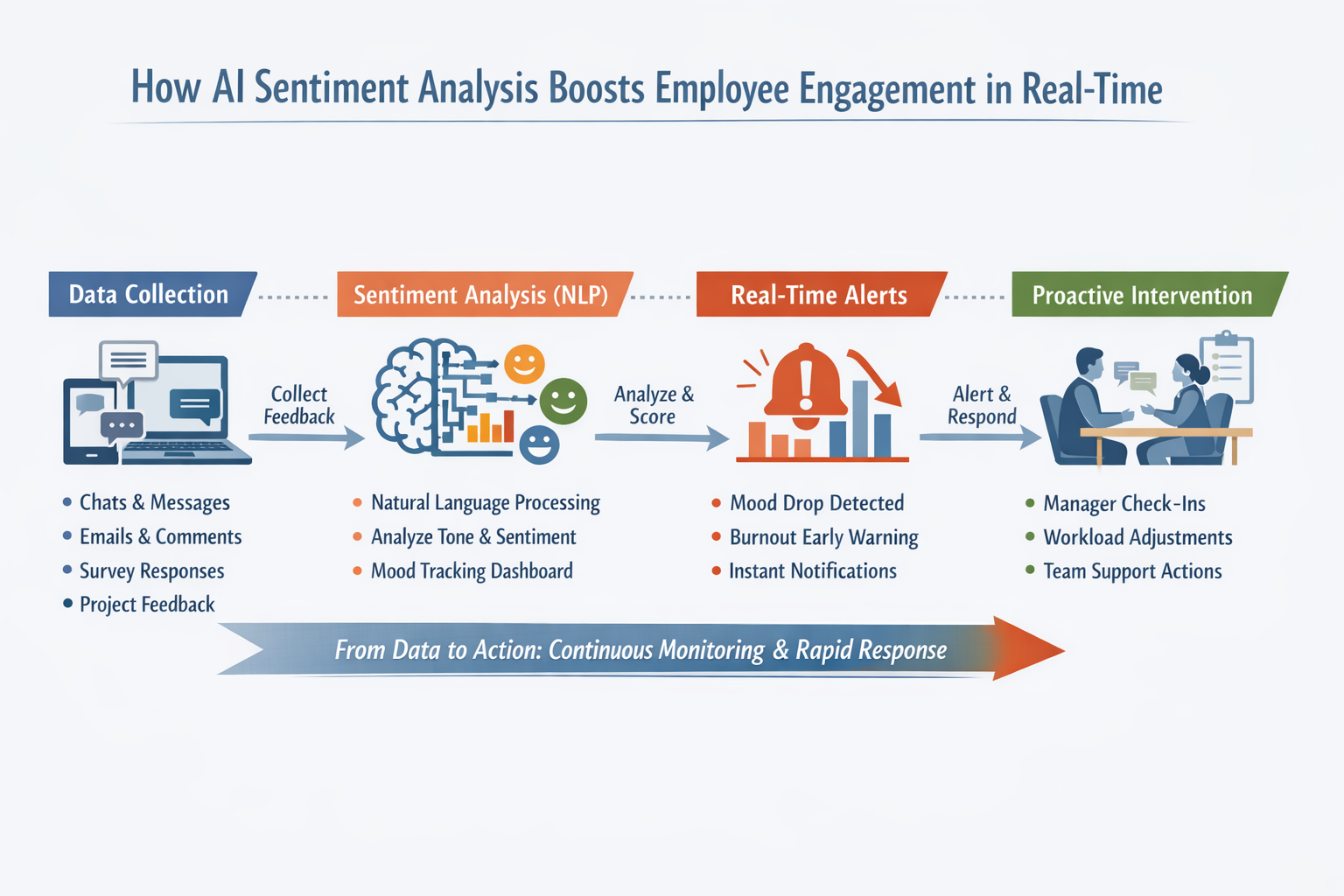
🧠 Using AI Sentiment Analysis to Boost Employee Engagement in Real-Time

Understanding how employees feel and responding quickly has become essential for maintaining engagement, productivity, and retention. Traditional methods like annual surveys or quarterly feedback reports often arrive too late, missing early signs of disengagement, stress, or burnout.

AI-powered sentiment analysis changes this dynamic. By analyzing patterns in communication and feedback, it provides real-time insights into employee morale and workplace sentiment. 

This allows organizations to detect small issues early and take meaningful action before they grow into larger problems such as disengagement, reduced performance, or employee turnover.

🤔 What Is AI Sentiment Analysis?

Sentiment analysis is a branch of Natural Language Processing (NLP) that interprets and quantifies emotions expressed in text-based communications. Applied to the workplace, it enables organizations to “read the room” across multiple channels while preserving privacy.

Typical data sources include:

  • Internal chat messages (Slack, Microsoft Teams)
     
  • Emails and comments
     
  • Open-ended survey responses
     
  • Project management and collaboration tools (Asana, Jira, Trello)

Using advanced algorithms, AI categorizes communication as positive, neutral, or negative and tracks shifts over time. Aggregated and anonymized insights ensure trust while providing actionable intelligence.

📈 Real-Time Insights: Acting on the “Heartbeat” of the Organization

Unlike traditional engagement methods, AI sentiment analysis provides continuous monitoring, turning static quarterly reports into live, adaptive engagement strategies. This allows organizations to:

  • Spot morale shifts immediately: Alerts managers when positive language drops after announcements or policy changes.
     
  • Detect early signs of burnout: Late-night messages, negative language, or declining collaboration can signal stress before it impacts productivity.
     
  • Differentiate temporary stress from systemic issues: NLP models distinguish short-term deadline pressure from chronic cultural problems, helping leadership prioritize interventions.

By shifting from rearview mirror tracking to real-time awareness, organizations can intervene proactively rather than reacting after problems escalate.

💡 Benefits of Real-Time Sentiment Analysis

  • Immediate Awareness: Understand employee feelings as they happen.
     
  • Adaptive Communication: Tailor messaging based on team mood.
     
  • Proactive Engagement: Detect negative trends early, reducing burnout and turnover.
     
  • Data-Driven Culture Insights: Aggregate sentiment to uncover hidden patterns or systemic issues.

🚀 From Insight to Action: Proactive Interventions

AI sentiment analysis doesn’t just signal problems, it enables targeted, timely actions:

  • Manager alerts when engagement dips in a team
     
  • Workload adjustments or task redistribution to alleviate stress
     
  • Pulse check-ins or informal conversations before morale issues escalate
     
  • Escalation to HR or leadership when persistent negative trends indicate cultural challenges

By converting qualitative communication into actionable intelligence, AI ensures organizations are continuously listening and responding to employee needs.

🌎 Real-World Examples and Measurable Outcomes

Global Consulting Firm: Detected low morale in a high-performing team due to lack of recognition. After HR coaching, team sentiment rose 35% in two months, retaining key talent.

Tech Start-Up: Identified frustration in engineering after a poorly implemented bug-tracking system. Leadership intervened within 24 hours, restoring productivity and engagement.

Telecommunications Call Center: Real-time monitoring of agent communications detected frustration spikes after a software update. Rapid response led to a 15% decrease in burnout and improved customer satisfaction.

These examples demonstrate AI sentiment analysis as a real-time “thermometer” for organizational health, allowing early detection and intervention.

⚖️ The Nuance: Temporary Stress vs. Systemic Culture

Not all negative sentiment signals a crisis. AI provides context to distinguish:

  • Temporary Stress: Short-term spikes due to deadlines or launches, may only require recognition or minor support.
     
  • Systemic Issues: Persistent negative sentiment, low participation, or high absenteeism over months, may require leadership coaching, cultural interventions, or organizational changes.

By providing these distinctions, AI equips managers with context-aware insights, ensuring interventions are timely, appropriate, and effective.

🤖 Best Practices for Implementing an AI Employee Engagement Platform

Deploying AI to enhance employee engagement is as much a cultural challenge as a technical one. While AI can provide powerful insights, predicting burnout, analyzing sentiment, and highlighting at-risk employees, its effectiveness depends on thoughtful implementation, ethical practices, and keeping humans at the center.

Done right, AI strengthens engagement, retention, and workplace culture. Done poorly, it risks creating distrust or a “Big Brother” effect. The following best practices provide a practical guide for integrating AI successfully into workforce engagement strategies.

1️⃣ Transparency Above All: Build Trust from Day One

Trust is the foundation of any AI engagement initiative. Employees must understand what data is collected, why, and how it will be used.

Key considerations:

  • The “What & Why”: Explain which data is analyzed (e.g., anonymized metadata, sentiment trends) and what is not analyzed (e.g., private messages).
     
  • Anonymity & Privacy: Aggregate and anonymize data to protect identities.
     
  • Ethical AI Practices: Emphasize that AI exists to support employees, not monitor them.

Transparency positions AI as a tool for empowerment, not surveillance, reducing resistance and fostering engagement.

2️⃣ Start Small: Pilot Programs for Proof of Concept

Avoid organization-wide rollouts immediately. Begin with a pilot program:

  • Volunteer Population: Choose a team or department where managers are enthusiastic.
     
  • Test Integration: Ensure seamless operation with tools like HRIS, Slack, Teams, or project management platforms.
     
  • Refine Workflows: Gather feedback to fine-tune alerts, dashboards, and interventions.
     
  • Demonstrate ROI: Track improvements in engagement, sentiment, and retention to build momentum for expansion.

Pilots reduce risk, calibrate predictive algorithms, and create real-world success stories.

3️⃣ Keep Humans in the Loop: AI as a Decision-Support Tool

AI is not a replacement for human judgment. Its role is to provide insights and recommendations, while managers act on them with empathy.

Best practices:

  • Alerts, Not Actions: AI flags risks, but managers decide the intervention, stay interviews, workload adjustments, or career discussions.
     
  • Manager Training: Teach managers to interpret insights sensitively:
     
     
      “I’ve noticed the team is under pressure, how can I help?”
     
     
  • Empathy-Driven Intervention: AI should enhance human connection, not turn employees into data points.

4️⃣ Choose the Right Platform: Integration, Compliance, and Usability

When selecting an AI platform, evaluate:

  • Seamless Integration: Works with HRIS, communication tools, and collaboration platforms.
     
  • Ease of Use: Intuitive dashboards for managers and HR leaders.
     
  • Privacy & Aggregation: Aggregated, anonymized data protects employees.
     
  • Compliance & Security: Supports GDPR, CCPA, and other standards.
     
  • Actionable Insights: Provides clear recommendations, not just raw data.

The right platform ensures smooth adoption and meaningful impact without workflow disruption.

5️⃣ Data Ethics and Privacy Considerations

Ethical AI and strong data privacy practices are non-negotiable:

  • Regulatory Compliance: Follow GDPR, CCPA, and other laws.
     
  • Ethical Oversight: Consider an internal committee (HR, legal, employee reps) to govern AI use.
     
  • Limit Scope: Focus on sentiment, metadata, and trends, not individual message content.
     
  • Transparency: Clearly communicate how insights are collected, stored, and used.

Prioritizing ethics builds trust and encourages authentic engagement.

6️⃣ Execution Strategy: Scale Gradually and Responsibly

Implementation should be incremental and iterative:

  • Start with a pilot, refine, then expand gradually.
     
  • Continuously monitor adoption, sentiment trends, and employee feedback.
     
  • Adjust alerts, thresholds, and interventions based on outcomes.

Gradual scaling ensures AI adoption is sustainable and culturally accepted.

7️⃣ Metrics and KPIs: Measure AI Effectiveness

Track both adoption and impact:

MetricPurposeAI Measurement
Employee Sentiment TrendsTrack engagement over timeAggregated sentiment scores from chats, surveys, and feedback
Manager ResponsivenessSpeed and quality of interventionsTime between AI alert and manager action
Engagement ScoresEvaluate improvement post-interventionPre- and post-AI engagement surveys
Retention / TurnoverAssess workforce stabilityCompare predicted flight-risk vs. actual attrition
Internal MobilityGauge career growthTrack reassignment or promotion of at-risk employees

Regular KPI review helps refine strategies, demonstrate ROI, and ensure meaningful impact.

🌟 Key Features for a Successful AI Engagement Platform

  • Real-Time Alerts: Notifications of sentiment dips or engagement risks.
     
  • Customizable Dashboards: Visualize trends across teams, departments, or organization-wide.
     
  • Predictive Insights: Identify flight risks, burnout, and engagement gaps early.
     
  • Integration with Communication Tools: Pulls anonymized data from Slack, Teams, email, and project management platforms.
     
  • Actionable Recommendations: Provides suggested interventions, not just metrics.
     
  • Ethical & Privacy Compliance: Supports regulatory standards while protecting employee trust.

Summary:

By following these best practices, organizations can deploy AI responsibly, empower managers, and enhance employee engagement while safeguarding trust and privacy. AI becomes a strategic partner, enabling a more responsive, resilient, and human-centered workplace.

🚀 Conclusion: AI as a Human-Centered Strategic Partner in Employee Engagement

The employee engagement crisis has made one thing abundantly clear: traditional, reactive HR methods, annual surveys, exit interviews, and sporadic feedback, are no longer enough. Organizations need a way to listen, respond, and act in real time to keep employees motivated, supported, and retained.

Artificial Intelligence (AI), when deployed thoughtfully, transforms HR from an administrative function into a predictive, strategic, and human-centered partner.

🌟 The Transformative Power of AI

AI empowers organizations to shift from hindsight-driven practices to proactive strategies, offering:

  • Real-Time Insights: Sentiment analysis detects morale shifts, nascent burnout, and systemic cultural challenges before they escalate.
     
  • Predictive Capabilities: Flight risks, engagement dips, and burnout patterns are identified early, enabling timely interventions.
     
  • Personalized Development: Career pathing and skill-building opportunities are tailored to individual employees, increasing retention.
     
  • Enhanced Decision-Making: AI augments human judgment with data-driven intelligence, helping managers act with empathy and precision.

Importantly, AI does not replace human leadership, it amplifies it. Algorithms reveal the “what” and sometimes the “when,” but understanding the “why” and determining the “how” remain the domain of humans. AI provides the radar, dashboard, and early-warning system, while managers deliver context, compassion, and human connection.

🔮 Looking Ahead: AI as a Workplace Co-Pilot

The future workplace envisions AI as an everyday co-pilot for employees, managers, and organizations:

  • For Employees: Suggests well-timed breaks, monitors workload stress, and surfaces skill development or internal mobility opportunities.
     
  • For Managers: Highlights hidden engagement risks, identifies high-potential talent, and supports proactive coaching and recognition.
     
  • For Organizations: Enables continuous feedback loops, refining culture, policies, and engagement strategies in real time rather than relying on guesswork.

AI handles the analytical heavy lifting, freeing humans to focus on the emotional and relational aspects of engagement, the very factors that drive loyalty, productivity, and organizational resilience.

⚖️ Responsible, Human-Centered Implementation

AI’s potential is unlocked only when implemented ethically and transparently:

  • Data Privacy and Anonymity: Build trust by protecting individual identities.
     
  • Human-in-the-Loop Approach: Ensure managers act on AI insights with empathy.
     
  • Balanced Use of Metrics: Avoid reducing employees to numbers; recognize them as people.
     
  • Pilot Programs: Start small, demonstrate ROI, and refine processes before scaling.

Responsible deployment positions AI as a trusted ally, not a surveillance tool.

🛠 Begin the AI Engagement Journey

AI alone cannot solve the engagement crisis, human connection, trust, and leadership remain irreplaceable. Yet AI is the most powerful tool HR has ever had to:

  • Understand workforce dynamics.
     
  • Detect risks early.
     
  • Enable actionable interventions at scale.

Leaders should begin by:

    1. Assessing Technological Maturity: Are current feedback systems delivering actionable insights?
       
    2. Prioritizing Human Judgment: Are managers ready to act on AI-driven alerts with empathy?
       
    3. Investing in Transparency and Ethics: Has the workforce been prepared and informed about AI use?

When applied thoughtfully, AI transforms engagement from a reactive challenge into a strategic advantage, ensuring employees feel seen, heard, and valued, not despite technology, but because of it. It becomes the bridge between human insight and organizational foresight, ushering in an era where engagement is continuous, personalized, and meaningful.

FREE DATASHEET
eXo Platform : The AI-Augmented,
Open-Source Digital Workplace Platform

Download the eXo Platform Datasheet and discover all the features and benefits

book-datasheet-7
cta-rectangle-rose
FREE DATASHEET

Download the eXo Platform Datasheet and discover all the features and benefits

FAQ

You will find here Frequently Asked Questions about AI for Employee Engagement with all the answers in one place.

Employee engagement is the emotional and intellectual commitment an employee has toward their job, their team, and their organization. It’s about how much an individual cares about the company’s success and how motivated they are to contribute to its goals. Engaged employees don’t just show up—they feel proud, passionate, and fully involved in their work.


This engagement can take many forms: feeling loyal and connected (emotional), being focused and eager to improve (cognitive), or showing high productivity and advocacy for the company (behavioral). Strong leadership, a positive culture, growth opportunities, and work-life balance are some of the key drivers that make it possible.


See the full definition of employee engagement

AI is helping rehumanize employee engagement by automating administrative tasks and providing real-time insights into employee well-being, motivation, and engagement levels. This allows managers to spend more time on meaningful conversations, coaching, recognition, and career development.


By combining data-driven intelligence with human empathy, AI enables organizations to create a more personalized, proactive, and engaging employee experience.


➝ Learn more about how AI is rehumanizing employee engagement

An AI-powered intranet is a modern internal platform that uses artificial intelligence technologies to enhance communication, knowledge management, and employee productivity within an organization.


Traditional intranets were designed primarily to store internal documents, company policies, and announcements in a centralized portal. While useful for organizing information, these systems often rely on manual navigation and basic keyword searches, which can make it difficult for employees to find what they need quickly.


AI-powered intranets solve this problem by integrating intelligent technologies that enable the platform to understand context, learn from user behavior, and deliver personalized information automatically. Instead of acting as passive storage systems, these intranets function as interactive digital assistants that support employees throughout their workday.


See the full definition of AI-Powered Intranet
An employee engagement platform is a digital space where employees feel more connected, motivated, and valued. It brings together tools for communication, recognition, feedback, and collaboration—all designed to improve satisfaction, productivity, and workplace culture. In short, it helps turn a company into a more engaged, innovative, and happy place to work.


See the full definition of an employee engagement platform

Employee engagement is far more than a buzzword—it directly impacts business success. When employees feel connected, valued, and motivated, both people and companies thrive. Engaged teams are more productive, innovative, and loyal, which translates into better results and stronger workplace culture.


Here’s why it matters:

  • ⚡ Higher productivity: Engaged employees are focused and efficient—Gallup reports they’re 17% more productive than disengaged ones.
  • 🔁 Lower turnover: Valued employees are 59% less likely to quit, reducing hiring and training costs.
  • 😊 Better customer satisfaction: Happy employees deliver better service, leading to higher customer ratings.
  • 💡 Greater innovation: Engagement encourages creativity, problem-solving, and fresh ideas.
  • 🤝 Stronger company culture: Open communication and recognition create a sense of belonging.
  • 💰 Improved financial performance: Highly engaged teams drive 21% higher profitability.
  • 📉 Reduced absenteeism: Motivated employees are more present—both physically and mentally.


Yet, only 23% of employees worldwide are actively engaged (Gallup 2023). This gap shows just how crucial it is for organizations to invest in engagement and create a workplace where people feel connected, appreciated, and inspired.


Find out why employee engagement is important.

Employee engagement platforms are designed to connect people, boost motivation, and help organizations perform at their best. They bring essential tools together in one place to improve communication, recognition, feedback, and collaboration.


Here are some of the most important features:


  • 📣 Centralized communication: A single hub for announcements, news, messages, and updates—keeping everyone aligned.
  • 🤝 Stronger collaboration: Shared workspaces, team channels, and project boards that make teamwork seamless in hybrid or remote setups.
  • 🌟 Recognition & rewards: Peer-to-peer recognition, shout-outs, and gamification tools to celebrate achievements and boost morale.
  • 📊 Real-time feedback: Surveys, polls, and feedback loops to capture employee sentiment and act on it quickly.
  • 🚀 Onboarding & development: Easy access to policies, training, and resources for faster integration and career growth.
  • 📚 Knowledge management: Wikis, searchable databases, and document management systems to find information instantly.
  • 📈 Data-driven insights: Analytics and sentiment tracking to measure engagement and guide decisions.
  • 🌍 Remote & hybrid support: Virtual spaces, social feeds, and mobile tools that keep teams connected anywhere.
  • 🫂 Community & belonging: Directories, profiles, and interest groups that help employees build stronger connections.


All of these features work together to create a workplace where people feel informed, appreciated, and part of a thriving community.


Dicover the full list of employee engagement platform features

  • Ensure a strong corporate culture
  • Ensure good relationship with management
  • Foster good relationships between the colleagues
  • Think about employee recognition
  • Express meaning for work in your organization
  • Make well-being and work/life balance your priority
  • Allow more flexibility and autonomy
  • Invest in skills development and training


Find out how to improve employee engagement in the workplace

I am a Digital Marketing specialist specialized in SEO at eXo Platform. Passionate about new technologies and Digital Marketing. With 10 years' experience, I support companies in their digital communication strategies and implement the tools necessary for their success. My approach combines the use of different traffic acquisition levers and an optimization of the user experience to convert visitors into customers. After various digital experiences in communication agencies as well as in B2B company, I have a wide range of skills and I am able to manage the digital marketing strategy of small and medium-sized companies.
Related posts
  • All
  • eXo
  • Digital workplace
  • Employee engagement
  • Open source
  • Future of work
  • Internal communication
  • Collaboration
  • News
  • intranet
  • workplace
  • Knowledge management
  • Employee experience
  • Employee productivity
  • onboarding
  • Employee recognition
  • Change management
  • Cartoon
  • Digital transformation
  • Infographic
  • Remote work
  • Industry trends
  • Product News
  • Thought leadership
  • Tips & Tricks
  • Tutorial
  • Uncategorized
Leave a Reply

( Your e-mail address will not be published)

guest
0 Comments
Commentaires en ligne
Afficher tous les commentaires

I am a Digital Marketing specialist specialized in SEO at eXo Platform. Passionate about new technologies and Digital Marketing. With 10 years' experience, I support companies in their digital communication strategies and implement the tools necessary for their success. My approach combines the use of different traffic acquisition levers and an optimization of the user experience to convert visitors into customers. After various digital experiences in communication agencies as well as in B2B company, I have a wide range of skills and I am able to manage the digital marketing strategy of small and medium-sized companies.