
FREE WHITE PAPER
Discover our in-depth analysis of the concept of employee engagement, its roots, and ways to improve it significantly
Employee engagement has become one of the most important drivers of organizational success and one of the biggest challenges facing businesses today. In an era where talent is harder to attract, employee expectations are evolving rapidly, and hybrid work has become the norm, organizations can no longer rely solely on competitive salaries and traditional benefits to retain their workforce and maintain high levels of performance.

Today’s employees are looking for more than a paycheck. They want meaningful work, opportunities for growth, recognition for their contributions, flexibility, a sense of belonging, and a workplace culture that supports their well-being. When these needs are met, employees are more likely to be motivated, productive, innovative, and committed to their organization’s success.
Yet despite growing awareness of its importance, employee engagement remains a global challenge. According to Gallup, only 20% of employees worldwide are actively engaged at work, while the majority are either disengaged or actively disconnected from their organizations. The consequences are significant.
Low engagement contributes to reduced productivity, increased absenteeism, higher turnover, and lost business opportunities, costing the global economy an estimated $9.6 trillion annually in lost productivity.
At the same time, the workplace itself is undergoing a profound transformation. The rise of remote and hybrid work models has reshaped how employees communicate, collaborate, and connect with their organizations. Traditional engagement methods that once relied on face-to-face interactions are no longer enough. Companies must now find new ways to foster connection, strengthen culture, and create meaningful employee experiences regardless of where people work.
This is why employee engagement has evolved from an HR initiative into a strategic business priority. Organizations with highly engaged employees consistently outperform their competitors. They benefit from stronger retention rates, higher customer satisfaction, increased innovation, better collaboration, and improved financial performance. In many cases, employee engagement becomes a sustainable competitive advantage that directly impacts long-term business growth.
Building an engaged workforce, however, does not happen by accident. It requires a deliberate strategy that combines effective leadership, transparent communication, continuous feedback, employee recognition, professional development opportunities, and the right digital tools to support collaboration and connection.
In this comprehensive guide, we’ll explore 25 proven employee engagement strategies that organizations can implement to create a more connected, motivated, and productive workplace. You’ll discover why each strategy matters, what makes it effective, practical examples of how it can be applied, and real-world insights from workplace research and successful organizations. We’ll also examine how modern digital workplace platforms such as eXo Platform can help turn engagement initiatives into measurable results by bringing communication, collaboration, recognition, and community-building into a single employee experience.
Whether you’re looking to improve retention, strengthen company culture, boost productivity, or simply create a better workplace experience, these employee engagement strategies will provide a practical roadmap for building a thriving and connected workforce in 2026 and beyond.
At its core, an employee engagement strategy is designed to increase employees’ sense of purpose, commitment, motivation, and belonging. It creates the conditions that help people feel valued for their contributions, connected to company goals, empowered to share ideas, and confident that their growth and well-being matter. When employees feel engaged, they are more likely to demonstrate discretionary effort, collaborate effectively, innovate, and remain committed to the organization over the long term.
Unlike isolated initiatives such as annual team-building events or recognition programs, a true engagement strategy integrates multiple elements of the employee experience into a cohesive framework. This includes leadership behaviors, communication practices, recognition systems, career development opportunities, workplace culture, technology, and everyday work experiences. Together, these components form a sustainable ecosystem that supports both employee success and organizational performance.
Effective employee engagement strategies align people, processes, leadership, and technology throughout the entire employee lifecycle, from recruitment and onboarding to development, retention, and career progression. By fostering a workplace where employees feel heard, appreciated, and equipped to do their best work, organizations can build stronger teams, improve productivity, enhance retention, and create a more connected and resilient workplace.
The Complete Guide to
Employee Engagement
Discover our in-depth analysis of the concept of employee engagement, its roots, and ways to improve it significantly
Discover our in-depth analysis of the concept of employee engagement, its roots, and ways to improve it significantly
Employee engagement is far more than an HR metric or a management concept; it is a critical driver of organizational performance and long-term success. When employees feel connected to their work, aligned with company goals, and genuinely valued for their contributions, the benefits extend throughout the entire organization.
Highly engaged employees bring greater energy, commitment, and purpose to their roles. They are more likely to contribute innovative ideas, collaborate effectively with colleagues, deliver exceptional customer experiences, and remain loyal to their employers. As a result, organizations that prioritize employee engagement often outperform competitors across key business metrics, including productivity, profitability, retention, and customer satisfaction.
To foster higher levels of engagement, organizations should implement targeted employee engagement strategies such as promoting transparent communication, providing regular recognition and feedback, investing in professional development opportunities, encouraging collaboration across teams, supporting employee well-being, and creating clear pathways for career growth. Empowering employees through meaningful work, inclusive leadership, and a strong organizational culture further strengthens engagement and helps build a motivated, high-performing workforce.
Ultimately, employee engagement is not a one-time initiative but an ongoing commitment that requires consistent effort from leaders and managers. Organizations that successfully cultivate an engaged workforce are better positioned to drive innovation, adapt to change, and achieve sustainable long-term success.
Engaged employees are motivated to perform at their best and frequently exceed expectations. They take ownership of their responsibilities, remain focused on organizational goals, and demonstrate a stronger commitment to achieving results.
Research consistently shows that highly engaged teams experience higher levels of productivity and operational efficiency, helping organizations accomplish more with greater consistency and quality.
Employee engagement has a direct impact on financial performance. Organizations with highly engaged workforces consistently achieve stronger business outcomes than those with disengaged employees.
Studies have found that companies with high engagement levels can experience up to 23% greater profitability, highlighting the strong connection between employee commitment and organizational success. Engaged employees contribute more value, improve operational effectiveness, and help drive sustainable growth.
Retaining skilled employees has become just as important as attracting top talent. When employees feel appreciated, supported, and connected to their workplace, they are far more likely to remain committed to their organization and less likely to explore opportunities elsewhere.
Organizations that foster a strong culture of engagement often experience lower turnover rates, helping reduce recruitment and onboarding costs while preserving valuable institutional knowledge. Beyond retention, engaged employees tend to be more productive, motivated, and invested in achieving both individual and organizational goals. They are more likely to take initiative, collaborate effectively, and consistently deliver high-quality work, contributing directly to overall business performance.
To strengthen employee engagement and productivity, organizations can implement strategies such as recognizing employee contributions, encouraging open communication, providing opportunities for learning and career development, promoting work-life balance, and creating an inclusive workplace culture. These initiatives help employees feel valued and empowered, leading to higher job satisfaction, stronger performance, and long-term organizational success.
Employee engagement and customer satisfaction are closely connected. Employees who care about their organization are more likely to deliver exceptional service, build meaningful customer relationships, and act as positive ambassadors for the brand.
When employees are engaged, customers notice the difference through better service quality, responsiveness, and overall experience.
Innovation thrives in workplaces where employees feel empowered to contribute ideas and participate in decision-making. Engaged employees are more willing to share insights, collaborate across departments, and take initiative when solving problems.
This culture of involvement encourages continuous improvement and helps organizations remain competitive in rapidly changing markets.
Employees who are emotionally invested in their work typically demonstrate stronger commitment and reliability. They are more likely to maintain consistent attendance and contribute positively to team performance.
As a result, highly engaged organizations often experience lower absenteeism rates, minimizing disruptions and improving overall productivity.
Employee engagement plays a foundational role in building a healthy organizational culture. Engaged teams foster trust, open communication, collaboration, and mutual respect, creating an environment where employees feel supported and valued.
A strong workplace culture not only improves morale but also helps employees develop a genuine sense of belonging and purpose.
Organizations known for prioritizing employee engagement develop stronger reputations as employers of choice. Positive employee experiences often translate into favorable reviews, referrals, and advocacy, making it easier to attract top talent.
A strong employer brand strengthens recruitment efforts while reinforcing long-term organizational success.
Organizations with highly engaged employees commonly experience:
The benefits of high employee engagement extend far beyond employee satisfaction. Engaged employees are more productive, innovative, loyal, and customer-focused, creating measurable advantages across every area of the business. By investing in meaningful engagement initiatives, organizations can build a thriving workplace culture while improving performance, profitability, retention, and long-term resilience.
Ultimately, employee engagement is not simply an HR initiative, it is a strategic business investment that drives sustainable success in today’s connected workplace.
Employee engagement does not happen by chance. While occasional team-building events, recognition programs, or workplace perks can boost morale temporarily, they rarely create lasting engagement on their own. Without a deliberate and well-structured employee engagement strategy, organizations often struggle to build meaningful employee experiences, resulting in inconsistent efforts and limited long-term impact.
A formal employee engagement strategy provides a clear roadmap for fostering a workplace where employees feel connected, valued, and motivated. Effective employee engagement strategies help organizations align individual aspirations with business objectives, ensuring employees see themselves as active contributors to a shared mission rather than simply fulfilling job responsibilities.
In addition, organizations that invest in employee engagement often benefit from higher employee productivity, stronger collaboration, and improved overall performance. Providing employees with the right tools and resources is also essential to maintaining engagement.
For example, implementing knowledge base software can help employees easily access information, share expertise, and find answers quickly, reducing frustration and enabling them to work more efficiently. By combining effective employee engagement strategies with technology that supports knowledge sharing and productivity, organizations can create a more engaged, informed, and high-performing workforce.
The need for a structured engagement strategy has never been greater. Recent workforce research indicates that employee engagement levels remain alarmingly low across many regions, with only a small percentage of employees feeling fully engaged in their work. At the same time, many leaders significantly overestimate how engaged their workforce actually is, creating a dangerous perception gap that can lead to declining morale, reduced loyalty, and unexpected turnover.
When organizations assume employees are engaged without actively measuring and improving the employee experience, they risk overlooking critical issues that impact performance, culture, and retention.
Organizations that lack a comprehensive engagement strategy often experience a range of challenges that affect both employees and business outcomes.
Common consequences include:
Over time, these challenges can create a cycle of disengagement that becomes increasingly difficult, and costly, to reverse.
Employee engagement is often viewed as an HR responsibility, but its impact reaches every area of the organization. Highly engaged employees are more productive, customer-focused, innovative, and committed to organizational success. They are also more likely to advocate for their employer, strengthen workplace culture, and contribute to long-term growth.
Effective employee engagement strategies help organizations create an environment where employees feel valued, supported, and empowered to perform at their best. These strategies not only improve individual performance but also foster stronger teamwork and cross-functional collaboration. By encouraging open communication and shared goals, organizations can build a culture where employees work together more effectively and contribute to collective success.
Technology also plays an important role in supporting engagement and collaboration. Modern team collaboration tools enable employees to communicate seamlessly, share knowledge, coordinate projects, and stay connected regardless of location. When combined with strong leadership and engagement initiatives, these tools help strengthen teamwork, improve efficiency, and create a more connected workforce.
Conversely, disengagement carries a significant financial cost. Lost productivity, increased absenteeism, higher turnover, and declining performance can collectively cost organizations millions each year. Investing in engagement is therefore not simply about improving employee satisfaction; it is about protecting and strengthening business performance while creating a collaborative and high-performing work environment.
A strong engagement strategy also plays a critical role in shaping organizational culture and employer reputation. Engaged employees are more likely to embody company values in their daily interactions, helping create a consistent experience for both colleagues and customers.
When employees genuinely believe in the organization’s mission and feel connected to its purpose, they become powerful brand ambassadors. Their actions, attitudes, and commitment reinforce the organization’s identity, strengthen customer trust, and enhance its reputation as an employer of choice.
As workplaces continue to evolve and become more digital and distributed, maintaining strong employee connections has become both more challenging and more important than ever. A structured employee engagement strategy helps organizations create consistent internal communications, support employee well-being, encourage professional development, and foster a sense of belonging regardless of where employees work.
Effective employee engagement strategies rely on clear communication, accessibility, and collaboration. An intranet can play a central role in these efforts by serving as a hub for company news, resources, knowledge sharing, and employee interactions. When supported by strong internal communications, an intranet helps keep employees informed, connected, and aligned with organizational goals, regardless of their location.
By investing in engagement, organizations build resilient, motivated, and high-performing teams that are better equipped to adapt to change, collaborate effectively, and drive sustainable success. These efforts not only strengthen employee relationships but also contribute to a more connected workplace culture and improved organizational performance.
An employee engagement strategy is not a nice-to-have initiative, it is a business necessity. Without a clear plan, engagement efforts become fragmented and reactive, leading to lower morale, weaker performance, and higher turnover. A well-designed strategy creates a foundation for meaningful employee experiences, stronger workplace culture, improved business outcomes, and a workforce that remains connected, committed, and motivated to succeed.
At their core, employee engagement strategies help bridge the gap between organizational goals and employee needs. They foster a workplace culture where people are not only productive but also genuinely invested in the success of the organization. When employees feel connected to their roles, their colleagues, and the company’s mission, they are more likely to perform at higher levels, collaborate effectively, and remain committed over the long term.
A common misconception is that employee engagement is driven solely by perks such as free lunches, team events, or office amenities. While these initiatives can contribute to a positive workplace experience, true engagement goes much deeper.
Effective engagement strategies focus on creating meaningful employee experiences by addressing the factors that have the greatest influence on motivation and job satisfaction, including purpose, recognition, growth opportunities, communication, leadership support, and well-being.
Successful engagement strategies typically focus on several interconnected areas of the employee experience, including:
The most successful organizations recognize that engagement is not achieved through a single initiative. Instead, they adopt a portfolio approach, combining multiple strategies into an integrated engagement ecosystem that supports employees throughout every stage of their journey.
For example, recognition programs may increase motivation, but their impact is amplified when combined with strong leadership, clear communication, career development opportunities, and a culture of trust. Together, these elements create a workplace where employees can thrive both personally and professionally.
In today’s connected workplace, employees expect more than just a paycheck. They want meaningful work, opportunities for growth, supportive leadership, and a culture that values their contributions. Organizations that invest in employee engagement strategies are better positioned to attract top talent, retain high performers, foster innovation, and achieve sustainable business success.
Employee engagement strategies are the building blocks of a thriving workplace. By implementing a combination of initiatives focused on recognition, communication, development, well-being, leadership, and culture, organizations can create an environment where employees feel connected, motivated, and empowered to do their best work. The following 25 proven employee engagement strategies provide practical ways to build that connected, high-performing workplace.
Successful employee engagement is not built on a single initiative or isolated program. Instead, it emerges from a carefully designed combination of strategies that shape how employees experience their work every day. The most effective organizations adopt a structured, multi-dimensional approach that strengthens connection, motivation, and performance across all levels of the workforce.
In 2025 and beyond, employee engagement strategies are increasingly shaped by deeper insights into what truly drives people at work. Research highlights that engagement is no longer just about perks or surface-level satisfaction, it is rooted in purpose, trust, growth, and meaningful connection to both leadership and organizational goals.
Modern engagement frameworks often align around six core themes: organizational culture, leadership transparency, resource investment, professional growth, meaningful work, and recognition. These pillars provide a foundation for building workplaces where employees feel supported, empowered, and inspired to contribute their best work.
Recognition remains one of the most powerful drivers of engagement. When employees feel their contributions are noticed and valued, their motivation and commitment naturally increase.
Effective recognition strategies go beyond occasional rewards and instead create a consistent culture of appreciation. This includes peer-to-peer recognition, manager-led feedback, and structured reward systems that reinforce positive behaviors and achievements.
Clear and honest communication is essential for building trust. Employees want to understand organizational goals, strategic direction, and how their work contributes to the bigger picture.
Transparent leadership involves not only sharing information but also listening actively to employee feedback. When leaders are accessible and communicative, employees feel more secure, included, and aligned with company vision.
Opportunities for growth are a major factor in employee satisfaction and retention. Employees are more engaged when they can see a clear path for advancement and skill development.
Organizations that invest in training programs, mentorship, and continuous learning create a culture of progress. This helps employees feel that their careers are evolving rather than stagnating.
Engagement thrives in environments where feedback is frequent, constructive, and two-way. Rather than relying solely on annual performance reviews, leading organizations encourage ongoing conversations between employees and managers.
This approach allows employees to understand expectations, track progress, and continuously improve while feeling supported throughout their journey.
Well-being has become a central pillar of engagement strategies. Employees perform best when they feel physically, mentally, and emotionally supported.
Organizations that prioritize well-being often provide wellness programs, mental health support, and policies that promote balance between professional and personal life. This leads to healthier, more resilient, and more productive teams.
Flexibility is now a key expectation in the modern workplace. Whether through hybrid models, remote work options, or flexible scheduling, organizations that offer autonomy over when and where work happens tend to see higher engagement levels.
Flexibility empowers employees to manage their responsibilities more effectively while maintaining productivity and satisfaction.
Leadership plays a critical role in shaping employee engagement. Accessible leaders who actively engage with teams foster trust, confidence, and alignment.
When employees feel that leadership is approachable and responsive, they are more likely to share ideas, raise concerns, and remain committed to organizational goals.
Collaboration strengthens both relationships and performance. Engaged workplaces encourage teamwork, cross-functional projects, and open communication between departments.
A collaborative environment helps employees feel connected to their peers, reduces isolation, and enhances problem-solving through shared knowledge and perspectives.
Organizations that encourage knowledge sharing create stronger, more adaptable teams. When employees freely exchange expertise, insights, and best practices, the entire organization benefits.
This can be supported through internal learning platforms, mentorship programs, team discussions, and documentation systems that preserve institutional knowledge.
In a connected workplace, digital tools play a vital role in engagement. Effective technology improves communication, streamlines workflows, and enhances collaboration across teams and locations.
From project management platforms to communication tools and employee experience systems, digital solutions help employees stay informed, productive, and connected regardless of where they work.
Together, these strategies form a comprehensive engagement ecosystem aligned with the most important drivers of employee experience: culture, leadership, growth, purpose, and recognition.
When organizations intentionally design engagement around these principles, they move beyond reactive initiatives and instead build a sustainable system that supports long-term performance and employee satisfaction.
Effective employee engagement strategies are interconnected rather than isolated. Recognition, communication, development, well-being, flexibility, and collaboration all work together to shape how employees experience their workplace. By integrating these elements into a cohesive strategy, organizations can build a connected, motivated, and high-performing workforce prepared for the future of work.
Employee retention is one of the clearest and most measurable outcomes of effective employee engagement. When organizations invest in meaningful engagement strategies, they don’t just improve morale, they directly reduce the likelihood that employees will leave. In today’s competitive talent market, where replacing an employee can cost up to 1.5 to 2 times their annual salary in recruitment, onboarding, and lost productivity, retention has become both a financial priority and a strategic necessity.
At its core, retention is about whether employees feel they have a future within an organization. Engagement strategies address this by strengthening emotional connection, improving workplace experience, and removing the most common drivers of voluntary turnover.
Research consistently shows that disengagement is one of the strongest predictors of employee turnover. Nearly 47% of employee departures are linked to unhealthy or unsupportive workplace culture, highlighting just how critical the employee experience is to retention outcomes.
Employee engagement strategies reduce turnover by addressing the root causes that typically push employees to leave, including lack of recognition, poor communication, limited career growth, and ineffective leadership.
When these issues are addressed, employees are far more likely to stay, not because they feel trapped, but because they feel genuinely connected and valued.
Effective engagement strategies improve retention by strengthening several key psychological and professional needs that employees consistently prioritize:
A major factor influencing retention is organizational culture. Employees who operate in healthy, supportive environments are significantly less likely to leave. In contrast, toxic management practices or inconsistent communication can quickly erode trust and drive turnover.
Engagement strategies that emphasize continuous feedback and recognition are particularly effective. Companies that maintain regular feedback cycles report up to 40% higher engagement levels, demonstrating the strong link between communication quality and employee satisfaction.
Similarly, non-monetary recognition programs, such as peer appreciation, milestone celebrations, and manager-led acknowledgment, help reinforce positive behavior and strengthen emotional commitment to the organization.
Retention is not only influenced by long-term engagement efforts but also by the very first stages of the employee journey. A well-structured onboarding experience significantly improves retention by helping new hires feel welcomed, informed, and aligned with company culture from day one.
Employees who experience strong onboarding are more likely to develop early connections, understand expectations clearly, and build confidence in their role, all of which reduce early-stage turnover.
When engagement strategies are consistently applied, they transform how employees perceive their workplace. Instead of viewing their job as a temporary stop or stepping stone, employees begin to see it as a place for long-term growth and professional fulfillment.
This shift is critical. Employees who feel connected to their peers, supported by leadership, and confident in their future within the organization are significantly less likely to explore external opportunities.
Employee engagement strategies directly strengthen retention by addressing the real reasons people leave organizations. By improving recognition, communication, leadership trust, career development, and workplace culture, companies can significantly reduce turnover and build a more stable, committed workforce.
Ultimately, employee engagement transforms retention from a reactive challenge into a proactive advantage, turning workplaces into environments where employees choose to stay, grow, and thrive.
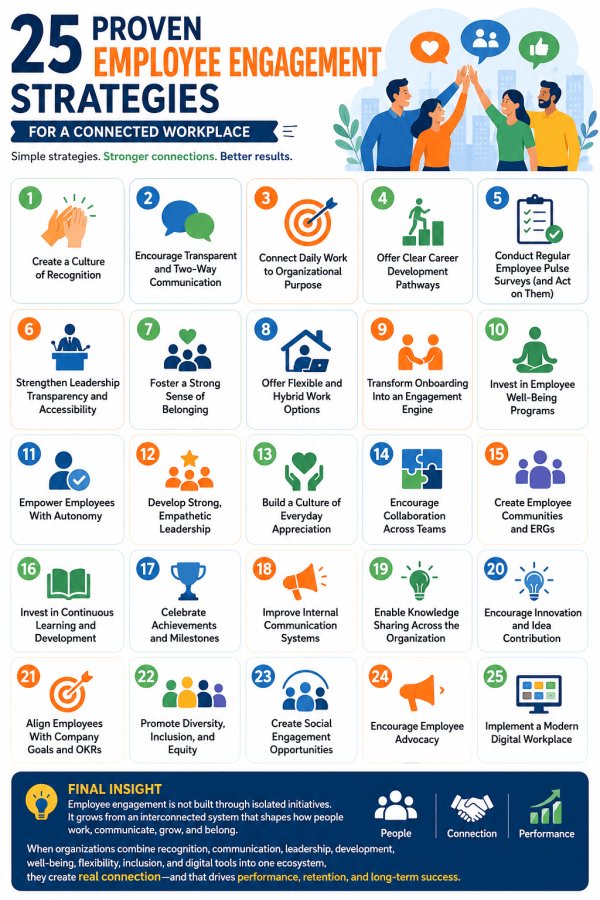
Building a truly engaged workforce requires more than isolated initiatives or occasional perks, it demands a structured, human-centered system of strategies that shape how employees experience work every day. In modern organizations, engagement is no longer a “nice-to-have” HR function; it is a core driver of productivity, retention, innovation, and long-term business success.
The most effective engagement strategies are interconnected. They combine culture, communication, leadership, development, technology, and well-being into a unified experience that helps employees feel connected not just to their tasks, but to their teams and the organization’s purpose.
Below are 25 proven employee engagement strategies that leading organizations use to build connected, motivated, and high-performing workplaces.
Among the 25 proven employee engagement strategies, creating a culture of recognition is one of the most foundational and high-impact approaches. At its core, it is about building a workplace where people don’t just work—they feel seen, valued, and genuinely appreciated for what they contribute. When recognition becomes part of everyday culture rather than an occasional event, it shapes a more positive, motivated, and emotionally connected workforce.
Recognition is one of the strongest drivers of employee engagement. When employees know that their contributions are noticed and appreciated, they experience higher job satisfaction, stronger morale, and greater loyalty to the organization. Consistent recognition also reinforces desired behaviors, boosts productivity, and helps reduce turnover by making employees feel that their work truly matters.
Effective recognition is not about annual awards or occasional praise, it’s about consistency and intention. The most successful recognition cultures share a few key characteristics:
When appreciation becomes part of daily interactions rather than a formal process, employees feel continuously supported and motivated.
Many organizations now use peer-to-peer recognition systems and digital platforms where employees can publicly appreciate each other’s efforts. Simple practices like team shout-outs during meetings, recognition boards in shared spaces, or online appreciation feeds can significantly improve morale. These small but consistent actions help build stronger relationships and create a workplace culture where positivity and encouragement naturally grow.
Transparent and two-way communication is essential for building trust and alignment within any organization. It ensures that communication doesn’t just flow from leadership downwards but moves in both directions, allowing employees to actively participate in conversations that shape the organization.
Employees cannot fully engage with a vision they do not understand. When communication is unclear, inconsistent, or one-sided, it creates confusion, mistrust, and disengagement. On the other hand, transparency helps employees understand not just what decisions are being made, but why they are being made—strengthening trust in leadership and the organization as a whole.
Strong communication systems are built on dialogue, not just information sharing. The most effective environments include:
When employees feel both informed and heard, trust grows naturally.
Many organizations hold CEO town halls, open Q&A sessions, and internal discussion forums where employees can directly engage with leadership. These formats create space for honest questions, real feedback, and clearer understanding of strategic decisions—ultimately strengthening alignment and trust across all levels of the organization.
This strategy focuses on helping employees understand how their daily tasks connect to a larger mission. When people clearly see the bigger purpose behind their work, their motivation and sense of meaning increase significantly.
Employees are far more engaged when they understand the “why” behind what they do. Without that connection, even important tasks can feel repetitive or disconnected from meaningful outcomes. Purpose gives work direction and helps employees feel that they are contributing to something larger than themselves.
This strategy becomes most powerful when purpose is consistently reinforced throughout the organization:
When purpose is part of everyday conversations, work becomes more meaningful and engaging.
Organizations often use customer success stories, case studies, or impact reports to show how employee efforts translate into real-world outcomes. For example, sharing how a product improves a customer’s life helps employees clearly see the value of their work and strengthens their emotional connection to the organization’s mission.
Career development is one of the most powerful drivers of long-term employee engagement. When employees can clearly see how they can grow within an organization, they are far more likely to stay motivated, committed, and invested in their work. Without visible growth opportunities, even satisfied employees may eventually look elsewhere for advancement.
One of the main reasons employees leave organizations is the lack of career progression. People want to feel that their efforts today are building toward something meaningful tomorrow. When growth feels unclear or inaccessible, engagement declines and turnover risk increases. Providing clear development pathways helps employees see a future within the company rather than outside it.
Effective career development is not just about promotions—it’s about structured growth and continuous learning. Strong systems typically include:
When employees understand how they can grow and what steps they need to take, they feel more in control of their future.
Employee pulse surveys are a simple but powerful way to stay connected to how employees are feeling in real time. Unlike annual surveys, pulse surveys are short, frequent, and focused, allowing organizations to quickly identify issues, trends, and opportunities for improvement.
Feedback only creates value when it leads to action. When employees share their opinions but see no response or change, trust erodes quickly. On the other hand, when feedback is acknowledged and acted upon, employees feel heard and respected, which significantly strengthens engagement and loyalty.
The effectiveness of pulse surveys depends on both consistency and follow-through:
Organizations that consistently close the feedback loop tend to see higher trust, stronger morale, and more open communication.
Many companies use monthly or quarterly pulse surveys and then share results openly with employees, followed by clear action plans. This transparency shows that feedback is not just collected—it is used to drive meaningful improvements.
Leadership transparency and accessibility are critical for building trust in any organization. Employees want leaders who are not only visible but also honest, approachable, and willing to communicate openly about both successes and challenges.
Employees are more engaged when they trust leadership. Without transparency, uncertainty grows, and rumors or assumptions can take over. When leaders communicate clearly and consistently, employees feel more secure, informed, and aligned with the organization’s direction.
Strong leadership communication is characterized by openness and approachability:
When leaders are present and transparent, employees feel more connected to decision-making and more confident in the organization’s future.
Belonging is one of the deepest drivers of employee engagement. When employees feel that they are truly part of a community where they are accepted, valued, and included, their motivation, satisfaction, and retention increase significantly.
People don’t just stay in organizations for pay or roles—they stay where they feel they belong. A lack of belonging often leads to disengagement, isolation, and eventual turnover. A strong sense of belonging helps employees feel emotionally connected not only to their work but also to their colleagues and organization.
Belonging is built through consistent, intentional cultural practices:
When employees feel they are part of something bigger than themselves, engagement becomes natural rather than forced.
Organizations often build belonging through onboarding communities, team rituals like weekly check-ins, company-wide events, and cross-functional projects. These shared experiences help employees form meaningful relationships and strengthen their emotional connection to the workplace.
Flexibility has evolved from being a workplace perk into a baseline expectation for many employees. Modern employees value the ability to choose when and where they work, as long as they can still perform effectively and contribute meaningfully to organizational goals.
Rigid work structures can limit engagement, especially in roles where outcomes matter more than physical presence. When employees are given flexibility, they experience better work-life balance, reduced stress, and higher job satisfaction. This ultimately leads to stronger retention and productivity.
Successful flexible work models are built on trust and accountability rather than supervision:
When flexibility is paired with clear expectations, it becomes a driver of both engagement and performance.
Onboarding is one of the most critical stages in the employee journey. It shapes first impressions, builds early connections, and strongly influences how engaged and committed an employee will be in the long term.
Employees often decide within their first weeks whether they see a future in the organization. Poor onboarding can lead to confusion, disengagement, or early turnover. In contrast, a strong onboarding experience creates confidence, clarity, and emotional connection from day one.
Effective onboarding goes beyond paperwork and introductions—it is structured and immersive:
When onboarding is intentional, employees integrate faster and feel more connected to the organization.
Employee well-being is a foundational element of engagement. When employees are physically and mentally well, they are more focused, motivated, and resilient in their work.
Burnout is one of the biggest threats to engagement. When employees feel overwhelmed or unsupported, productivity drops and turnover increases. Supporting well-being is not just a benefit—it is essential for sustaining a healthy, high-performing workforce.
Strong well-being programs are embedded into the culture, not treated as optional extras:
When well-being is prioritized consistently, employees are more engaged and sustainable in their performance.
Autonomy is a powerful motivator in the workplace. When employees are trusted to make decisions and manage their work, they develop a stronger sense of ownership and responsibility.
Micromanagement can reduce motivation and limit creativity. In contrast, autonomy encourages employees to think independently, take initiative, and feel personally invested in outcomes. This leads to higher engagement and stronger performance.
Effective autonomy is supported by structure, not absence of guidance:
When autonomy is balanced with clarity, employees feel both empowered and supported.
Leadership is one of the strongest determinants of employee engagement. The way managers lead their teams directly influences motivation, trust, and overall workplace experience.
A large portion of engagement differences between teams comes down to the quality of leadership. Poor management can lead to disengagement even in otherwise strong organizations, while empathetic leadership can elevate performance and morale significantly.
Effective leadership development focuses on both skills and emotional intelligence:
When leaders are trained to lead with empathy and clarity, teams become more engaged, resilient, and high-performing.
While formal recognition programs are important, real engagement is often built in the small, everyday moments. A culture of everyday appreciation ensures that employees feel valued not only during awards or reviews, but continuously through regular interactions.
Employees don’t just want to be recognized occasionally—they want to feel appreciated as part of daily work life. When gratitude becomes routine, it strengthens relationships, boosts morale, and creates a more positive and supportive environment.
Everyday appreciation is most effective when it becomes part of how teams naturally operate:
When appreciation is embedded into daily behavior, engagement becomes more natural and sustained.
Cross-team collaboration is essential for innovation and organizational agility. When employees work beyond their immediate teams, they gain new perspectives, build stronger relationships, and contribute to more creative problem-solving.
Silos can limit communication, slow progress, and reduce engagement. Collaboration breaks down these barriers, helping employees feel more connected to the wider organization and its goals.
Effective collaboration requires both structure and support:
When collaboration becomes routine, employees feel more connected and engaged in the organization as a whole.
AI-Augmented Digital Workplace
Artificial intelligence has rapidly become part of everyday work. Employees experiment with AI tools, generate content, and explore new ways to be more productive.
Artificial intelligence has rapidly become part of everyday work. Employees experiment with AI tools, generate content, and explore new ways to be more productive.
Employee communities and Employee Resource Groups (ERGs) provide spaces where individuals can connect over shared interests, identities, or experiences. These communities strengthen belonging and emotional connection within the workplace.
People are more engaged when they feel they belong to a community. ERGs help employees build relationships, feel supported, and express themselves authentically within the organization.
Strong employee communities are supported but not controlled by leadership:
When employees feel seen and supported through communities, engagement and retention increase.
Continuous learning is a key driver of long-term engagement. Employees are more likely to stay motivated and committed when they feel they are developing new skills and advancing professionally.
Stagnation is one of the main reasons employees disengage. When growth opportunities are limited, employees often look elsewhere. Learning and development programs ensure that employees continue evolving within the organization.
Effective learning cultures are accessible and ongoing:
When learning is continuous, employees feel invested in their own growth and the organization’s success.
Celebrating achievements reinforces motivation and helps employees see the value of their contributions. Recognition of both small and large milestones strengthens emotional connection to work.
When progress is acknowledged, employees feel more accomplished and motivated to continue performing at a high level. Celebration also strengthens team morale and reinforces a culture of appreciation.
Celebrations are most effective when they are consistent and meaningful:
When achievements are consistently celebrated, employees feel their efforts truly matter.
Strong internal communication is the backbone of employee engagement. When communication systems are clear, centralized, and easy to use, employees stay informed, aligned, and connected.
Poor communication leads to confusion, misalignment, and disengagement. Employees need timely access to updates, information, and conversations that impact their work.
Effective communication systems bring everything together in one place:
When communication is streamlined and transparent, employees feel more informed, engaged, and aligned with organizational goals.
Knowledge sharing ensures that information, experience, and expertise flow freely across the organization instead of being trapped in isolated teams. When knowledge is accessible, employees work faster, make better decisions, and collaborate more effectively.
Knowledge silos slow down productivity and limit innovation. When employees repeatedly solve problems that others have already solved, efficiency drops. Open knowledge sharing creates a more connected and intelligent organization where learning is collective rather than isolated.
Strong knowledge-sharing systems are structured and easy to access:
When knowledge flows freely, employees spend less time searching and more time creating value.
Employees are more engaged when they feel their ideas can influence real change. Encouraging innovation transforms employees from task executors into active contributors to organizational growth.
When employees feel unheard, engagement drops. But when they are invited to share ideas and see them taken seriously, they feel ownership and emotional investment in the organization’s future.
Innovation thrives when participation is simple, visible, and rewarded:
When employees see their ideas lead to action, engagement and motivation increase significantly.
Clear alignment between individual work and organizational goals is essential for engagement. When employees understand how their daily tasks contribute to broader objectives, they become more focused and purposeful.
Unclear goals lead to confusion and low motivation. Employees perform better when they can clearly see how their work impacts company success. Alignment also improves accountability and performance consistency.
Effective alignment systems are transparent and measurable:
When employees understand the bigger picture, their work becomes more intentional and engaging.
Diversity, inclusion, and equity (DEI) are essential for building a workplace where every employee feels respected, valued, and empowered to contribute fully.
Inclusive environments drive stronger engagement because employees feel safe, represented, and supported. Without inclusion, employees may feel excluded or undervalued, leading to disengagement and turnover.
Strong DEI cultures are built through consistent systems and behaviors:
When inclusion is embedded into the organization, engagement becomes more sustainable and equitable.
Workplace relationships play a major role in employee satisfaction. Social engagement opportunities help employees connect beyond tasks and build meaningful relationships with colleagues.
Employees who have strong social connections at work are more likely to stay engaged, motivated, and loyal. Positive relationships reduce stress and improve collaboration.
Social engagement is most effective when it is natural and inclusive:
When employees feel socially connected, the workplace becomes more enjoyable and engaging.
Employee advocacy turns employees into authentic ambassadors for the organization. When employees voluntarily share their positive experiences, it strengthens both internal culture and external brand reputation.
Employees are the most trusted voice of any organization. When they speak positively about their experiences, it builds credibility and pride. Advocacy also strengthens employees’ own connection to the company.
Effective advocacy is always voluntary and authentic:
When employees genuinely enjoy their workplace, advocacy happens naturally.
A modern digital workplace brings together communication, collaboration, recognition, and knowledge sharing into a unified experience. It reduces fragmentation and makes work more seamless and connected.
Fragmented tools and systems create confusion, inefficiency, and frustration. Employees spend too much time switching between platforms instead of focusing on meaningful work. A unified digital environment improves both productivity and engagement.
A strong digital workplace is integrated and user-friendly:
Organizations that adopt integrated digital workplaces report improved collaboration, higher participation in initiatives, and better employee satisfaction. By reducing friction and simplifying workflows, employees can focus more on meaningful work and less on navigating systems.
Employee engagement is not built through isolated initiatives. It grows from an interconnected system of practices that shape how people work, communicate, grow, and belong within an organization.
When companies bring together recognition, transparent communication, strong leadership, continuous development, well-being, flexibility, inclusion, and modern digital tools into one cohesive ecosystem, they create something far more powerful than engagement alone—they create genuine connection.
And that sense of connection is what drives performance, strengthens retention, and supports long-term success.
The Modern Intranet: From
corporate website to digital hub
Employee engagement has become a central concern for organizations of all sizes. It is widely recognized as a key driver of performance, retention, and alignment — especially in increasingly distributed and fast-moving work environments.
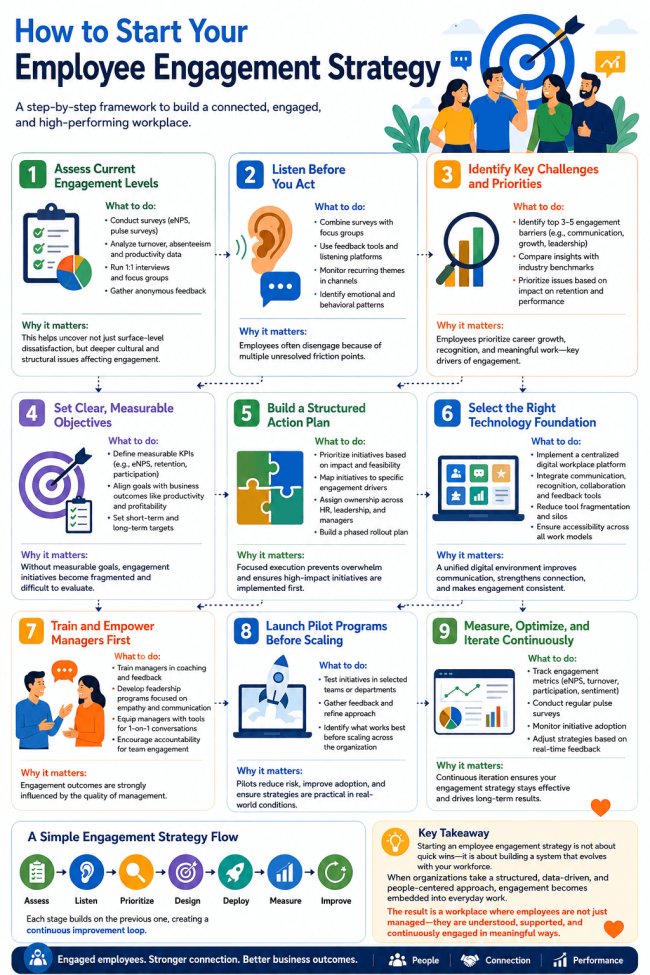
Building a successful employee engagement strategy is not about launching random initiatives, it is about following a structured, intentional process that turns insight into action and action into lasting cultural change. The most effective organizations treat engagement as an ongoing system rather than a one-time project.
A strong employee engagement strategy moves through a clear journey: understanding the current state, identifying what truly matters to employees, designing targeted solutions, and continuously refining based on real feedback and measurable outcomes.
Below is a practical, step-by-step framework for launching a sustainable employee engagement strategy in a connected workplace.
Every effective strategy begins with understanding where you currently stand. Without a clear baseline, it is impossible to measure progress or identify meaningful improvements.
This step involves collecting both quantitative and qualitative insights into the employee experience.
This helps uncover not just surface-level dissatisfaction, but deeper cultural and structural issues affecting engagement.
Engagement strategies fail when organizations rush into solutions without understanding root causes. Listening is the foundation of effective action.
Modern engagement requires a mix of active and passive listening.
Employees often don’t disengage because of one issue, they disengage because of multiple unresolved friction points.
Once data is collected, the next step is to identify the most critical engagement drivers within your organization.
Not all issues have equal impact. The goal is to focus on what matters most.
Research consistently shows employees prioritize career growth, recognition, and meaningful work, organizations that align with these drivers see stronger engagement outcomes.
Engagement must be treated as a business outcome, not just a cultural initiative. Clear goals ensure accountability and progress tracking.
Without measurable goals, engagement initiatives become fragmented and difficult to evaluate.
This is where strategy becomes execution. A strong action plan ensures initiatives are prioritized, realistic, and aligned with organizational capacity.
This step involves collecting both quantitative and qualitative insights into the employee experience.
Focused execution prevents overwhelm and ensures high-impact initiatives are implemented first.
Technology is the backbone of modern employee engagement. Without the right tools, even the best strategies become fragmented.
A unified digital environment improves communication flow, strengthens connection, and makes engagement activities visible and consistent.
Managers play a defining role in employee engagement outcomes. In fact, a significant portion of engagement variation across teams is directly influenced by management quality.
Even the best engagement strategy will fail without strong, emotionally intelligent leadership.
Instead of rolling out initiatives across the entire organization at once, successful companies start small.
Pilots reduce risk, improve adoption, and ensure strategies are practical in real-world conditions.
Employee engagement is not static, it evolves over time. Continuous measurement ensures the strategy remains effective and relevant.
Organizations that continuously iterate their engagement strategies are far more likely to sustain high performance and retention
A strong engagement strategy typically follows this lifecycle:
Each stage builds on the previous one, creating a continuous improvement loop rather than a one-time initiative.
Starting an employee engagement strategy is not about quick wins, it is about building a system that evolves with your workforce. When organizations take a structured, data-driven, and people-centered approach, engagement becomes embedded into everyday work rather than treated as a separate initiative.
The result is a workplace where employees are not just managed, they are understood, supported, and continuously engaged in meaningful ways.
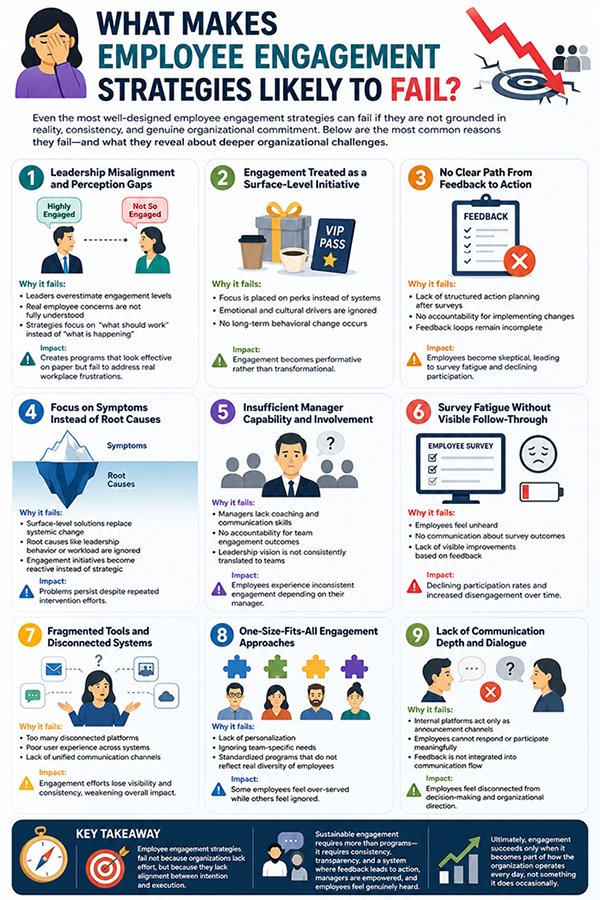
Even the most well-designed employee engagement strategies can fail if they are not grounded in reality, consistency, and genuine organizational commitment. Many companies invest heavily in engagement initiatives, yet still struggle with low morale, high turnover, and disengaged teams.
The issue is rarely a lack of ideas, it is usually a lack of alignment, follow-through, and structural support. Engagement cannot be sustained through isolated programs or surface-level perks. It requires deep integration into leadership behavior, communication systems, and day-to-day employee experience.
Below are the most common reasons employee engagement strategies fail, and what they reveal about deeper organizational challenges.
One of the biggest barriers to successful engagement is the disconnect between leadership perception and employee reality.
Studies consistently show a major perception gap: while a majority of leaders believe their employees are fully engaged, far fewer employees agree. This misalignment leads to strategies that are designed around assumptions rather than actual employee needs.
This gap creates engagement programs that look effective on paper but fail to address real workplace frustrations.
Many organizations mistakenly treat engagement as a set of perks, events, or HR campaigns rather than a structural business priority.
Free lunches, rewards, or occasional recognition programs may improve morale temporarily, but they do not fix deeper issues like poor leadership, lack of growth opportunities, or unclear communication.
Engagement becomes performative rather than transformational.
Collecting employee feedback is not enough, acting on it is what builds trust.
A significant number of organizations struggle with translating feedback into meaningful change. In many cases, employees repeatedly provide input through surveys but see no visible improvements.
Employees become skeptical, leading to survey fatigue and declining participation.
Engagement issues are often treated as isolated problems rather than symptoms of deeper organizational challenges.
For example, low morale may be addressed with recognition programs, while the real issue could be poor management or unclear career paths.
Problems persist despite repeated intervention efforts.
Managers play one of the most influential roles in shaping employee engagement. When they are not properly trained or aligned, even strong engagement strategies break down at the execution level.
Employees experience inconsistent engagement depending on their manager, creating uneven workplace culture.
Employee surveys are a powerful tool, but only when they lead to visible change.
When employees repeatedly share feedback but see no action, trust erodes quickly.
Declining participation rates and increased disengagement over time.
A fragmented digital workplace is one of the most overlooked causes of disengagement.
When employees must switch between multiple tools for communication, collaboration, recognition, and knowledge sharing, it creates friction and fatigue.
Engagement efforts lose visibility and consistency, weakening overall impact.
Employees are not a uniform group, yet many engagement strategies are designed as if they are.
A single approach rarely works across different roles, generations, or working environments.
Some employees feel over-served while others feel ignored.
Engagement fails when communication is one-directional, where leadership broadcasts information but does not encourage dialogue.
Employees feel disconnected from decision-making and organizational direction.
Employee engagement strategies fail not because organizations lack effort, but because they lack alignment between intention and execution. When leadership misalignment, poor communication, fragmented systems, and lack of accountability persist, engagement initiatives lose credibility.
Sustainable engagement requires more than programs, it requires consistency, transparency, and a system where feedback leads to action, managers are empowered, and employees feel genuinely heard.
Ultimately, engagement succeeds only when it becomes part of how the organization operates every day, not something it does occasionally.
Measuring employee engagement is not about relying on a single survey or isolated metric, it is about building a multi-dimensional view of how employees actually experience their work. Engagement is emotional, behavioral, and operational at the same time, which means it must be tracked through a combination of quantitative data and qualitative insight.
Organizations that measure engagement effectively are able to identify risks early, understand workforce sentiment in real time, and make data-driven decisions that improve retention, performance, and culture. In contrast, companies that rely only on annual surveys often miss the evolving signals that shape employee experience.
A strong measurement system connects what employees feel with what they do, and ultimately how the organization performs.
The most effective engagement measurement frameworks combine surveys, behavioral data, and leadership interactions into a continuous feedback system.
Pulse surveys are short, frequent check-ins that capture how employees feel about key aspects of their work experience.
They provide real-time insight into employee mood and help detect early signs of disengagement before they escalate.
Monthly or quarterly
eNPS measures employee advocacy by asking a simple but powerful question: Would you recommend this organization as a great place to work?
It acts as a high-level indicator of engagement health across the organization.
Quarterly
One of the most valuable yet underutilized measurement tools is consistent manager-employee dialogue.
A large portion of engagement variance is influenced directly by managers, making these conversations critical for understanding real employee sentiment.
Weekly or bi-weekly
Turnover is one of the clearest indicators of engagement health.
Rising turnover is often a direct signal of deeper engagement issues such as poor leadership, lack of growth, or cultural misalignment.
Monthly and quarterly reviews
Absenteeism provides behavioral clues about disengagement and workplace stress.
Frequent or rising absenteeism can indicate deeper organizational issues beyond surface-level engagement scores.
Monthly
Engagement and performance are closely linked. Productivity data helps validate whether engagement efforts are translating into business outcomes.
Engagement is ultimately valuable when it improves organizational performance.
Monthly
Internal movement reflects whether employees see a future within the organization.
High internal mobility is often a sign of strong engagement and career satisfaction.
Quarterly
Modern workplaces generate valuable behavioral data through digital tools.
These signals show how actively employees participate in the organizational ecosystem.
Real-time
While individual metrics are useful, the real value comes from connecting them together. Engagement is not one number, it is a pattern.
For example:
This kind of cross-analysis allows organizations to move from measurement to meaningful action.
Beyond understanding employee sentiment, organizations must also demonstrate the business impact of engagement strategies. This requires linking engagement metrics to operational and financial outcomes.
| Metric Category | KPI | Business Impact |
| Employee Sentiment | eNPS | Measures employee advocacy and internal brand strength |
| Operational Efficiency | Search time reduction, tool consolidation | Reduces daily friction and improves productivity |
| Retention Impact | Voluntary turnover rate | Reduces hiring, onboarding, and replacement costs |
| Platform Adoption | Daily active users, engagement activity | Indicates participation in company culture and communication |
Measurement alone does not improve engagement, action does.
Organizations must:
Without this feedback loop, even the most advanced measurement systems lose credibility.
Measuring employee engagement requires a balanced combination of data and human insight. No single metric can capture the full employee experience. Instead, organizations must connect sentiment, behavior, and performance data to understand what truly drives engagement.
When done correctly, measurement becomes more than reporting, it becomes a decision-making system that helps leaders build a healthier, more connected, and more high-performing workplace.
Managers are the most influential factor in shaping employee engagement. While companies often invest in tools, programs, and policies, the day-to-day employee experience is largely defined by direct managers. In fact, research consistently shows that up to 70% of engagement differences between teams are directly linked to managerial behavior.
This means engagement is not just a company-wide initiative, it is something that lives and dies in everyday interactions between managers and their teams.
Strong managers do not just assign work. They build trust, create clarity, support growth, and foster an environment where employees feel safe, valued, and motivated to contribute their best work.
Below are the most effective ways managers can actively improve employee engagement within their teams.
One-on-one meetings are the foundation of strong manager-employee relationships. They are not just status updates, they are the primary space for engagement conversations.
Regular 1:1s build trust, surface early signs of disengagement, and show employees that their voice matters.
Employees do not want feedback once a year, they want guidance in real time that helps them improve and grow.
Continuous feedback helps employees stay aligned, confident, and engaged in their work.
Recognition is one of the simplest yet most powerful engagement tools a manager has.
When employees feel seen, their motivation and emotional connection to their work increase significantly.
Employees are far more engaged when they see a future within their organization.
Development-focused managers turn jobs into long-term career journeys.
Engaged teams are not overworked teams, they are balanced and supported teams.
Sustainable performance depends on physical and emotional well-being.
Psychological safety is the foundation of open communication and innovation.
When employees feel safe, they are more creative, collaborative, and engaged.
Trust is built through honesty, especially during uncertainty.
Transparency reduces confusion and builds confidence in leadership.
Engagement grows when employees feel connected to their peers.
Strong team relationships increase belonging and reduce isolation.
Micromanagement is one of the fastest ways to reduce engagement.
Autonomy increases ownership, accountability, and motivation.
Employees are more engaged when they understand the “why” behind their work.
Purpose transforms routine tasks into meaningful contributions.
Organizations should not only measure employee engagement, they should also measure manager effectiveness.
If managers are the strongest driver of engagement, their behavior must be visible and measurable.
Managers are not just supervisors, they are the primary architects of employee engagement. Every conversation, decision, and interaction either strengthens or weakens engagement within their teams.
When managers consistently communicate clearly, recognize effort, support growth, and build trust, they create environments where employees do not just perform, they thrive.
Ultimately, strong managers do not simply manage work. They shape the employee experience.
Employee engagement is often viewed as a “soft” metric, something related to culture, morale, or workplace happiness. In reality, it is one of the most measurable drivers of business performance. When organizations invest in engagement strategies, they are not just improving employee experience, they are influencing retention, productivity, customer satisfaction, and ultimately revenue.
However, to secure long-term support and investment, engagement must be translated into the language of business impact. That means connecting engagement efforts directly to financial outcomes and operational performance.
Proving ROI is not about a single formula alone, it is about building a structured system that links human behavior to business results in a clear, data-driven way.
At its simplest, engagement ROI can be expressed as:
But in practice, the real value comes from breaking “benefits” into measurable business outcomes that reflect how engagement improves organizational performance.
The most immediate impact of employee engagement appears in cost savings and productivity improvements.
Engaged employees are less likely to leave, reducing expensive turnover costs.
Replacing employees is costly due to recruitment, onboarding, and lost productivity, making retention one of the clearest ROI drivers.
Engaged employees consistently perform better and contribute more effectively.
Even small productivity improvements across large teams translate into significant financial gains.
Engaged employees are more present, reliable, and consistent.
Lower absenteeism improves operational continuity and reduces hidden workforce costs.
Not all ROI is immediate or purely financial. Engagement also drives long-term strategic advantages.
Engaged employees deliver better customer experiences, leading to higher satisfaction and loyalty scores.
Engaged teams are more likely to share ideas, solve problems creatively, and improve processes.
A strong engagement culture reduces hiring costs and attracts higher-quality talent organically.
To fully appreciate ROI, organizations must also measure what disengagement costs them.
Large-scale studies show that disengagement is not just an internal issue, it is a global economic challenge:
These figures highlight a critical truth: not investing in engagement is far more expensive than investing in it.
A single metric cannot capture the complexity of employee engagement. Organizations need a combined dashboard that tracks both human experience and business performance.
When engagement data is linked directly to business KPIs, leaders can clearly see the financial value of engagement investments.
Measurement only creates impact when it is communicated effectively to leadership.
Leadership buy-in strengthens when engagement is presented as a performance driver, not just a cultural initiative.
Modern organizations are increasingly treating engagement data as a strategic asset. Instead of measuring engagement once a year, they continuously track it alongside operational metrics to identify patterns, predict risks, and guide decision-making.
Research from leading workforce studies shows that organizations using data-driven, human-centered engagement systems are far more successful at converting employee experience into measurable ROI.
Measuring employee engagement is not about proving that employees are happy, it is about demonstrating how engagement drives real business value. When organizations connect engagement metrics to retention, productivity, customer satisfaction, and revenue, they transform engagement from a cultural concept into a strategic performance engine.
Ultimately, organizations that measure well don’t just understand engagement, they optimize it, scale it, and turn it into a measurable competitive advantage.
Designing a strong employee engagement strategy is only half the work. The real challenge begins when organizations try to bring dozens of initiatives, recognition programs, communication systems, collaboration tools, learning pathways, feedback loops, into daily practice without losing coherence.
Across modern workplaces, a clear pattern emerges: engagement fails not because companies lack ideas, but because those ideas are scattered across disconnected tools and inconsistent experiences. Recognition happens in one system, communication in another, knowledge in a third, and feedback somewhere else entirely. The result is fragmentation, friction, and disengagement.
This is where technology becomes a critical enabler, not as a replacement for culture, but as the infrastructure that makes culture scalable.
eXo Platform addresses this challenge by providing a unified digital workplace designed specifically to support employee engagement at scale.
When we look at the full spectrum of employee engagement strategies, recognition, feedback, career development, collaboration, well-being, and communication, they all share one requirement: they need to be visible, connected, and consistently reinforced.
Without integration:
With integration, engagement becomes part of everyday work, not an additional task.
eXo Platform is built around this principle: bringing every engagement touchpoint into one connected environment.
Instead of relying on multiple disconnected systems, eXo Platform centralizes the employee experience into a single digital workplace.
This unified approach removes the friction of switching between tools and ensures every employee, whether remote, hybrid, or frontline, has equal access to company life.
Rather than treating engagement initiatives as separate programs, eXo embeds them into everyday workflows.
Leadership communication becomes interactive, not just informational.
Collaboration is no longer fragmented across multiple apps, it becomes a continuous experience.
Recognition stops being occasional and becomes part of the daily culture.
Information is no longer buried in emails or isolated folders, it becomes living organizational memory.
Engagement becomes interactive, motivating, and continuous rather than passive.
Organizations gain visibility into what is working, and what needs improvement.
What makes eXo Platform different is not just the features, it is the philosophy behind it.
Instead of offering isolated solutions for communication, recognition, or collaboration, eXo brings everything together into a single, unified employee experience ecosystem.
This eliminates:
And replaces it with:
The reality is clear: engagement cannot survive in fragmented environments.
Across organizations today:
Meanwhile, global engagement levels remain low, and disengagement costs organizations trillions annually in lost productivity and turnover.
The solution is not more tools, it is better integration.
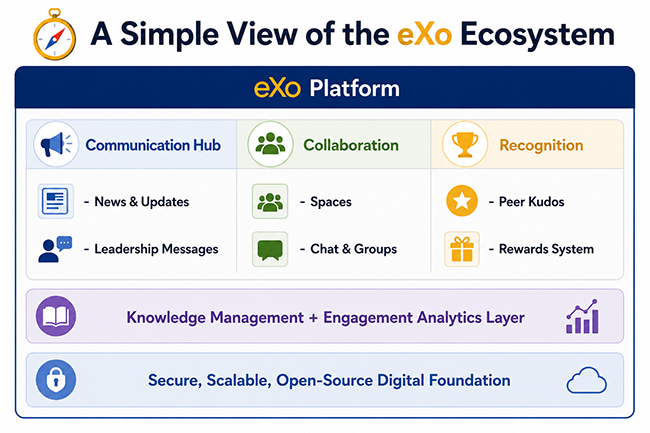
By consolidating engagement into one ecosystem, organizations unlock several advantages:
Employee engagement is no longer about isolated initiatives, it is about creating a connected experience where communication, collaboration, recognition, and growth all reinforce each other.
eXo Platform provides the digital foundation that makes this possible. It transforms engagement from a collection of programs into a living system embedded in everyday work.
In the end, organizations do not just need an engagement strategy, they need an environment where that strategy can actually live, grow, and evolve.
That is what a truly connected workplace looks like.
Employee engagement is no longer a “nice-to-have” initiative or a secondary HR focus. It has become a core business driver that directly influences productivity, innovation, retention, and long-term organizational performance. In a world where talent expectations are rising and workplace dynamics are rapidly evolving, companies that fail to prioritize engagement risk falling behind, not just culturally, but competitively.
Throughout this guide, the 25 proven employee engagement strategies have shown a consistent truth: engagement is not created through isolated actions. It is built through a connected system of practices that reinforce one another, recognition, communication, leadership behavior, career development, well-being, collaboration, and technology working together as one ecosystem.
When these elements are intentionally designed and consistently applied, organizations see measurable transformation:
But strategy alone is not enough.
The real differentiator lies in execution, turning engagement principles into everyday employee experiences that feel seamless, consistent, and meaningful. This is where modern digital workplaces play a critical role, helping organizations unify communication, collaboration, recognition, and knowledge sharing into a single connected environment.
By combining strong engagement strategies with enabling technology such as eXo Platform, organizations can move beyond fragmented initiatives and build a truly integrated employee experience, one where engagement is not managed in silos, but lived every day.
Ultimately, the future of work belongs to organizations that understand a simple but powerful truth:
When employees feel connected to their purpose, supported by their leaders, recognized for their contributions, and empowered by the right tools, they do not just perform better, they thrive. And when employees thrive, organizations grow stronger, more innovative, and more resilient.
That is the real promise of employee engagement, and the direction every connected workplace must move toward.
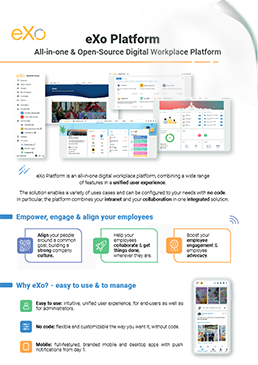

Download the eXo Platform Datasheet and discover all the features and benefits

Download the eXo Platform Datasheet and discover all the features and benefits
You will find here Frequently Asked Questions about AI for Employee Engagement with all the answers in one place.
Employee engagement is the emotional and intellectual commitment an employee has toward their job, their team, and their organization. It’s about how much an individual cares about the company’s success and how motivated they are to contribute to its goals. Engaged employees don’t just show up—they feel proud, passionate, and fully involved in their work.
This engagement can take many forms: feeling loyal and connected (emotional), being focused and eager to improve (cognitive), or showing high productivity and advocacy for the company (behavioral). Strong leadership, a positive culture, growth opportunities, and work-life balance are some of the key drivers that make it possible.
AI is helping rehumanize employee engagement by automating administrative tasks and providing real-time insights into employee well-being, motivation, and engagement levels. This allows managers to spend more time on meaningful conversations, coaching, recognition, and career development.
By combining data-driven intelligence with human empathy, AI enables organizations to create a more personalized, proactive, and engaging employee experience.
➝ Learn more about how AI is rehumanizing employee engagement
An AI-powered intranet is a modern internal platform that uses artificial intelligence technologies to enhance communication, knowledge management, and employee productivity within an organization.
Traditional intranets were designed primarily to store internal documents, company policies, and announcements in a centralized portal. While useful for organizing information, these systems often rely on manual navigation and basic keyword searches, which can make it difficult for employees to find what they need quickly.
AI-powered intranets solve this problem by integrating intelligent technologies that enable the platform to understand context, learn from user behavior, and deliver personalized information automatically. Instead of acting as passive storage systems, these intranets function as interactive digital assistants that support employees throughout their workday.
An employee engagement platform is a digital space where employees feel more connected, motivated, and valued. It brings together tools for communication, recognition, feedback, and collaboration—all designed to improve satisfaction, productivity, and workplace culture. In short, it helps turn a company into a more engaged, innovative, and happy place to work.
➝ See the full definition of an employee engagement platform
Employee engagement is far more than a buzzword—it directly impacts business success. When employees feel connected, valued, and motivated, both people and companies thrive. Engaged teams are more productive, innovative, and loyal, which translates into better results and stronger workplace culture.
Here’s why it matters:
Yet, only 23% of employees worldwide are actively engaged (Gallup 2023). This gap shows just how crucial it is for organizations to invest in engagement and create a workplace where people feel connected, appreciated, and inspired.
Employee engagement platforms are designed to connect people, boost motivation, and help organizations perform at their best. They bring essential tools together in one place to improve communication, recognition, feedback, and collaboration.
Here are some of the most important features:
All of these features work together to create a workplace where people feel informed, appreciated, and part of a thriving community.
➝ Dicover the full list of employee engagement platform features
➝ Find out how to improve employee engagement in the workplace
( Your e-mail address will not be published)

I am a Digital Marketing specialist specialized in SEO at eXo Platform. Passionate about new technologies and Digital Marketing. With 10 years' experience, I support companies in their digital communication strategies and implement the tools necessary for their success. My approach combines the use of different traffic acquisition levers and an optimization of the user experience to convert visitors into customers. After various digital experiences in communication agencies as well as in B2B company, I have a wide range of skills and I am able to manage the digital marketing strategy of small and medium-sized companies.