


FREE WHITE PAPER
Discover our in-depth analysis of the concept of employee engagement, its roots, and ways to improve it significantly
Effective teamwork is a critical driver of organizational performance, resilience, and long-term growth. Across industries and workforce models, how well teams collaborate directly influences innovation speed, strategy execution, and employee engagement.
In the modern workplace, teamwork is no longer just a desirable soft skill or cultural bonus, it is a core operational capability that determines success.

At its heart, teamwork involves individuals working together toward shared goals, combining complementary skills, perspectives, and responsibilities.
When teamwork is strong, it fosters alignment, trust, and momentum; when it is weak, it creates silos, duplicated efforts, slow decision-making, and disengagement. While leadership, communication habits, and organizational culture are crucial, the tools teams rely on every day increasingly shape how collaboration unfolds.
The rise of hybrid, distributed, and cross-functional work environments has further raised the bar for effective teamwork. Teams must coordinate across locations, time zones, and departments while managing growing volumes of information and increasingly complex workflows. In this context, outdated collaboration methods or fragmented tools can create friction, slow progress, and reduce engagement.
This article presents practical, actionable teamwork tips designed to help organizations strengthen collaboration and build more aligned, high-performing teams. It explores the common challenges that impede teamwork in modern workplaces and shows how integrated digital platforms, such as eXo Platform, can turn collaboration into a seamless, efficient, and engaging experience.
By centralizing knowledge, streamlining communication, and supporting shared accountability, the right tools complement human teamwork practices to maximize productivity, enhance engagement, and foster a culture of transparency and shared ownership.
Whether your goal is to overcome communication silos, improve coordination across teams, or simply build stronger collaboration habits, these top 10 teamwork tips provide concrete strategies to make teamwork at work more effective and sustainable.
The tools teams use every day play a pivotal role in shaping how work gets done. Collaboration technology has become central to how teams communicate, manage projects, share knowledge, and stay aligned with organizational goals.
Research consistently shows that teams leveraging well-designed collaboration platforms are not only more productive but also experience fewer misunderstandings and spend less time searching for critical information. By centralizing knowledge, enabling real-time communication, and fostering transparency, these tools reduce redundancy and enhance overall execution.
Yet, not all teamwork tools deliver the same impact. Many organizations still rely on fragmented systems, emails, chat apps, file repositories, intranets, and project management platforms that operate in isolation. This disconnection scatters information, obscures priorities, and forces employees to constantly switch contexts, creating friction and undermining effective teamwork.
Building stronger teams requires a holistic approach. Effective teamwork at work is about more than just deploying software, it involves aligning tools with established collaboration practices, clear processes, and a culture that emphasizes transparency, accountability, and shared ownership. Choosing the right tools, combined with actionable teamwork tips, empowers teams to collaborate efficiently, stay connected, and achieve results consistently.
The evolution of teamwork tools mirrors the increasing complexity of organizational collaboration. In the past, teams relied primarily on email chains and shared drives to coordinate work. Over time, document management systems and enterprise portals offered more structure, yet collaboration remained fragmented and intermittent. Today, leading organizations are turning to integrated digital workplace platforms that unify communication, project management, knowledge sharing, and employee engagement into a single, seamless environment.
This transformation moves teamwork beyond occasional coordination, embedding collaboration directly into daily workflows. Teams now work together continuously through shared spaces, dynamic knowledge bases, activity streams, and contextual conversations linked directly to the work at hand. Such environments allow teams to stay aligned, share insights instantly, and act decisively, turning effective teamwork at work from a goal into an operational reality.
Platforms like eXo Platform exemplify this evolution. Designed to support the full teamwork lifecycle, eXo Platform connects people, content, projects, and communities in one unified digital workplace.
By enabling real-time collaboration and centralizing knowledge, it empowers teams to work smarter, stay aligned, and consistently achieve results, making it a critical tool for organizations seeking to implement practical teamwork tips and strengthen team performance.
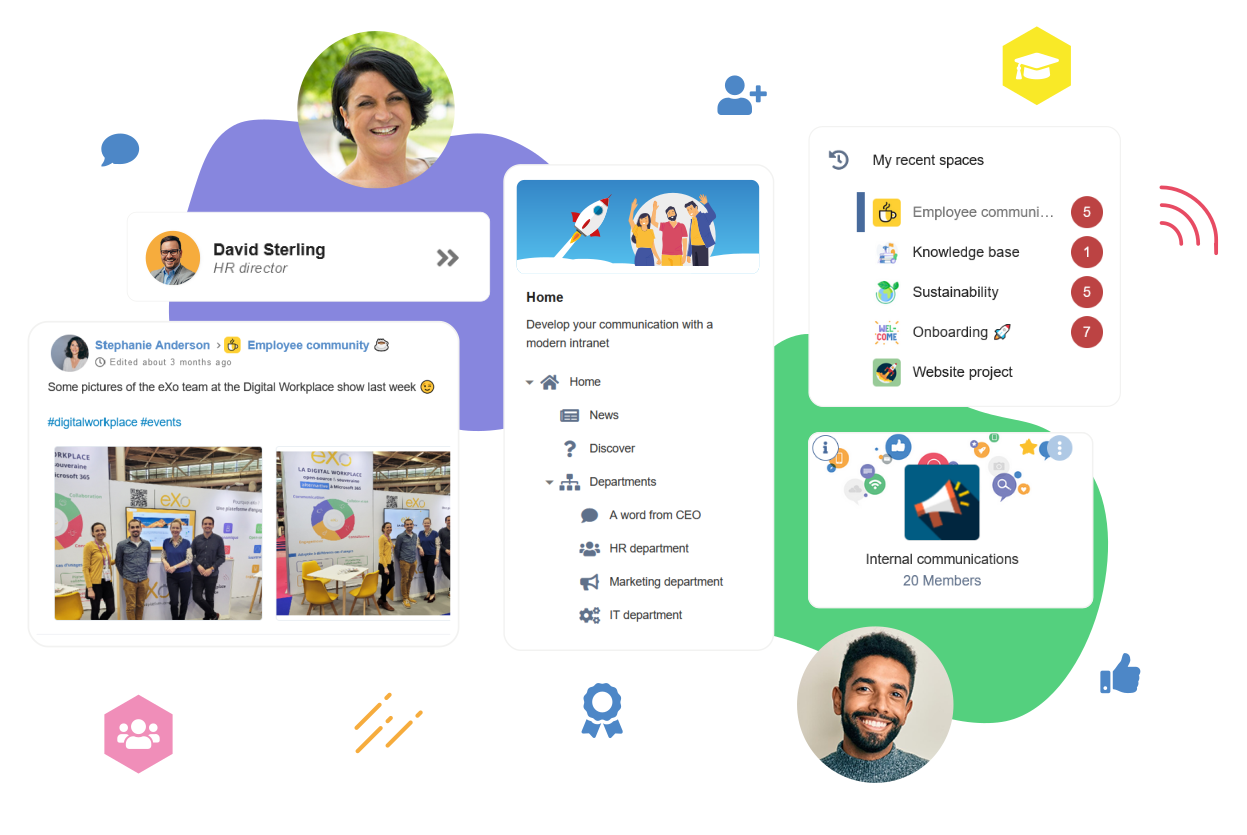
eXo Platform Digital Workplace
Building high-performing teams requires a strategic approach that goes beyond simply assigning tasks or holding meetings.
Effective teamwork at work is shaped by a combination of culture, processes, communication practices, and the tools that support daily collaboration. Organizations that invest in these areas consistently see higher productivity, stronger innovation, and greater employee engagement.
The following ten strategies combine research-backed insights, practical workplace advice, and digital teamwork best practices to help teams work smarter, stay aligned, and achieve results.
Building high-performing teams starts with psychological safety. Without it, even the most skilled teams struggle to collaborate effectively. Psychological safety is the shared belief that the team environment is safe for interpersonal risk-taking: members can ask questions, admit mistakes, or propose new ideas without fear of judgment or retaliation.
Many teams operate in environments where employees feel pressure to “perform perfectly.” This fear of making mistakes or speaking up can lead to:
Without psychological safety, even transparent processes and the best collaboration tools cannot overcome the communication barriers caused by fear or self-censorship.
Creating psychological safety requires intentional culture and leadership practices. Teams should cultivate an environment where:
Google’s Project Aristotle, a comprehensive study of hundreds of teams, found psychological safety to be the number one predictor of team success, even above skills, experience, or talent. Teams that feel safe are more likely to take risks, innovate, and engage deeply with their work. (Psychological Safety +1, Harvard Business Review)
Google provides a well-documented example of cultivating psychological safety at scale:
This approach ensures that employees at all levels feel empowered to contribute their ideas and challenge assumptions, fostering a culture of continuous improvement.
Organizations that invest in psychological safety see measurable benefits:
By making psychological safety a priority, leaders lay the groundwork for trust, creativity, and collaboration, setting the stage for all other teamwork strategies to succeed. Teams that feel safe are not just more effective, they thrive.
Clarity is the cornerstone of effective teamwork. Without a shared understanding of what needs to be done, who is responsible, and how success is measured, teams struggle to align efforts, prioritize tasks, and deliver results. Clearly defined goals and roles not only streamline work, they empower team members to take ownership and contribute confidently.
Many teams fail because members:
These issues are especially common in distributed or hybrid teams, where misalignment can easily occur across locations and time zones.
To overcome these challenges, leaders should implement transparent goal-setting and role-definition practices:
By linking individual contributions to team outcomes, members understand the “why” behind their work, fostering accountability and engagement.
Distributed Product Development Teams:
A global product team adopted a centralized collaboration platform (like eXo Platform) to organize sprint goals, task assignments, and deliverables in a single workspace. Each member, whether in Toronto, Singapore, or Lisbon, could see:
This centralization eliminated confusion from fragmented communication channels and provided one source of truth for the entire team.
Implementing clear goals and roles led to:
Studies have shown that teams with well-defined objectives and role clarity deliver significantly higher performance and satisfaction (PMC: Role Clarity & Team Performance).
When goals and roles are transparent, teams operate with confidence, alignment, and purpose, reducing friction and maximizing productivity.
Effective communication is the lifeblood of teamwork. Even the most skilled teams can falter if information is siloed, misunderstood, or lost in fragmented channels. Open and transparent communication ensures that everyone stays informed, aligned, and able to make timely decisions.
Teams often face communication challenges such as:
Without clarity and visibility, teams risk errors, delays, and misaligned outcomes.
To foster transparent communication, organizations should implement practices that combine synchronous and asynchronous channels:
By establishing protocols and structured spaces, teams can reduce confusion, improve collaboration, and maintain continuity even across time zones.
 IBM: Unified Communication for Sales and Technical Teams
 IBM migrated its sales and technical collaboration to platforms like Slack, consolidating email threads, spreadsheets, and ad-hoc chats into a single communication hub. This enabled:
The result was shorter deal cycles and greater transparency, as critical information was no longer buried in private emails or scattered documents. (Slack Case Study)
Implementing open communication practices leads to:
Transparent communication is not just a practice, it’s a strategic enabler that ensures teams can collaborate effectively, make better decisions, and achieve shared objectives consistently.
The right tools can accelerate teamwork and eliminate friction, while the wrong ones can create chaos. In modern workplaces, teams often juggle multiple apps, email, chat, project management, file storage, which can fragment workflows, slow decision-making, and reduce engagement. Leveraging purpose-driven collaboration platforms streamlines work and allows teams to focus on what matters.
Teams frequently struggle with:
Without an integrated approach, collaboration becomes reactive rather than proactive.
Organizations should select collaboration platforms that align with team workflows and provide:
The goal is a single hub where structured and informal collaboration coexist seamlessly, reducing context switching and keeping teams aligned.
 Engineering Teams Using Slack and Integrated Workflows
 Many engineering teams embed build alerts, deployment notifications, and code reviews directly into Slack channels. This integration allows developers, QA, and operations teams to:
Similarly, organizations adopting unified digital workplaces like eXo Platform centralize chats, project boards, and shared documents in one environment. Teams no longer need to toggle between multiple apps, improving both speed and focus. (Slack Engineering Case Study)
Adopting real-time, integrated tools produces measurable benefits:
By leveraging the right collaboration tools, organizations enable teams to move faster, communicate clearly, and resolve issues in real time, setting the stage for higher productivity and stronger alignment.
Innovation and efficiency thrive when teams collaborate across functional boundaries. When departments work in isolation, opportunities are lost, decisions are delayed, and knowledge becomes siloed. Fostering cross-functional collaboration ensures that insights, expertise, and skills are shared widely, turning individual knowledge into an organizational asset.
Organizations often encounter:
To break down silos, leaders can implement strategies such as:
These approaches turn collaboration into a habitual, visible, and measurable practice rather than an ad-hoc activity.
By connecting people and processes, both companies transformed isolated knowledge into collective intelligence.
By fostering cross-functional connections, organizations ensure that knowledge flows freely, decisions are faster, and teams are empowered to innovate collaboratively.
Predictable routines are a cornerstone of effective teamwork. When teams know when and how to connect, alignment improves, accountability strengthens, and issues are surfaced before they escalate. Establishing structured touchpoints keeps work flowing smoothly, even in hybrid or distributed environments.
Teams without consistent rhythms often face:
Without these structures, even high-performing teams can lose momentum and transparency.
Implementing predictable rituals and check-ins ensures that everyone is informed, connected, and able to adjust priorities in real time:
These rituals create a reliable cadence that balances structure with flexibility, ensuring teams stay aligned without overloading their schedules.
 Agile Software Development Teams:
 Agile teams routinely run daily stand-ups and weekly retrospectives. These rituals help:
Using platforms like eXo Platform or Jira integrated chat, teams can combine these rituals with centralized dashboards, making progress and issues visible to all members, regardless of location.
Establishing predictable check-ins and rhythms leads to:
By embedding these rituals and rhythms, teams establish a consistent framework for collaboration, alignment, and continuous improvement, making teamwork predictable, transparent, and effective.
In today’s global and hybrid workplaces, team members are rarely co-located or working the same hours. Relying solely on synchronous communication can stall projects and exclude valuable contributions. Empowering asynchronous collaboration allows teams to work efficiently across time zones, maintain inclusivity, and sustain momentum without overburdening anyone.
Distributed teams often struggle with:
Without asynchronous strategies, global teams risk misalignment, burnout, and stalled workflows.
To enable effective asynchronous collaboration:
The key is making asynchronous work a first-class method of collaboration, not just an afterthought.
 GitLab – A Fully Remote Company
GitLab operates globally with team members in multiple time zones. They rely almost entirely on asynchronous communication through:
This approach allows every team member to contribute on their schedule, while maintaining transparency and a continuous workflow. (GitLab Handbook)
Empowering asynchronous collaboration results in:
By prioritizing asynchronous workflows, organizations ensure hybrid and distributed teams stay aligned, productive, and empowered, turning time zone differences into an advantage rather than a barrier.
Acknowledging accomplishments is more than a morale booster, it reinforces collaborative behavior and motivates teams to continue performing at their best. Celebrating successes, both big and small, helps create a culture where contributions are visible, appreciated, and aligned with organizational values.
Teams that neglect recognition face:
Without intentional recognition, teamwork loses momentum, and performance can plateau.
To embed recognition into daily workflows:
Platforms like eXo Platform or Workday enable organizations to integrate recognition into digital workplaces, connecting acknowledgment with collaboration and performance metrics.
 HR & Culture Engagement Teams Using eXo Platform
 HR teams used eXo’s recognition workflows to celebrate both everyday contributions and major project achievements. Features like peer-to-peer Kudos, badges, and community shout-outs:
This approach made recognition part of the work rhythm, rather than an occasional event.
Implementing structured recognition practices leads to:
Recognizing achievements isn’t just “nice to have”, it’s a strategic tool for engagement, collaboration, and sustained high performance. By celebrating contributions regularly, teams stay motivated, cohesive, and aligned with their shared mission.
High-performing teams are built by combining individual talents with collective capability. Even the best collaboration tools or processes only deliver results if team members know how to use them effectively. Investing in skills, leveraging natural strengths, and fostering digital literacy ensures that teams can work smarter, adopt tools fully, and collaborate seamlessly.
Organizations often encounter:
Without deliberate investment in skills and digital literacy, even well-designed teamwork systems fail to reach their full potential.
To develop a skilled and empowered team:
This approach ensures that technology, processes, and people are fully aligned for maximum impact.
Teams Adopting eXo Platform Organizations that trained employees on eXo Platform workflows and collaboration features reported:
For example, a global consultancy integrated microlearning sessions with live use-case workshops, enabling employees to understand how to navigate digital communities, co-edit documents, and leverage project dashboards (eXo Platform Learning Resources).
Investing in skills and digital literacy drives:
By investing in skills, strengths, and digital literacy, organizations ensure that teams are not only equipped with the right tools but also capable of using them effectively to achieve high-performance collaboration.
High-performing teams are never static, they adapt and evolve by learning from experience. Regularly collecting feedback on collaboration practices, workflows, and tools allows teams to refine processes, remove friction, and sustain performance over time. Iterative improvement fosters a culture of continuous learning, ownership, and responsiveness.
Teams often struggle with:
Without continuous iteration, even the best-designed systems can become obsolete or ineffective.
To build a feedback-driven and adaptive culture:
Platforms like eXo Platform enable teams to collect insights directly in the collaboration environment, making feedback both visible and actionable.
Agile Teams & Remote Workforces For example, a distributed product team implemented small improvements to asynchronous workflows after each sprint, which increased on-time deliverables by 15% over six months (Atlassian Agile Practices).
Continuous feedback and iteration lead to:
By gathering feedback and iterating continuously, teams transform collaboration from a static practice into a dynamic, responsive system, ensuring sustained performance, engagement, and innovation.
Strong teams aren’t built by accident, they are intentionally crafted through a combination of people, processes, and the right technologies. Psychological safety, clear goals, structured communication, purpose-built collaboration tools, cross-functional connections, recognition practices, and continuous feedback all work together to create teams that don’t just work together, they thrive together.
When these 10 teamwork strategies are integrated into an organization’s culture and daily workflows, they transform fragmented efforts into cohesive, engaged, and high-performing teams capable of consistently achieving shared goals.
From centralizing communication to celebrating wins, investing in skills, and iterating based on feedback, each tip addresses a critical aspect of teamwork while reinforcing the others. The result is an environment where:
By applying these principles thoughtfully, organizations create a resilient, motivated, and innovative workforce, ready to tackle complex challenges together. Ultimately, enhancing teamwork is not about a single initiative or tool, it’s a holistic approach that integrates strategy, culture, and technology to unlock the full potential of every team member.

The Complete Guide to
Employee Engagement
Discover our in-depth analysis of the concept of employee engagement, its roots, and ways to improve it significantly
Discover our in-depth analysis of the concept of employee engagement, its roots, and ways to improve it significantly
Effective teamwork at work is about more than assigning tasks or holding meetings, it requires creating structured, aligned, and engaging collaboration practices supported by the right digital tools. Achieving this involves a holistic approach that integrates people, processes, culture, and technology. Organizations that successfully combine these elements consistently experience higher productivity, faster innovation, and stronger employee engagement.
Equally critical is the process of transitioning teams from legacy systems to modern collaboration platforms. Thoughtful planning, phased implementation, and proactive adoption strategies ensure that the migration enhances teamwork instead of creating disruption or confusion.
Before selecting and implementing a new collaboration platform, it is essential to understand how teams currently operate. Conducting a comprehensive collaboration audit helps document existing workflows, highlight bottlenecks, capture success stories, and identify areas where processes can be improved. This foundation allows organizations to make informed decisions about platform selection and deployment strategy.
Identifying champions, motivated early adopters from across departments, is another crucial step. These champions serve as guides and role models, helping colleagues navigate the new platform and demonstrating best practices. Their involvement increases engagement and builds confidence in the new system. Organizations should also adopt a phased rollout approach, introducing the platform by department, project, or use case. This method reduces disruption, allows teams to adjust gradually, and creates early success stories that can motivate broader adoption across the organization.
Once a platform such as eXo Platform is chosen, thoughtful implementation is essential. Platforms should be customized to align with organizational workflows, but over-customization should be avoided as it can complicate upgrades and long-term maintenance. A well-defined data migration strategy ensures that only active, relevant content is moved, avoiding clutter and enhancing usability.
Integration planning is also critical. Mapping which existing systems, such as email, document repositories, project management tools, and intranets, need to connect with the new platform ensures seamless workflows. Proper integration prevents fragmented collaboration, eliminates duplicated efforts, and helps centralize knowledge for all team members.
Even the best platform will fail without strong user adoption. Gamified onboarding, including challenges or interactive tutorials, helps users explore and adopt key features in an engaging way. Leadership participation is equally important; when executives and managers actively use the platform, it signals its importance and encourages employees to follow suit.
Creating a continuous feedback loop allows teams to provide input on usability, workflows, and processes, enabling rapid adjustments and reinforcing a culture of learning and continuous improvement. Feedback can also highlight training needs and help optimize platform usage for maximum efficiency.
Collaboration platforms can do more than store documents, they can actively enhance teamwork when used strategically. Establishing dedicated Spaces for projects centralizes communication, files, and tasks, keeping work organized and transparent. Posting documents to activity streams invites immediate feedback and collaboration, encouraging discussion and knowledge sharing. Implementing a Kudos culture, where team members regularly recognize each other’s contributions, strengthens morale, reinforces positive behaviors, and nurtures a collaborative mindset.
For teams transitioning from legacy systems such as SharePoint, careful planning is key to minimizing disruption. Conducting a pre-migration audit to archive outdated files, identifying “eXo Champions” to support colleagues, and using a phased rollout approach ensures a smooth transition. Mapping user permissions to the new platform maintains security, while leveraging built-in migration tools automates the transfer of documents, metadata, and settings, reducing errors and saving time.
Migration and implementation for teamwork at work is a dual challenge: it requires both establishing strong collaboration practices and managing technological change effectively. By auditing workflows, empowering champions, implementing phased rollouts, and leveraging the full potential of modern platforms, organizations can transform their teamwork and digital workspace simultaneously. When culture, processes, and technology work in harmony, teams become more engaged, aligned, and productive, and digital tools become powerful enablers of effective collaboration rather than obstacles.
Building high-performing teams requires more than just assigning tasks or holding meetings. Teams need a unified platform that supports collaboration, knowledge sharing, real-time communication, and employee engagement. eXo Platform delivers all of this while addressing the limitations of legacy systems and anticipating the future needs of modern teams.
Unlike legacy platforms such as SharePoint, which often require multiple integrations with Microsoft products and third-party tools, eXo Platform delivers a unified experience out of the box. Users enjoy:
This integration ensures that teams spend more time collaborating rather than managing disconnected systems.
Adoption is key for any digital collaboration tool. eXo Platform provides a clean, intuitive interface, modeled after popular consumer social networks. This familiar design drives:
eXo Platform combines multiple essential capabilities under a single roof, eliminating the need for fragmented solutions:
| Feature | Description |
| Team Spaces | Project collaboration with integrated task management |
| Social Intranet | News streams, peer recognition, ideation, and employee engagement tools |
| Knowledge Management | Wikis, searchable content hubs, and AI-enhanced document discovery |
| Communication Hub | Real-time chat, video calls, and forums for synchronous and asynchronous collaboration |
| Employee Directory | Skills-based discovery and expertise location for cross-functional collaboration |
| Analytics Dashboard | Insights into collaboration patterns, team engagement, and productivity metrics |
| Integration & APIs | Connect with CRM, HR, cloud storage, Office 365, and more |
| Mobile & No-Code Experience | Full-featured mobile access and easy configuration without developers |
| Gamification & Engagement Tools | Badges, recognition, and participation incentives to drive adoption |
| Secure & Flexible Deployment | Options for cloud, on-prem, or hybrid deployment with enterprise-grade security |
eXo Platform continues to innovate, adding features that enhance teamwork and engagement:
These features make eXo Platform not just an alternative, but a comprehensive solution for modern digital workplaces.
Built on open-source foundations with robust API extensibility, eXo Platform offers:
Companies across industries have leveraged eXo Platform to streamline collaboration, improve engagement, and increase productivity:
These results demonstrate that eXo Platform is more than software, it’s an enabler of smarter, faster, and more cohesive teamwork.
Building stronger teams is not about working harder, it’s about working smarter, together, in a system that truly supports collaboration, knowledge sharing, and human connection. The 10 teamwork strategies outlined in this article, ranging from cultivating psychological safety and setting clear goals to leveraging asynchronous collaboration and recognizing achievements, provide actionable steps for creating cohesive, high-performing teams. Yet even the best strategies can struggle if the digital environment isn’t optimized for modern ways of working.
Legacy platforms like SharePoint and standalone tools have historically served organizations well, but the demands of today’s hybrid, distributed, and knowledge-driven workplaces call for more: a unified, flexible, and intuitive platform that integrates communication, collaboration, task management, and engagement in one place. Fragmented tools create context-switching, duplicate work, and missed opportunities for connection. In contrast, eXo Platform delivers a fully integrated digital workplace, purpose-built to support the realities of modern teamwork.
eXo Platform eliminates the friction of juggling multiple disconnected apps. By combining:
…teams can focus on what really matters: solving problems, sharing expertise, and achieving shared goals. Its mobile-first design, intuitive interface, and AI-enhanced features ensure that both desk-based and frontline employees are connected and empowered to contribute fully.
Effective teamwork doesn’t emerge from technology alone. Psychological safety, transparency, structured communication, and continuous feedback remain essential. eXo Platform provides the foundation that allows these human-centered practices to thrive. Teams can safely share ideas, recognize contributions, and iterate on processes, while the platform keeps knowledge accessible, workflows visible, and engagement high.
Organizations that adopt integrated platforms see measurable results:
These examples highlight that investing in the right platform is as critical as implementing teamwork strategies. Without a cohesive digital environment, even well-designed practices struggle to reach their full potential.
As the future of work continues to evolve, one thing is clear: organizations that embrace integrated, human-centric collaboration platforms will outperform those that cling to legacy systems or patch together disconnected tools.
Modern teamwork is holistic, it combines people, processes, culture, and technology into a seamless ecosystem. eXo Platform provides that ecosystem, enabling teams to not only collaborate but thrive in a hybrid, fast-paced, and innovation-driven world.
In short, the question is no longer whether to modernize your collaboration tools, it’s how quickly you can transition to a platform designed for the way we work today, and tomorrow. By combining thoughtful teamwork strategies with an integrated digital workplace like eXo Platform, organizations can transform fragmented efforts into unified, high-performing teams capable of consistently achieving their goals.
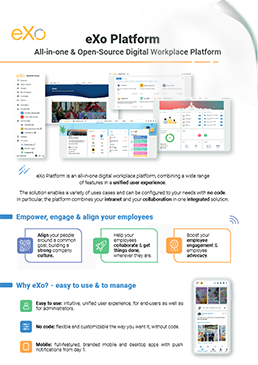

eXo Platform 7 : The Open-Source
Digital Workplace Platform
Download the eXo Platform 7 Datasheet and discover all the features and benefits

Download the eXo Platform Datasheet and discover all the features and benefits
Teamwork is the collaborative effort of a group of individuals working together to achieve a shared objective in the most effective and efficient manner. It’s a process where individual skills, experiences, and ideas are combined, leveraged, and applied toward a common goal, making the collective output greater than the sum of its individual parts—a principle known as synergy.
Effective teamwork combines complementary skills, a shared purpose, clear roles, open communication, psychological safety, and well-designed coordination mechanisms. These elements ensure that each contribution fits into the larger picture, transforming individual efforts into results far greater than the sum of their parts.
Teamwork is far more than a feel-good concept—it is a strategic driver of organizational performance. Across industries, research consistently shows that effective collaboration has a measurable impact on innovation, productivity, employee engagement, decision-making, and organizational resilience.
Selecting the right teamwork platform is a strategic decision that can significantly impact productivity, collaboration, and employee engagement.
The right platform not only supports day-to-day teamwork but also helps your organization scale, share knowledge effectively, and reduce friction across processes.
To make an informed choice, follow this structured roadmap and the teamwork tips for technology selection:
Employee productivity refers to how efficiently and effectively an individual or a team converts their time, effort, and resources into meaningful outcomes that contribute to the organization’s overall goals. In simple terms, it measures the relationship between output (the work produced, goals achieved, or value delivered) and input (the time, energy, tools, and resources invested).
Traditionally, productivity was expressed through a straightforward formula:
Productivity = Output Input (Labor Hours and Resources)
Employee turnover refers to the number or percentage of employees who leave an organization (voluntarily or involuntarily) and are replaced by new hires. High turnover can impact productivity, morale, and costs.
Employee productivity isn’t just a performance metric — it’s the foundation of organizational growth, innovation, and long-term success. When employees work efficiently and purposefully, organizations can achieve more with the same resources, adapt faster to change, and maintain a competitive edge in an increasingly demanding business landscape.
💼 The Strategic Importance of Productivity
📈 The Business Case for Employee Productivity
⚖️ Productivity as a Balance of Performance and Well-Being
Employee engagement is the emotional and intellectual commitment an employee has toward their job, their team, and their organization. It’s about how much an individual cares about the company’s success and how motivated they are to contribute to its goals. Engaged employees don’t just show up—they feel proud, passionate, and fully involved in their work.
This engagement can take many forms: feeling loyal and connected (emotional), being focused and eager to improve (cognitive), or showing high productivity and advocacy for the company (behavioral). Strong leadership, a positive culture, growth opportunities, and work-life balance are some of the key drivers that make it possible.
Employee turnover refers to the number or percentage of employees who leave an organization (voluntarily or involuntarily) and are replaced by new hires. High turnover can impact productivity, morale, and costs.

I am a Digital Marketing specialist specialized in SEO at eXo Platform. Passionate about new technologies and Digital Marketing. With 10 years' experience, I support companies in their digital communication strategies and implement the tools necessary for their success. My approach combines the use of different traffic acquisition levers and an optimization of the user experience to convert visitors into customers. After various digital experiences in communication agencies as well as in B2B company, I have a wide range of skills and I am able to manage the digital marketing strategy of small and medium-sized companies.