Discover our Employee Portal Solution for a Centralized access to Tools & information
- Brahim Jaouane
- June 20, 2025
What Is Teamwork? Definition, Importance, and Tips for a Collective Succes
Teamwork transforms individual effort into collective achievement, turning disparate skills, perspectives, and talents into meaningful results.
Mastering teamwork, especially teamwork, requires a clear understanding of its principles and a set of practical teamwork tips to guide collaboration in modern, distributed workplaces.

Content
Across organizations of all sizes, the ability to work effectively as a team has evolved from being a “nice-to-have” quality to a strategic imperative. In hybrid, remote, and fast-moving workplaces, effective teamwork fuels innovation, accelerates project execution, strengthens employee engagement, and ultimately drives customer success. Applying the right teamwork tips is crucial for unlocking this potential.
⚡The Power of teamwork in Modern Organizations
teamwork has become the backbone of organizational resilience and growth. Major accomplishments—from space missions and medical breakthroughs to revolutionary software—rarely occur through individual effort alone. Instead, they emerge from coordinated collaboration, where diverse individuals contribute their unique strengths toward a shared objective.
Research consistently confirms that organizations with strong collaborative cultures perform better, completing projects faster, retaining employees longer, and adapting more effectively to change. Studies indicate that organizations leveraging integrated collaboration platforms for teamwork can reduce project delays by up to 30%, boost employee engagement, and prevent burnout.
🔩Teamwork: The Engine of Organizational Success
At its core, teamwork acts as an engine, multiplying the impact of individual contributions through alignment, communication, and shared purpose. Across industries, this engine powers real-world achievements: interdisciplinary healthcare teams improve patient outcomes by coordinating through collaborative platforms; agile software teams accelerate product releases with centralized tools; global research teams solve complex problems such as climate modeling or vaccine development by working seamlessly across borders.
Key enablers of this engine include shared collaboration spaces, real-time document management, AI-assisted workflows, and performance dashboards that provide clarity and accountability for every team member.
👏Teamwork: The Bedrock of Modern Success
Beyond immediate project outcomes, teamwork lays the foundation for sustainable, long-term success. High-performing teams combine human skills—trust, communication, and accountability—with digital enablers that reduce friction, centralize knowledge, and empower collaboration across locations.
Organizations that integrate intelligent collaboration tools for teamwork report faster decision-making, shorter innovation cycles, and higher employee satisfaction. For example, multinational companies using AI-enhanced platforms can reduce time-to-market for new products by 20–25%, while research institutions accelerate discovery and facilitate cross-disciplinary knowledge sharing.
By embedding teamwork as a core organizational principle and supporting it with the right technology and teamwork tips, companies cultivate a culture where collaboration becomes a lasting competitive advantage.
From understanding the fundamentals to implementing advanced team collaboration strategies and tools, this guide breaks down what teamwork truly means, why it is essential in the modern workplace, and how organizations can build stronger, more resilient teams using practical teamwork tips. You’ll discover updated key features to look for in teamwork solutions, real-world examples of teamwork excellence, and practical steps to choose the right digital tools to support your collaboration strategy.
📘 What Is Teamwork?
Teamwork is the collaborative effort of a group of individuals working together to achieve a shared objective in the most effective and efficient manner. It’s a process where individual skills, experiences, and ideas are combined, leveraged, and applied toward a common goal, making the collective output greater than the sum of its individual parts—a principle known as synergy.
Effective teamwork combines complementary skills, a shared purpose, clear roles, open communication, psychological safety, and well-designed coordination mechanisms. These elements ensure that each contribution fits into the larger picture, transforming individual efforts into results far greater than the sum of their parts.
Teams can take many forms. They may be formal, such as project teams, product squads, or operational units managing day-to-day activities. They can also be informal, like cross-functional problem-solving groups or communities of practice that share knowledge and expertise. Regardless of structure, the principles of alignment, trust, and communication remain constant.
Clarity of purpose is fundamental. Every team member must understand not only the objective but also why it matters and how their work contributes to the bigger picture. This shared understanding drives alignment, accelerates decision-making, and fosters commitment.
Complementary skills are equally critical. Teams bring together diverse strengths—technical expertise, creativity, problem-solving, and communication—to ensure that all aspects of a project or challenge are effectively addressed. By leveraging these diverse talents, teams can innovate and perform at a higher level than individuals working in isolation.
Clearly defined roles and responsibilities prevent confusion and duplication of effort. Each member knows their duties, how these connect to the team’s goals, and how they can support others. This clarity builds accountability and ensures smooth, efficient collaboration.
Open communication sustains teamwork. Transparent, continuous exchange of ideas, feedback, and information strengthens trust, prevents misunderstandings, and maintains momentum. In distributed or hybrid teams, digital platforms that centralize communication and collaboration are essential for keeping everyone aligned.
Trust and psychological safety form the foundation for high-performing teams. When team members feel safe to share ideas, experiment, and raise concerns without fear of blame, they are more likely to contribute fully, take initiative, and innovate.
Ultimately, teamwork is more than people working together—it is a strategic, coordinated effort that transforms individual talent into collective achievement. By combining diverse skills, knowledge, and perspectives within a culture of trust and collaboration, teams can achieve outcomes far beyond what any individual could accomplish alone.
🚀 What Makes teamwork Different?
teamwork presents a unique set of challenges and opportunities compared to traditional, co-located teamwork. Without the benefit of shared physical space and spontaneous “watercooler” conversations, virtual collaboration must be more intentional.
The key differences that define teamwork include:
- Communication Relies on Technology: Every conversation, from a quick question to a major decision, must flow through a digital channel. This makes choosing the right platform and establishing clear communication norms essential.
- The Need for Over-Communication: In a remote setting, subtle non-verbal cues are often lost. Successful teamwork requires team members to be more explicit, repeat key messages, and document decisions more thoroughly to ensure everyone is aligned.
- Intentional Relationship Building: Trust and cohesion don’t happen by accident in a distributed team. Leaders must create virtual spaces and dedicate time for social interaction and relationship building to foster the psychological safety that high-performing teams need.
- Asynchronous Work is the Default: Team members often work across different time zones. Effective teamwork leverages tools and processes that allow work to continue seamlessly, without requiring everyone to be online at the same time.
Understanding these differences is the first step to mastering virtual collaboration. The principles and tips that follow are designed specifically to address these challenges.
🗂️Forms of Teamwork in the Modern Workplace
Teamwork in the modern workplace can take many forms, with teamwork becoming increasingly prevalent:
- Operational Teams: Manage day-to-day activities and ensure business continuity.
- Project Teams: Tasked with delivering specific, time-bound outcomes.
- Cross-Functional Teams: Bring together expertise from multiple departments to solve complex problems.
- Agile Squads: Focus on rapid iteration, customer-centric development, and flexible workflows.
- Communities of Practice: Share knowledge and build expertise across organizational boundaries.
Regardless of their type, all high-performing teams rely on the same essential principles and teamwork tips.
🫀Core Principles of Effective Teamwork
1. Shared Purpose
Every team member understands and commits to the overarching goal. Clear purpose aligns efforts, accelerates decision-making, and fosters a sense of collective ownership.
2. Complementary Skills
Teams leverage the unique strengths of each member—technical expertise, creativity, communication, and problem-solving—to create a balanced and effective group.
3. Clear Roles and Responsibilities
Defining duties prevents duplication, ensures accountability, and helps each person understand how their work contributes to the overall mission.
4. Open and Continuous Communication
Transparent communication—including active listening, timely feedback, and clear articulation of expectations—is critical to building trust, maintaining alignment, and sustaining momentum.
5. Trust and Psychological Safety
Members perform best when they feel safe to share ideas, raise concerns, and experiment without fear of blame. Mutual respect and confidence in each other’s abilities are essential.
6. Collaborative Problem-Solving
Teams tackle challenges collectively, leveraging diverse perspectives to generate innovative solutions and better outcomes.
7. Effective Collaboration Tools
In modern, distributed, and hybrid workplaces, digital platforms like eXo Platform centralize knowledge, streamline communication, and maintain alignment across locations and time zones, making teamwork more efficient and impactful. This is one of the most crucial teamwork tips for modern teams.
Discover our employee portal solution
for a Centralized access to
tools & information
for a Centralized access to
tools & information
💡 Top Teamwork Tips for Hybrid and Online Success
Effective teamwork online doesn’t happen by accident. It requires intention and practice. Here are essential teamwork tips to enhance collaboration, whether your team is in-person, hybrid, or fully remote.
👌Tip 1: Master the 5 Cs of Teamwork
Experts often summarize teamwork into five essential components, the “5 Cs”:
- Communication: The open, transparent, and timely exchange of information, ideas, and feedback. It includes active listening and clear articulation of roles and expectations. (Source: Simpplr, SMOWL)
- Coordination: The organized management of tasks and responsibilities, ensuring everyone knows their role and how it fits into the overall plan, which minimizes overlap and confusion.
- Complementarity: The utilization of diverse skills and competencies, where team members’ unique strengths are strategically combined to address all aspects of a project comprehensively.
- Commitment: The dedication of each team member not only to their individual tasks but also to the team’s shared goal and overall success, which fosters accountability.
- Cohesion and Trust: The foundation of a psychologically safe environment where members respect each other, feel comfortable sharing ideas, taking risks, and holding one another accountable.
👉In essence: teamwork is both an art and a discipline. It combines human collaboration with structured processes and, increasingly, digital tools to maximize performance. Teams that master these principles and teamwork tips unlock faster innovation, higher productivity, stronger engagement, and sustainable success.
👌Tip 2: Design Team Rituals
Implement short daily standups, clear retrospectives, and pre-read documents to keep meetings focused and productive. Consistent rituals create rhythm and predictability.
👌Tip 3: Leverage the Right Technology for teamwork
teamwork thrives with the right platform. Choose a tool that unifies communication, task management, and knowledge sharing to reduce context-switching and keep everyone aligned, regardless of location.
👌Tip 4: Foster Psychological Safety
Create an environment where team members feel safe to share ideas, experiment, and raise concerns without fear of blame. This is a cornerstone of innovation and high performance.
👌Tip 5: Protect Deep Work Time
Limit required meetings to prevent “collaborative overload“. Establish shared norms and “focus blocks” in calendars to ensure team members have uninterrupted time for concentrated work.
📈 Why teamwork Is Important ?
Teamwork is far more than a feel-good concept—it is a strategic driver of organizational performance. Across industries, research consistently shows that effective collaboration has a measurable impact on innovation, productivity, employee engagement, decision-making, and organizational resilience.
Teams that practice the right behaviors—clarity of purpose, open communication, mutual accountability, and trust—and implement practical teamwork tips consistently outperform those that do not.
1. Drives Innovation and Problem-Solving
Teams bring together diverse perspectives, experiences, and skills, enabling them to tackle complex challenges creatively and efficiently. This diversity fuels innovation by encouraging fresh ideas, challenging assumptions, and combining expertise.
- Evidence: Boston Consulting Group (BCG) found that companies with more diverse management teams achieve 19% higher revenue due to innovation, a benefit amplified through teamwork.
- Example: Cross-functional innovation teams in tech companies often combine designers, developers, and product managers. By sharing insights early in the process, they reduce development cycles and deliver more customer-centric solutions.
- Additional Insight: The American Psychological Association notes that groups consistently outperform individuals in solving complex problems, thanks to collaborative analysis and distributed expertise.
2. Boosts Productivity and Efficiency
Effective teamwork streamlines workflows, reduces duplication of effort, and accelerates decision-making. By dividing labor according to individual strengths and coordinating tasks, teams accomplish more in less time.
- Study Insight: McKinsey research on “team health” shows that teams with clarity of purpose, trust, and effective collaboration outperform peers in both productivity and project delivery speed.
- Stanford Study: Employees engaged in collaborative work can sustain focus on challenging tasks 64% longer and report higher engagement with lower fatigue.
3. Enhances Employee Engagement and Retention
Working in cohesive teams fosters psychological safety, mutual respect, and a sense of belonging. Employees who feel their contributions matter and who are part of supportive networks demonstrate higher satisfaction, engagement, and loyalty.
- Evidence: Gallup reports that employees in highly engaged teams are 21% more productive and significantly less likely to leave their organization.
- Practical Impact: A strong team culture creates camaraderie, boosts morale, and helps employees navigate challenges together, reducing burnout and turnover.
4. Improves Organizational Agility
High-performing teams can pivot quickly in response to changing strategies, technologies, or market conditions. Effective coordination and knowledge sharing allow teams to maintain momentum, even in uncertainty.
- Real-World Example: During the COVID-19 pandemic, organizations with strong remote teamwork systems and teamwork tips transitioned to distributed work seamlessly, maintaining project continuity and customer service.
5. Reduces Errors and Strengthens Decision-Making
Teamwork enhances accuracy and mitigates risk by leveraging collective insight. Group discussions and checks help identify potential pitfalls and knowledge gaps that an individual might miss.
- Evidence: In healthcare and aviation, effective teamwork is directly linked to improved safety, fewer errors, and better outcomes. Hospitals with strong team communication report significant reductions in medical mistakes.
6. Promotes Knowledge Sharing and Continuous Learning
Teams are natural engines of learning. By sharing experiences, insights, and lessons learned, team members retain and build knowledge collectively. This creates a cycle of continuous improvement, strengthening organizational capabilities.
- Practical Tools: Digital collaboration platforms like eXo Platform centralize knowledge, facilitate communities of practice, and surface expertise, making it easier for teams to collaborate efficiently and learn from one another.
🎁Summary of Teamwork Benefits
| Benefit | Impact | Evidence / Example |
| Innovation | Faster, more creative solutions | Cross-functional product teams, BCG study |
| Productivity | More output, less duplication | McKinsey team health study, Stanford study |
| Employee Engagement | Higher satisfaction and retention | Gallup engagement research |
| Agility | Rapid adaptation to change | Remote work transition case studies |
| Error Reduction | Fewer mistakes, improved outcomes | Healthcare teamwork studies |
| Knowledge Sharing | Continuous learning | Digital platforms like eXo Platform |
🤏In short: Teamwork transforms individual effort into collective organizational results. By combining diverse skills, aligning purpose, and leveraging structured collaboration processes and tools and practical teamwork tips, organizations can innovate faster, retain top talent, and outperform competitors.
🗺️ Real-World Examples and Studies of Teamwork Success
Teamwork is not just a theoretical concept—it has repeatedly proven its value in high-stakes, complex, and everyday organizational contexts. Examining real-world cases illustrates how effective collaboration transforms individual effort into extraordinary outcomes.
1. Monumental Achievements: Apollo 11 Moon Landing (1969)

The Apollo 11 mission is a classic example of teamwork on a massive scale. Landing humans on the moon required the coordinated effort of approximately 400,000 people—scientists, engineers, and technicians—all working toward a single, clearly defined objective set by President Kennedy.
📚Key lessons and teamwork tips:
- Alignment and shared purpose: Everyone knew their role and how it contributed to the overarching mission.
- Coordination at scale: Sophisticated processes ensured that thousands of individual contributions meshed seamlessly.
The result was a historic achievement that would have been impossible without this level of collective focus and collaboration.
2. Crisis Teamwork: US Airways Flight 1549 ("Miracle on the Hudson")

Captain “Sully” Sullenberger’s safe landing on the Hudson River was a success born from crisis teamwork. The immediate and composed collaboration between the flight crew, flight attendants, and air traffic control, all operating with clear roles under extreme pressure, saved 155 lives. This highlights the importance of open communication and strong conflict resolution skills.
Captain Chesley “Sully” Sullenberger’s emergency landing of Flight 1549 demonstrates teamwork under extreme pressure. The flight crew, cabin staff, and air traffic control coordinated with clarity, calm, and trust to safely land the plane on the Hudson River, saving 155 lives.
📚Key lessons and teamwork tips:
- Clear roles and responsibilities: Every team member knew what to do in a crisis.
- Open communication and trust: Quick, precise communication allowed for rapid decision-making under pressure.
- Conflict resolution and composure: Calm handling of stress and disagreements ensured cohesive action.
This case highlights that teamwork is critical not only for efficiency but also for safety and risk management.
3. Innovation and Growth: Google’s Early Days

The transformation of Google from a garage project into a global technology leader underscores the power of shared vision and relentless collaboration. Founders Larry Page and Sergey Brin worked closely with their early team to develop innovative solutions, iterating quickly and relying on mutual trust and open communication.
📚Key lessons and teamwork tips:
- Shared vision drives motivation: Belief in a common goal fosters commitment and creativity.
- Collaboration accelerates innovation: Combining diverse skills and perspectives generates better solutions than working in isolation.
4. Organizational Use Cases for Teamwork Today
Modern organizations apply these principles of teamwork and teamwork tips using both process design and technology platforms like eXo Platform:
- Onboarding & Knowledge Transfer: Centralized onboarding hubs with guides, videos, and FAQs reduce new-hire ramp-up time and ensure knowledge is captured and reused. Case studies show measurable improvements in onboarding efficiency.
- Cross-Functional Innovation: Ideation communities with voting, recognition, and collaborative spaces accelerate the maturation of ideas into pilot projects, fostering faster innovation.
- Regulated Industries: Public sector and healthcare organizations leverage on-prem deployments, governance, and knowledge management features to ensure compliance while supporting effective teamwork.
5. Practical Tips to Maximize Teamwork
To get the most from teamwork, combine process discipline with the right tools and teamwork tips:
- Design Team Rituals: Implement short standups, clear retrospectives, and pre-read documents to keep meetings focused and productive.
- Limit Required Meetings: Protect “deep work” windows and establish shared norms to prevent collaborative overload, a phenomenon documented by Harvard Business Review.
- Measure What Matters: Track adoption, time-to-find information, and reductions in redundant work to assess impact.
- Leverage Champions: Identify early adopters in each team to evangelize best practices, provide peer support, and model behavior.
- Govern Gently: Light governance with templates, naming conventions, and lifecycle rules prevents chaos while maintaining flexibility.
📝Summary:
From historic achievements like Apollo 11 to real-time crisis management and modern corporate innovation, teamwork consistently proves to be the multiplier of human potential.
By combining clear purpose, complementary skills, open communication, trust, and supportive tools, organizations can replicate these successes in their daily operations, improve efficiency, and drive innovation. Platforms like eXo Platform further amplify these outcomes by providing a centralized, flexible, and engaging digital workspace.
⚙️ Key Features and Capabilities to Look for in a Teamwork Platform
In the digital age, effective teamwork, particularly teamwork, relies on technology to facilitate collaboration, communication, and knowledge sharing. The right platform serves as a digital headquarters, enabling distributed teams to work efficiently, stay aligned, and leverage collective expertise. When evaluating teamwork tools, organizations should prioritize features that support effective team behaviors, reduce friction, and drive measurable outcomes.
💻What Makes a Platform Great for teamwork?
1. Unified Communication
Effective teamwork starts with clear communication. Platforms should offer integrated chat (direct and group messages), video conferencing, @mentions, and activity streams. These capabilities reduce context switching, prevent information silos, and allow instant feedback, quick problem-solving, and even emotional connection across teams.
2. Collaborative Workspaces
Teams need dedicated spaces to work together. Shared workspaces for projects, departments, or topics, with integrated tasks, calendars, and documents, create a single source of truth. This ensures alignment, improves transparency, and centralizes resources so teams can collaborate without losing context.
3. Knowledge Management
A strong teamwork platform provides a centralized wiki or document management system with versioning, powerful search, and expertise location. These capabilities prevent knowledge loss, speed up onboarding, and make it easier for employees to find information or connect with experts. A rich, searchable knowledge base is essential for ensuring teams avoid duplicating work and can act quickly.
4. Social and Engagement Tools
Collaboration goes beyond tasks—it thrives in a connected culture. Features like activity feeds, recognition badges, polls, gamification, and communities of practice foster engagement, surface expertise, and create a sense of belonging. Social tools are particularly valuable in hybrid and distributed teams, where casual interactions are less frequent.
5. Task and Project Management
Even lightweight project management capabilities, such as Kanban boards, task assignments, deadlines, and progress tracking, are critical. They clarify responsibilities, maintain accountability, and reduce the need for multiple standalone tools. Integrated task management ensures teams can track work without context switching between apps like Jira or Trello.
6. Integration and Extensibility
A teamwork platform should integrate seamlessly with existing enterprise tools. Support for REST APIs, pre-built connectors, and single sign-on (SSO) with systems like Google Workspace, Microsoft 365, Salesforce, HRIS, or CI/CD pipelines keeps teams in context, reduces friction, and enhances adoption.
7. AI-Assisted Personalization and Discovery
Modern platforms increasingly leverage AI to personalize dashboards, recommend content, and enable smart search, helping teams find the right information quickly and improving overall efficiency.
8. Analytics and Adoption Metrics
Measuring engagement, content reach, and knowledge flow provides actionable insights. Platforms with analytics dashboards help leaders identify gaps, optimize processes, and ensure that collaboration practices and teamwork tips are effective.
9. Security and Deployment Flexibility
Enterprise teams need platforms that offer robust security, granular permissions, encryption, audit logs, and flexible deployment options—cloud, on-premise, or hybrid—to meet regulatory requirements and protect sensitive data.
📝In Summary:
A modern teamwork platform acts as the foundation for effective teamwork. By combining communication, coordination, knowledge sharing, engagement, and security, it empowers teams to focus on high-value work, innovate faster, and maintain alignment across distributed environments. Platforms like eXo Platform exemplify this approach, providing a holistic suite of tools that enable organizations to strengthen teamwork and drive measurable outcomes.
🧭 How to Choose the Right Teamwork Platform
Selecting the right teamwork platform is a strategic decision that can significantly impact productivity, collaboration, and employee engagement.
The right platform not only supports day-to-day teamwork but also helps your organization scale, share knowledge effectively, and reduce friction across processes.
To make an informed choice, follow this structured roadmap and the teamwork tips for technology selection:
1. Diagnose Your Pain Points
Start by identifying the challenges your teams currently face. Are employees struggling with poor communication, lost documents, or excessive meetings? Are knowledge silos preventing cross-team collaboration? Understanding these pain points will guide the platform requirements and ensure that the tool addresses your organization’s most pressing needs.
2. Map Real Team Journeys
Interview teams to understand how they actually work. Identify where they lose time—searching for documents, waiting for approvals, or navigating inefficient workflows. Observing real behaviors uncovers friction points that the platform must address, ensuring the solution is practical, not theoretical.
3. Define Top Outcomes
Decide on the key objectives you want the platform to achieve. Examples include reducing onboarding time, increasing knowledge reuse across teams, or shrinking meeting hours. Prioritize these outcomes so that every feature you evaluate aligns with measurable organizational benefits.
4. Match Features to Outcomes
Not all platforms are built the same. Focus on tools whose strengths align with your top outcomes. For example:
- If knowledge retention is critical, prioritize intranet features with smart search and document management.
- If remote collaboration is a focus, look for integrated chat, video, and task management to support teamwork.
By mapping features to desired outcomes, you avoid being distracted by unnecessary bells and whistles.
5. Consider Integration and Ecosystem Fit
A platform with countless features is of little value if it doesn’t integrate with the tools your teams already use, such as Microsoft 365, Google Workspace, Slack, or your HR and CRM systems. Seamless integration reduces context switching, improves adoption, and keeps workflows smooth.
6. Evaluate User Experience (UX)
Even the most powerful platform fails if it is not intuitive. Assess the interface and overall user experience. The platform should be inviting, easy to navigate, and simple enough for all user types—from executives to developers—to encourage organic use rather than forced compliance.
7. Pilot and Gather Feedback
Never buy without testing. Run a 6–8 week pilot with a cross-functional or power-user team. Measure adoption, track time savings, and collect honest feedback. Pilots reveal real-world usability and help you refine configurations before a full rollout.
8. Assess Scalability and Total Cost of Ownership (TCO)
Look beyond the initial subscription cost. Consider long-term factors such as implementation, training, customization, administration, and ongoing support. Ensure the platform can grow with your organization without adding disproportionate operational complexity.
9. Iterate and Optimize
After the pilot, analyze results, iterate on configurations, and adjust processes as needed. A platform is only as effective as the practices and teamwork tips it supports, so continuous optimization is essential for sustained adoption and value.
📝In summary:
Choosing the right teamwork platform requires a balance of strategy, practicality, and user focus. By diagnosing pain points, defining clear outcomes, matching features to needs, testing adoption, and considering long-term costs, organizations can select a platform that genuinely enhances collaboration, knowledge sharing, and productivity.
Platforms like eXo Platform, which combine knowledge management, communication, task management, and social engagement, are designed to meet these criteria and support modern, distributed teams effectively, making them ideal for mastering teamwork and implementing key teamwork tips.

FREE WHITE PAPER
The Complete Guide to
Employee Engagement
Discover our in-depth analysis of the concept of employee engagement, its roots, and ways to improve it significantly



FREE WHITE PAPER
Discover our in-depth analysis of the concept of employee engagement, its roots, and ways to improve it significantly
🚀 Tips & Tricks for Migrating to a New Teamwork Platform
Adopting a new teamwork platform is more than just a technology upgrade—it is a change management initiative that involves people, processes, and technology. A thoughtful migration strategy ensures that teams adopt the new system quickly, minimize disruption, and realize value from day one.
Here’s a step-by-step guide for a smooth transition, incorporating essential teamwork tips:
1. Define Purpose, Goals, and Governance
Start with the “why.” Clearly define the business problems the platform will solve—such as reducing email overload, improving collaboration, or increasing knowledge reuse.
- Establish governance policies for creating spaces, managing content, and expected behaviors.
- Identify internal champions across departments to act as early adopters, advocates, and peer coaches, guiding others through the change.
2. Inventory, Archive, and Plan
Before moving any content:
- Inventory all files, sites, groups, and apps, prioritizing based on frequency of use and business value.
- Archive or prune outdated content—less is more. A clean, relevant migration ensures a fresh start and improves discoverability.
- Define information architecture: team spaces, communities, topics, and permissions should be simple, intuitive, and scalable.
For organizations migrating from platforms like Workplace by Meta, Slack, or SharePoint-heavy setups, start by mapping group structures, integrations, and SSO to avoid broken workflows.
3. Pilot Migration with a Small Team
Start small:
- Migrate a representative set of content and workflows with a cross-functional pilot group.
- Gather feedback to identify friction points and refine processes before full deployment.
- Use staged migration and coexistence features where possible to maintain business continuity during the transition.
4. Phased Rollout and Feature Introduction
Avoid overwhelming users:
- Launch basic features first, such as chat, activity streams, and document search.
- Gradually introduce more advanced tools like project management boards, advanced document management, and analytics dashboards.
- Align feature rollout with real team needs, ensuring that each addition directly improves workflows or reduces pain points.
5. Train, Support, and Champion Adoption
Successful migration depends on people adoption:
- Offer role-based training tailored to user responsibilities (e.g., team leaders, project contributors).
- Leverage gamification and social features to encourage engagement, such as rewarding users who create collaborative spaces or complete their profiles.
- Use practical resources—video tutorials, live demos, and “Day in the Life” scenarios—to show how the platform simplifies daily work.
- Identify team champions to model behaviors and provide peer support, ensuring that adoption spreads organically.
6. Measure, Iterate, and Communicate Wins
Track the success of your migration using adoption metrics, active users, content findability, and time saved through collaboration:
- Use analytics to identify areas for improvement and optimize workflows.
- Celebrate quick wins—for example, faster onboarding, reduced email volume, or increased cross-team knowledge sharing.
- Share success stories widely to build momentum and reinforce the platform’s value.
7. Lead with Culture, Not Just Features
Finally, emphasize the human benefits of the new platform:
- Promote it as a tool to improve collaboration, reduce email overload, and connect colleagues, rather than just a technical upgrade.
- Focus on behaviors, habits, and culture change as much as on technology—people will adopt tools that make their work easier, more engaging, and more productive.
📝In summary:
Migrating to a new teamwork platform is a strategic initiative. By combining careful planning, phased rollout, targeted training, and continuous feedback, organizations can reduce friction, boost adoption, and unlock the full potential of their teams.
Platforms like eXo Platform, with staged migration capabilities, integrated collaboration features, and user-friendly design, are particularly effective in supporting this transformation and are a cornerstone for successful teamwork and the application of proven teamwork tips.
🏆 Why eXo Platform is the Best Software for Modern Teamwork
While many collaboration tools exist, eXo Platform distinguishes itself by taking a holistic, human-centric approach specifically designed for teamwork.
It’s not just a messaging app or a project management tool; it’s a complete Digital Workplace Platform designed to connect, engage, and empower entire organizations.
Here’s why eXo Platform is a superior choice for fostering effective teamwork and implementing the teamwork tips outlined in this guide:
1. The All-in-One Digital Workplace Advantage
Many organizations juggle multiple tools for chat, document sharing, knowledge management, and project tracking, creating friction and context-switching. eXo Platform unifies these functions into a single interface, eliminating complexity and boosting productivity:
- Collaborative Spaces: Private, customizable hubs where teams can manage projects, co-edit documents, chat, hold video calls, and organize events—all in one place.
- Knowledge Management & Discovery: A robust Document Management System (DMS), wikis, forums, and AI-powered search ensure that knowledge is captured, organized, and easily discoverable. Teams can quickly find documents, people, or expertise, accelerating problem-solving and decision-making.
- Social and Engagement Tools: Activity streams, recognition systems, micro-blogging, and gamification (points, badges, leaderboards) foster collaboration, engagement, and a positive culture, particularly valuable in remote work environments.
2. Open Source and Flexible Deployment
eXo Platform is open source, giving IT teams full control over customization, security, and compliance. Organizations can choose deployment on cloud, on-premise, or hybrid environments, which is especially important for regulated industries or public sector entities that require strict data residency and governance.
3. AI-Powered Personalization
The platform leverages AI-driven dashboards and content discovery to deliver personalized experiences for users. By highlighting relevant documents, people, and expertise, eXo reduces search time and helps teams find what they need faster, boosting efficiency and knowledge sharing.
4. Integration and Extensibility
eXo Platform seamlessly integrates with popular business tools such as Microsoft 365, Google Workspace, HRIS, CRM systems, and CI/CD pipelines. With a robust REST API and pre-built connectors, it acts as a central integration layer for your digital workplace, maintaining workflow continuity and minimizing tool fatigue.
5. Real Customer Wins and Measurable Impact
Organizations adopting eXo Platform report:
- Faster onboarding and knowledge access
- Improved team engagement and collaboration
- Reduced context-switching across tools
- Enhanced visibility into projects and content
Case studies from eXoPlatform illustrate measurable improvements in adoption, productivity, and employee satisfaction, demonstrating that the platform drives real-world business results.
6. Key Features at a Glance (2025 Snapshot)
| Feature | What It Enables | Benefit |
| AI-Powered Personalized Dashboards | Faster access to relevant content and experts | Reduces search time, improves knowledge flow |
| Advanced Content Lifecycle & Governance | Versioning, approvals, single source of truth | Ideal for regulated industries, ensures knowledge retention |
| Integrated Community & Recognition Tools | Build communities, highlight contributors | Boosts engagement and knowledge sharing |
| Built-In Task & Lightweight Project Features | Assign tasks without leaving platform | Reduces context switching, keeps work aligned |
| Deep SaaS Integrations + SSO | Connects to Microsoft 365, Google Workspace, and more | Maintains seamless workflows across tools |
| Flexible Deployment | Cloud or on-premise | Ensures compliance, data residency control |
7. eXo Platform vs. Alternatives
| Capability / Need | eXo Platform | Microsoft Teams / Viva Engage | Slack | Workplace (Meta) |
| Intranet & Knowledge Hub | Strong — built-in CMS & portals | Moderate — relies on SharePoint/Teams | Weak — add-ons required | Moderate — social focus, not deep KM |
| Social Communities & Recognition | Strong — native features | Strong — integrated with MS365 | Basic channels | Strong social, live streaming |
| Task/Project Management | Built-in lightweight tasks | Limited — relies on MS ecosystem | Strong integrations (Jira, Asana) | Limited |
| Integrations & Ecosystem | Flexible connectors | Deep Microsoft 365 integration | Excellent app connectors | Limited social focus |
| Deployment Flexibility | Cloud / On-Prem (open source) | Cloud | Cloud | Cloud |
| Best For | Organizations needing all-in-one platform + deployment control | Enterprises invested in Microsoft ecosystem | Real-time messaging & dev workflows | Social employee engagement |
8. Summary: Why eXo Platform Excels
eXo Platform is more than a tool—it is a complete digital workplace designed to enhance teamwork, knowledge sharing, and employee engagement. Its all-in-one capabilities, AI personalization, open-source flexibility, and robust integrations make it an ideal choice for modern organizations seeking a unified, efficient, and scalable collaboration environment.
By centralizing collaboration, communication, and knowledge management, eXo Platform allows teams to focus on what matters most: working together effectively to achieve shared goals using the best teamwork tips.
🎯 Conclusion: Teamwork as a Strategic Advantage
Teamwork is both an organizational muscle and a design challenge. It transforms individual effort into collective achievement, fuels innovation, and drives efficiency across all levels of an organization.
Achieving this requires a strategic combination of culture, processes, and technology. Organizations must foster clarity, purpose, and psychological safety while equipping teams with tools that remove friction, streamline workflows, and support engagement. Productivity is no longer about working harder—it’s about working smarter, with impact and focus.
Digital workplace platforms play a pivotal role in this transformation. By consolidating communication, collaboration, knowledge management, task tracking, and engagement into a single, unified environment, they enable employees to focus on high-value work and make decisions based on clear insights. Among these platforms, eXo Platform stands out as a best-in-class solution:
- Holistic Digital Workplace: Combines intranet, collaboration spaces, knowledge management, and productivity tools in one unified hub.
- Open and Extensible: Open-source architecture allows organizations to tailor the platform to their specific workflows, security requirements, and compliance needs.
- Enhanced Employee Engagement: Gamification, recognition, and community features motivate employees, encourage collaboration, and build a strong workplace culture.
- Seamless Integration: Open APIs and pre-built connectors enable smooth adoption, consolidating legacy tools and reducing friction.
- Analytics and Insights: Provides actionable metrics to track usage, measure impact, and continuously optimize productivity initiatives.
Investing in the right employee productivity platform is not just a technology decision—it is a strategic move that empowers employees, drives efficiency, and delivers measurable business results. When teams are supported by tools that simplify work, provide clarity, and foster engagement, productivity becomes sustainable, innovation thrives, and organizations are better prepared to adapt in a constantly evolving business landscape.
Ultimately, employee productivity is about doing better, not just doing more. By combining clear strategy, supportive culture, and a modern, integrated digital workplace like eXo Platform, organizations can transform potential into performance, enabling their workforce to deliver meaningful, high-impact results every day.
Would you like to explore a deeper dive into eXo Platform’s specific knowledge management features or a case study on its implementation?
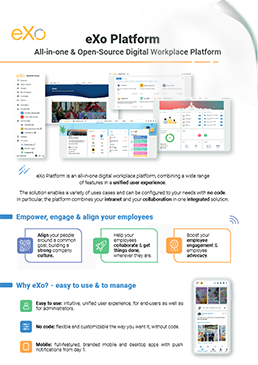

FREE DATASHEET
eXo Platform 7 : The Open-Source
Digital Workplace Platform
Download the eXo Platform 7 Datasheet and discover all the features and benefits

FREE DATASHEET
Download the eXo Platform Datasheet and discover all the features and benefits
FAQ
📘 What is Teamwork?
Teamwork is the collaborative effort of a group of individuals working together to achieve a shared objective in the most effective and efficient manner. It’s a process where individual skills, experiences, and ideas are combined, leveraged, and applied toward a common goal, making the collective output greater than the sum of its individual parts—a principle known as synergy.
Effective teamwork combines complementary skills, a shared purpose, clear roles, open communication, psychological safety, and well-designed coordination mechanisms. These elements ensure that each contribution fits into the larger picture, transforming individual efforts into results far greater than the sum of their parts.
📈 Why teamwork Is Important ?
Teamwork is far more than a feel-good concept—it is a strategic driver of organizational performance. Across industries, research consistently shows that effective collaboration has a measurable impact on innovation, productivity, employee engagement, decision-making, and organizational resilience.
- Drives Innovation and Problem-Solving
- Boosts Productivity and Efficiency
- Enhances Employee Engagement and Retention
- Improves Organizational Agility
- Reduces Errors and Strengthens Decision-Making
- Promotes Knowledge Sharing and Continuous Learning
🧭 How to Choose the Right Teamwork Platform?
Selecting the right teamwork platform is a strategic decision that can significantly impact productivity, collaboration, and employee engagement.
The right platform not only supports day-to-day teamwork but also helps your organization scale, share knowledge effectively, and reduce friction across processes.
To make an informed choice, follow this structured roadmap and the teamwork tips for technology selection:
- Diagnose Your Pain Points
- Map Real Team Journeys
- Define Top Outcomes
- Match Features to Outcomes
- Consider Integration and Ecosystem Fit
- Evaluate User Experience (UX)
- Pilot and Gather Feedback
- Assess Scalability and Total Cost of Ownership (TCO)
- Iterate and Optimize
🧐What Is Employee Productivity?
Employee productivity refers to how efficiently and effectively an individual or a team converts their time, effort, and resources into meaningful outcomes that contribute to the organization’s overall goals. In simple terms, it measures the relationship between output (the work produced, goals achieved, or value delivered) and input (the time, energy, tools, and resources invested).
Traditionally, productivity was expressed through a straightforward formula:
Productivity = Output Input (Labor Hours and Resources)
Employee turnover refers to the number or percentage of employees who leave an organization (voluntarily or involuntarily) and are replaced by new hires. High turnover can impact productivity, morale, and costs.
🤷♂️Why Is Employee Productivity Important?
Employee productivity isn’t just a performance metric — it’s the foundation of organizational growth, innovation, and long-term success. When employees work efficiently and purposefully, organizations can achieve more with the same resources, adapt faster to change, and maintain a competitive edge in an increasingly demanding business landscape.
💼 The Strategic Importance of Productivity
📈 The Business Case for Employee Productivity
- Increased Profitability and ROI
- Enhanced Competitive Advantage
- Improved Employee Engagement and Retention
- Greater Customer Satisfaction
- Cost-Efficiency and Smart Resource Use
- Adaptation to Hybrid and Digital Work Models
- Innovation and Knowledge Reuse
⚖️ Productivity as a Balance of Performance and Well-Being
🤝What is employee engagement?
Employee engagement is the emotional and intellectual commitment an employee has toward their job, their team, and their organization. It’s about how much an individual cares about the company’s success and how motivated they are to contribute to its goals. Engaged employees don’t just show up—they feel proud, passionate, and fully involved in their work.
This engagement can take many forms: feeling loyal and connected (emotional), being focused and eager to improve (cognitive), or showing high productivity and advocacy for the company (behavioral). Strong leadership, a positive culture, growth opportunities, and work-life balance are some of the key drivers that make it possible.
😵💫What is employee turnover?
Employee turnover refers to the number or percentage of employees who leave an organization (voluntarily or involuntarily) and are replaced by new hires. High turnover can impact productivity, morale, and costs.
4.7/5 - (3 votes)

I am a Digital Marketing specialist specialized in SEO at eXo Platform.
Passionate about new technologies and Digital Marketing.
With 10 years' experience, I support companies in their digital communication strategies and implement the tools necessary for their success.
My approach combines the use of different traffic acquisition levers and an optimization of the user experience to convert visitors into customers.
After various digital experiences in communication agencies as well as in B2B company, I have a wide range of skills and I am able to manage the digital marketing strategy of small and medium-sized companies.
Related posts
- All
- eXo
- Digital workplace
- Employee engagement
- Open source
- Future of work
- Internal communication
- Collaboration
- News
- intranet
- workplace
- Knowledge management
- Employee experience
- Employee productivity
- onboarding
- Employee recognition
- Change management
- Cartoon
- Digital transformation
- Infographic
- Remote work
- Industry trends
- Product News
- Thought leadership
- Tips & Tricks
- Tutorial
- Uncategorized



Leave a Reply
( Your e-mail address will not be published)
Connexion
0 Comments
Commentaires en ligne
Afficher tous les commentaires
