

FREE WHITE PAPER
The term open source refers to any solution that has its source code widely accessible to the public for modification and sharing.
Organizations have never had access to such powerful digital tools… yet they have never been so dependent on vendors, platforms, and infrastructures, most often non-European, over which they have little control.
Who really owns the data? Who controls the infrastructure? What happens if the U.S. vendor an organization depends on decides tomorrow to change its pricing, its terms of use, or to hand over confidential data following an order from a foreign court?

These questions, long considered theoretical, have now become strategic for CIOs. Collaboration tools, digital workplaces, intranets, messaging systems, document management… These core organizational tools are most often entirely driven by American players.
The geopolitical context of recent months has triggered a collective awareness. As a result, in 2026, a growing number of European IT decision-makers are strategically choosing open source.
Interest in open source is not new. But what has changed in 2026 is its nature.
It is no longer just a technical preference or an optimization lever. Open source has become a tool for sovereignty, compliance, and governance.
The starting point of this shift is the Cloud Act, a U.S. law adopted in 2018. It allows the U.S. government to require American companies to hand over data hosted on their servers – even when those servers are located in Europe. In concrete terms: the data of a European company using Microsoft Azure, Google Cloud, or AWS can be disclosed to foreign authorities, even if that data is physically stored in Paris or Frankfurt.
This legal reality has been compounded by a series of cases that have brought digital sovereignty into the public spotlight: GDPR violations, personal data transfers to the United States invalidated by the Court of Justice of the European Union, and revelations about large-scale data collection practices.
In response, public authorities have begun to act. In January 2026, the European Commission launched a call for contributions to shape an ambitious open source strategy, aiming to reduce dependence on American solutions and strengthen European autonomy.
In France, this momentum is notably driven by the Interministerial Directorate for Digital Affairs (DINUM), with a clear strategy to reduce digital dependencies: gradual phase-out of Windows in favor of Linux, deployment of sovereign collaborative tools (Tchap, Visio, FranceTransfert), and migration of the national health data platform to a trusted solution by the end of 2026. Each ministry will also be required to formalize its own plan to reduce non-European dependencies before the fall, particularly regarding collaboration tools, AI, and databases.
At the same time, the French national cybersecurity agency (ANSSI) is updating its open source policy, actively contributing to strengthening security and promoting trusted digital solutions.
We are witnessing a paradigm shift: open source has become a tool of public digital policy.
For years, French companies have aligned with global market standards for their information systems – particularly by adopting Microsoft 365 for productivity and collaboration. These choices made sense: mature tools, rich ecosystems, and adoption facilitated by strong brand recognition.
But behind these seemingly straightforward choices lies a deep dependency, the limits of which CIOs are now recognizing.
The first is technological lock-in. The more an organization integrates proprietary tools into its processes and data, the harder and more expensive it becomes to switch. Microsoft understands this well: Teams, SharePoint, Active Directory… are tightly interconnected, and each tool reinforces dependence on the others.
Pricing increases are unpredictable. Microsoft 365 prices have risen several times in recent years – sometimes by more than 20% within a few months – without any real alternative for organizations already committed. Those that built their systems around these tools had no choice but to pay.
The imposed roadmap is another major limitation. With proprietary solutions, the vendor decides which features to develop, which interfaces to change, and which integrations to prioritize. Companies have little real influence over product direction.
Finally, total cost of ownership (TCO) is often underestimated at the outset. Licenses are only the visible part of the iceberg. Additional costs include training, integration, customization, support – and especially migration costs when evolving the information system becomes necessary.
These American models, long dominant, are now showing their limits.

Benefits of Open Source Software
for the Enterprise
The term open source refers to any solution that has its source code widely accessible to the public for modification and sharing.
The term open source refers to any solution that has its source code widely accessible to the public for modification and sharing.
Faced with these limitations, continuing to rely exclusively on proprietary solutions represents a risk. Open source is emerging as a pragmatic alternative. Open source solutions, especially in collaboration and communication, have reached a level of maturity that allows them to compete with proprietary tools across several key dimensions.
Organizations decide where their data is hosted, who can access it, and under which jurisdiction it falls.
Open source offers strategic freedom highly valued by CIOs. The code belongs to the community, data remains in the organization’s hands, and integrations can be easily developed within open architectures. Tools can interoperate seamlessly without dependence on a closed ecosystem.
Open source software can be audited by any technical expert. Its behavior is verifiable, and vulnerabilities can be detected and fixed without relying on a vendor’s timeline. For security-conscious CIOs, this is a critical guarantee.
Switching providers, tools, or hosting environments becomes possible without structural dependency.
Community-driven innovation is often underestimated. Open source platforms benefit from contributions by thousands of developers worldwide, continuous community monitoring of security flaws, and rapid adaptation to new use cases, including AI. The digital workplace can be tailored to actual user needs.
These benefits are confirmed in practice: a French local authority (Occitanie Region), like many public organizations, has initiated its transition to sovereign open source tools and is seeing tangible gains in cost, security, and autonomy (source: CIO Online).
These individual benefits can only fully materialize if the surrounding ecosystem is strong. And the signals are encouraging: Europe now has more open source contributors on GitHub than the United States or China (source: IT for Business). The community momentum is there.
But for open source alternatives to become credible at scale, three conditions are essential:
These conditions are beginning to come together. European technology players are now offering increasingly comprehensive solutions. The sovereign collaborative suite Live Collaboration by Orange Business, built on the open source digital workplace eXo Platform to centralize usage and structure the user experience, illustrates the emergence of such an ecosystem: one capable of competing with American tech giants across the entire value chain, from software to hosting and integration.
In 2026, choosing open source for the digital workplace is a decision driven by risk management, cost control, and strategic autonomy. CIOs making this choice are not only demanding in terms of performance, but also in sovereignty, transparency, and the freedom to evolve at their own pace.
What they gain in concrete terms: control over their data, the agility to adapt their digital environment to real needs, and resilience in the face of geopolitical, commercial, and regulatory uncertainties that define today’s world.
This movement is only just beginning. Organizations that anticipate this transition today are building a strategic advantage that will be difficult to catch up with tomorrow.
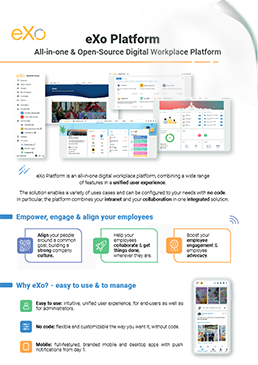

Download the eXo Platform Datasheet and discover all the features and benefits

Download the eXo Platform Datasheet and discover all the features and benefits
( Your e-mail address will not be published)

I am the communication manager at eXo Platform. I found myself in communications a bit by chance, but this field brings together everything that pationates me: creativity, energy, meetings, collaborative work, sharing and exchanges of good practices. I need to give meaning to what I do and put people at the center of all my actions.